
Back to Blogs
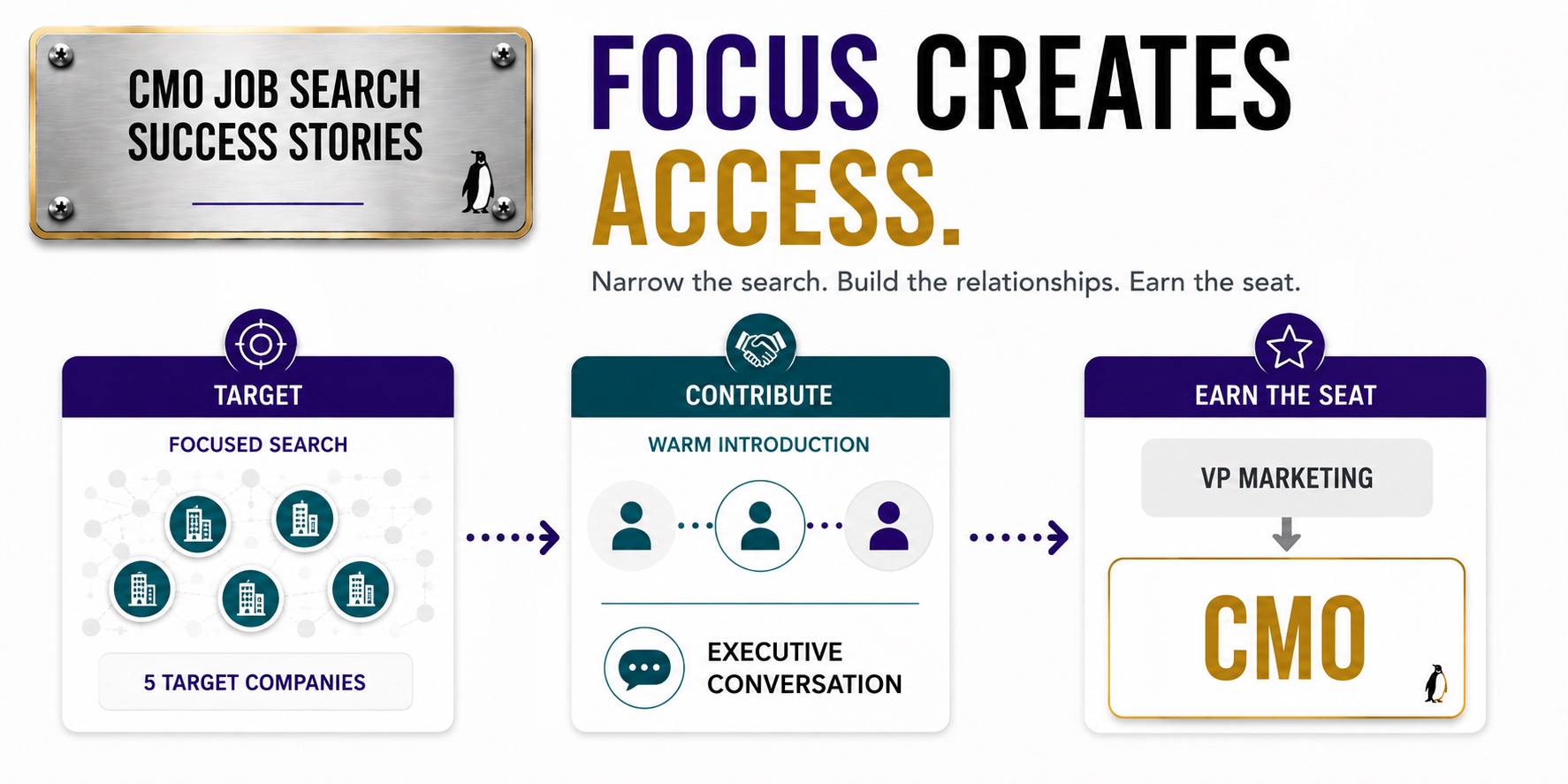
One marketing executive turned a shortlist of 80 target contacts into a CMO offer in less than 100 days. The anonymized Huddler combined focused relationship management, original thought leadership, AI-supported preparation, and a clear go-to-market framework to earn access, demonstrate strategic value, and help the company see the role as larger than originally planned today.
One Huddler landed a CMO position at a midsize HealthTech company in fewer than 100 days. The company had advertised a VP of Marketing position, but the candidate’s strategic preparation helped the executive team recognize a broader leadership need.
The process moved quickly. Fewer than 60 days passed between the first interview and the offer, and the interview sequence consisted of one conversation with the CRO followed by a lunch with the president, COO, and CFO.
The anonymized account comes from CMO Job Search Success Story #23.
The Huddler began by organizing professional contacts according to their relevance to the search. From a much larger network, the candidate identified 80 priority relationships and five target companies.
That level of focus changed the nature of the outreach. The Huddler could discuss specific companies, industry developments, and business needs instead of asking contacts for general job-search assistance.
One of the target companies was advertising a VP of Marketing position on LinkedIn. The listing provided useful information about the opportunity, but the candidate did not rely on the application process alone.
The Huddler looked for a credible relationship that could provide context for the introduction.
An industry analyst connected the Huddler with the company’s CRO, who was serving as the hiring manager. The introduction produced an interview within 72 hours.
The analyst did not need to guarantee that the candidate was right for the position. The introduction gave the CRO a reason to examine the match more closely.
That sequence demonstrates how a public listing and a network can complement each other. The listing identifies the opportunity. A relevant connection can help the candidate reach the person responsible for solving the underlying business problem.
The warm path also gave the Huddler an opportunity to enter the conversation with more than a résumé. The candidate could connect prior experience with the company’s market and explain why the role deserved attention.
The Huddler developed a personal-brand strategy focused on AI and healthcare. Articles, podcast appearances, and video content created visible evidence of expertise in areas relevant to the target market.
The content did not simply announce that the executive was looking for work. It demonstrated how the Huddler approached issues that mattered to prospective employers.
That distinction made networking more reciprocal. The candidate could contribute observations, frameworks, and informed perspectives instead of beginning every interaction with a request for an introduction.
The Huddler also maintained separate websites for full-time and fractional opportunities. Each audience encountered a version of the executive’s experience suited to the type of engagement being considered.
The underlying expertise remained consistent, while the presentation reflected the needs of the visitor.
The candidate arrived with a 360-degree go-to-market framework and a competitive analysis grounded in the company’s market.
The process included:
The framework allowed the executive team to see how the candidate approached the business as a whole. Marketing appeared as part of an interconnected growth system involving positioning, demand, sales, customers, operations, and leadership priorities.
This changed the level of the discussion. The candidate was no longer demonstrating readiness to manage only a marketing function. The Huddler was showing the perspective expected from a company-level executive.
Three of the candidate’s previous employers were already familiar to the company, giving the experience additional context and credibility.
A candidate entering from outside the organization does not have complete access to its customers, performance data, internal relationships, or operational history. A useful framework acknowledges those limits.
The Huddler’s preparation provided a point of view rather than a finished prescription. The framework showed how the candidate organized complex business questions and which areas would receive attention after gaining fuller access.
That approach gave the executive team a way to evaluate strategic judgment. It also created room for discussion, allowing company leaders to challenge assumptions and explain where their priorities differed.
The presentation became evidence of how the candidate would work with the leadership team, not only a demonstration of what the candidate already knew.
The Huddler used AI to support company research, résumé optimization, market analysis, and interview preparation.
The technology helped compress information and identify patterns more efficiently. It could assist with understanding competitors, organizing research, and testing how clearly the candidate’s experience matched the company’s needs.
The Huddler remained responsible for deciding which findings mattered. Industry knowledge and operating experience shaped the final framework and recommendations.
AI was one component of a broader preparation system that included coaching, original content, relationship development, and firsthand executive experience. Its value came from helping the candidate arrive with a more developed perspective in a relatively short period.
No single tactic produced the offer. The result came from several parts of the search working together.
The target list concentrated the Huddler’s attention. Original content gave contacts and prospective employers evidence of relevant expertise. A warm introduction created access to the CRO. Strategic preparation helped the candidate make the executive conversation valuable.
Each element strengthened the next. The network was more useful because the candidate’s positioning was clear. The interview was more productive because the Huddler had researched the company. The framework was more credible because it reflected relevant industry experience.
The process resembled a focused go-to-market motion: Define the market, identify priority accounts, cultivate the right relationships, bring a relevant point of view, and earn the next conversation.
The company entered the process looking for a VP of Marketing. The Huddler’s experience and business-level preparation revealed a need for broader marketing leadership.
Changing the title was not simply a reward for a strong presentation. The executive team could see a larger match between the candidate’s capabilities and the company’s requirements.
The shift from VP to CMO reflected the level at which the candidate engaged with the business. Rather than limiting the conversation to campaigns, channels, or departmental activity, the Huddler connected marketing with the company’s complete growth model.
That broader perspective gave the organization a reason to reconsider the original role design.
Several lessons emerge from the Huddler’s experience:
The search succeeded because focus, access, visibility, and preparation worked as one system.
The Huddler landed the CMO role in fewer than 100 days.
An industry analyst made the introduction after the candidate identified the opening.
The process included one CRO interview and one lunch with the president, COO, and CFO.
The candidate’s experience, strategic framework, and business-level perspective aligned with a broader leadership need.
CMO Huddles has a dedicated Transition Team for experienced B2B marketing executives navigating what comes next.