
Back to Blogs
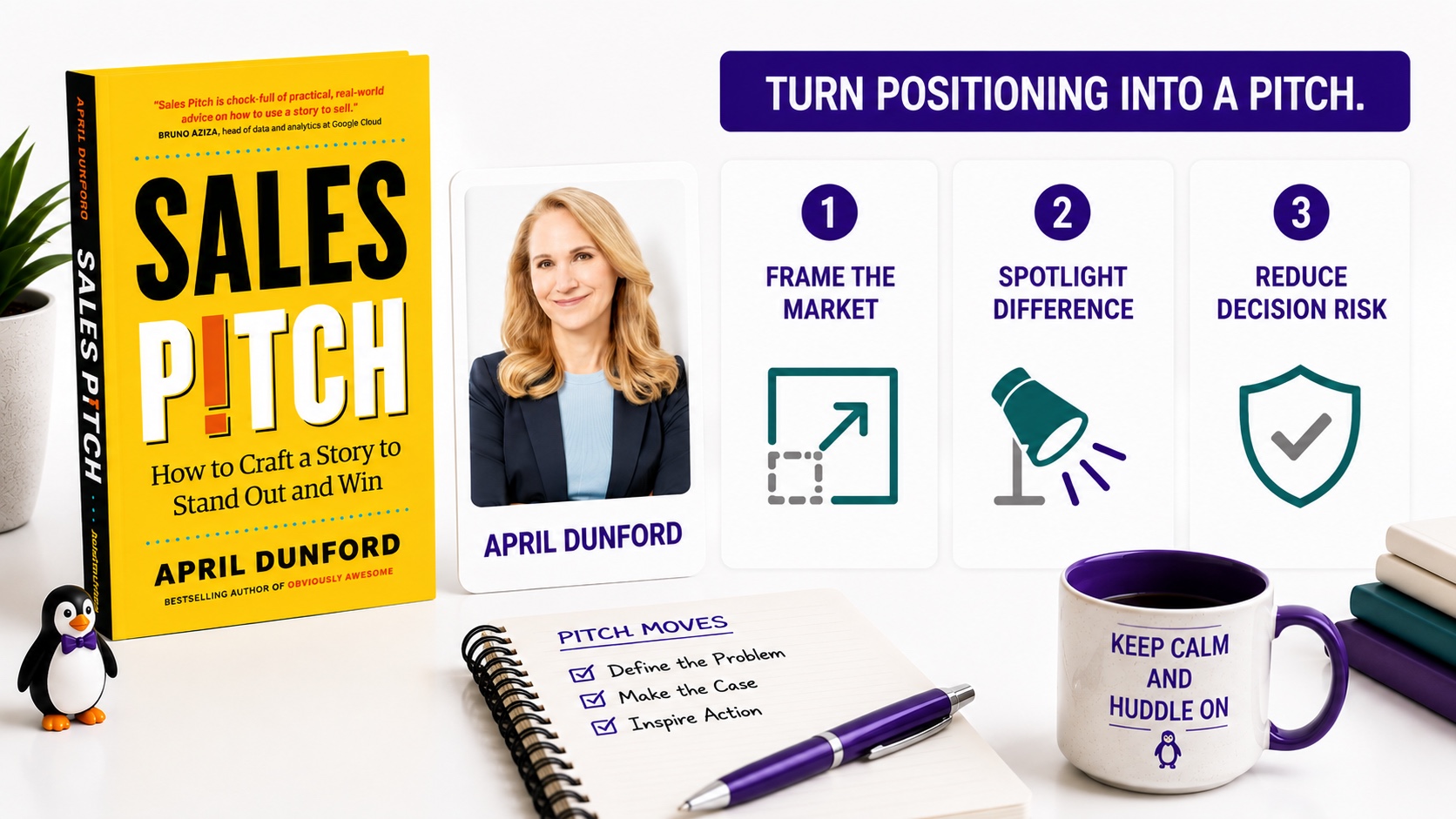
Strong positioning can disappear inside a weak sales deck. Drawing from Sales Pitch, April Dunford explains how marketing and sales can turn differentiated value into a buyer-centered narrative that clarifies the market, exposes overlooked priorities, reduces decision risk, and helps customers understand not only why a solution matters, but why it stands apart from alternatives.
Positioning defines how a product is uniquely valuable within a competitive market. A sales pitch turns that positioning into a conversation buyers can understand, remember, and use to make a decision.
In her book Sales Pitch, positioning expert April Dunford examines what happens between the positioning exercise and the customer conversation. Handing sales a positioning document rarely completes that translation. Marketing and sales still need to determine how the story unfolds, what the buyer needs to understand first, and which differentiated value deserves the greatest attention.
Buyers enter a sales conversation with an established understanding of the market. They may already have a shortlist of solutions, a preferred approach, or a belief that the status quo remains adequate.
That starting point affects whether the company’s differentiation will mean anything. A capability may be genuinely unique while addressing a consideration the buyer has not yet recognized.
April uses a flashlight metaphor to describe the moment.
“What we’re doing is we’re clicking on the flashlight and pointing at a thing and saying, ‘Hey, have you ever considered this?’”
The pitch brings an overlooked issue into view. Once the buyer sees that issue, the product’s differentiated value becomes easier to understand.
This approach does not depend on manufacturing fear or exaggerating a problem. It gives the buyer a more useful frame for evaluating the decision.
Many sales decks distribute attention across company history, broad market trends, product features, customer logos, screenshots, and implementation details. The presentation may be comprehensive without giving the buyer a compelling reason to choose the solution.
April describes the central challenge this way:
“Often our differentiated value, if it really is unique, it’s something that the customers are not really thinking about... We gotta wake them up.”
Unique value often requires context. If the buyer already understood the importance of the difference, every competitor would likely be talking about it.
A stronger narrative identifies the market insight that makes the difference relevant. It then connects that difference to an outcome, constraint, or risk the buyer recognizes. The conversation moves from a catalog of capabilities to a clearer argument: This factor changes how the problem can be solved, and this company is particularly equipped to address it.
The competition often includes more than similar products. Buyers may consider maintaining the status quo, building an internal solution, using a general-purpose platform, outsourcing the work, or addressing only part of the problem.
A useful pitch explains the tradeoffs among those approaches before presenting the company as the preferred option. Each approach may work well under certain conditions. The buyer gains a structure for understanding which conditions apply.
This comparison can increase credibility because it does not require declaring every alternative inferior. It shows what each path optimizes, what it sacrifices, and where the company’s differentiated value becomes especially relevant.
For marketing, this means competitive research can extend beyond vendor battlecards. The team can explore the full range of ways customers attempt to solve the problem and the reasons those approaches remain attractive.
April also addressed how marketers can determine the sequence of the sales narrative.
“In a good sales pitch, we’re looking at the differentiated value and saying, ‘What does my customer need to understand in order to understand why that value is critical?’”
That question changes the structure of the presentation. The story no longer begins automatically with the company’s founding, mission, or complete product portfolio. It begins with the context required for the buyer to recognize why the difference matters.
A buyer-centered sequence may include:
Each stage prepares the buyer for the next. The pitch becomes a guided decision narrative instead of a collection of slides competing for attention.
A structured pitch still leaves room for discovery. The seller can learn how the buyer understands the problem, which alternatives are under consideration, and what could prevent the organization from moving forward.
That information helps determine which parts of the narrative deserve emphasis. A buyer already convinced that change is necessary may need little education about the market. Another buyer may need help understanding why the existing approach creates limitations.
Discovery also helps prevent sellers from delivering the same pitch regardless of context. The positioning remains consistent, but the route through the story can reflect the buyer’s situation.
Marketing can support that flexibility by giving sales a narrative framework, questions, evidence, and modular proof instead of a rigid script.
A buyer can believe in the solution’s value and still decide to do nothing. Implementation risk, internal disagreement, limited capacity, or fear of regret can make inaction appear safer.
Price reductions do not resolve every form of uncertainty. A buyer concerned about organizational disruption may need implementation proof. A committee struggling to agree may need a clearer decision framework. An executive worried about credibility may need examples from comparable companies.
Marketing can help sales match proof to the source of hesitation through:
The objective is to make the decision easier to understand and defend.
Positioning can lose power when marketing develops the narrative without observing how sales conversations unfold. A strategically sound deck may still be difficult to deliver, disconnected from discovery, or missing the proof buyers request most often.
Working with a respected seller can create a productive starting point. Marketing can observe calls, test the sequence, identify confusing language, and refine the pitch using real buyer reactions.
The seller can also help introduce the approach to peers. Adoption becomes more credible when the story has already worked in customer conversations.
This collaboration gives marketing a clearer view of where sales needs support. It may reveal missing proof, difficult transitions, inconsistent definitions, or objections that the existing positioning work did not anticipate.
A sales pitch is not a finished deck stored in enablement software. It is a shared narrative that influences discovery, presentations, competitive conversations, customer evidence, and follow-up materials.
Keeping it useful requires feedback from sales and buyers. Marketing can track which insights generate discussion, which comparisons clarify the market, where buyers become confused, and what evidence advances the decision.
Those observations can improve more than the deck. They can inform content strategy, product marketing, customer research, sales training, and future positioning work.
The result is a stronger connection between the company’s strategic story and the conversations that create revenue.
Positioning defines differentiated value. A sales pitch turns that value into a buyer-centered decision narrative.
The differentiated value most relevant to the buyer, supported by market context, comparison, and credible proof.
Implementation risk, internal alignment, uncertainty, limited capacity, and fear of regret can make inaction appear safer.
Marketing and sales can co-create, test, refine, and enable a shared pitch using feedback from real buyer conversations.
Listen to the full conversation with April Dunford.
CMO Huddles helps B2B marketing leaders win by bringing together peers, fresh perspectives, and opportunities to build stronger personal brands. Want to join the huddle? Learn more about CMO Huddles and join CMO Huddles Starter.