
Back to Blogs
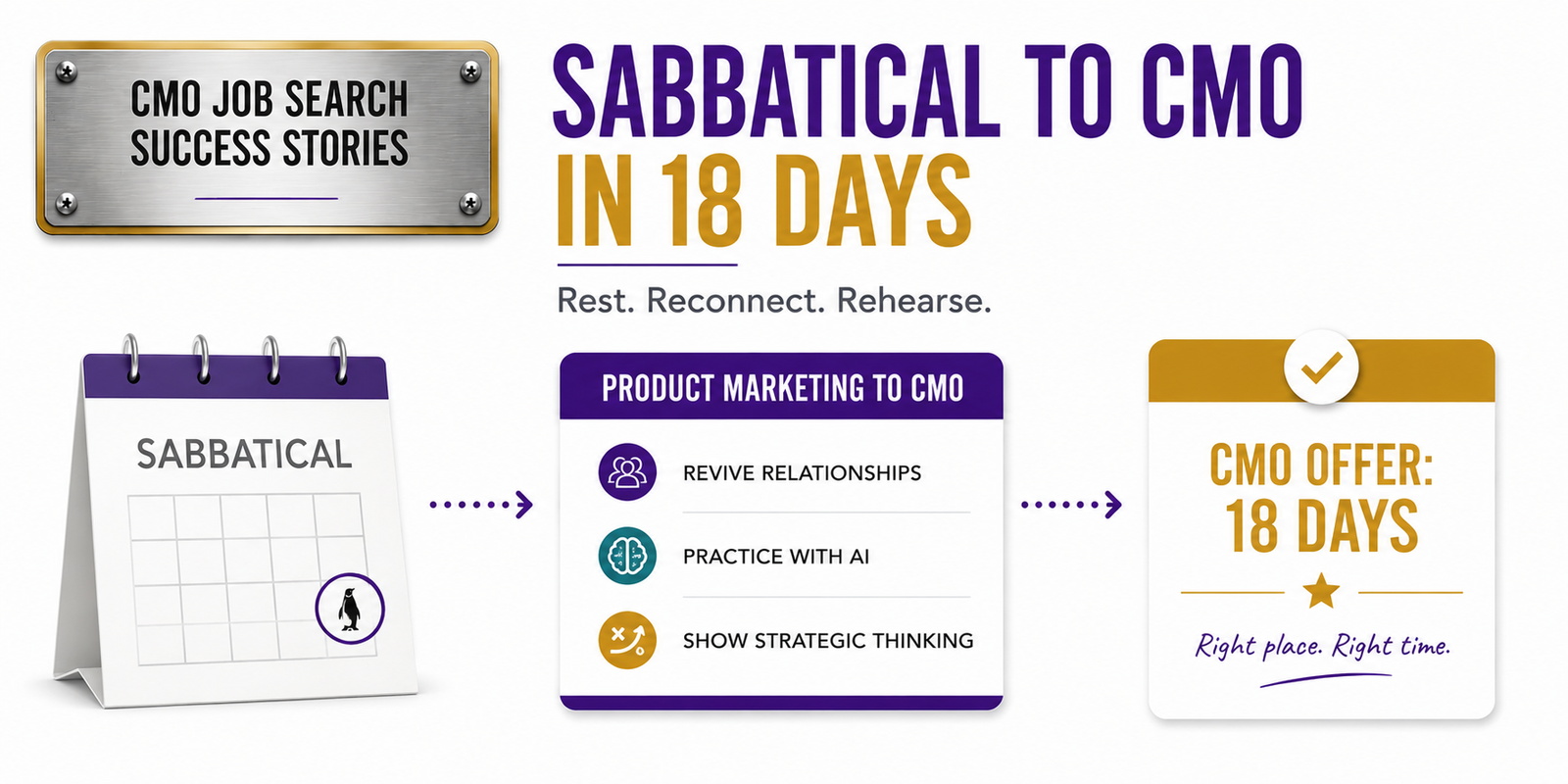
After an intentional sabbatical, an experienced product-marketing leader restarted the search through trusted relationships rather than job boards. A revived recruiter connection produced a rapid executive interview process and a first CMO appointment 18 days later. Focused preparation, AI-assisted rehearsal, category thinking, and thoughtful negotiation turned prior credibility into a compelling next-chapter story with confidence.
The 18-day result began months earlier with something senior candidates often resist: Stopping.
After leaving a previous company, this Huddler took an intentional sabbatical. The break created space to recharge before beginning another demanding executive chapter. Although the overall transition ran from May through September, the active search did not begin until mid-August.
That distinction matters. Time away was part of the strategy, not evidence that the search had stalled.
A rested candidate is better equipped to evaluate opportunities, recognize tradeoffs, and show up with curiosity instead of urgency.
When the Huddler was ready to begin, the search started with old Gmail and LinkedIn conversations. The candidate identified recruiters and professional contacts worth re-engaging.
One renewed recruiter relationship produced the opportunity.
Not every old conversation will lead to a role, but established relationships retain context and credibility. A thoughtful reconnection has a stronger foundation than a cold introduction.
The Huddler did not apply to public openings. The search relied entirely on the network.
“I didn’t apply for any role. I relied 100% on my network.”
The statement sounds bold, but the network was not built in 18 days. It was built over years and activated at the right moment.
Once the opportunity appeared, the process moved quickly.
The Huddler met with the CEO, CTO, CRO, senior AI leadership, the Chief People Officer, and the CEO again in person. The final step was a presentation addressing category creation and AI-driven marketing.
The candidate was pursuing a first CMO appointment but brought credibility from senior product-marketing roles at prominent B2B technology companies.
The challenge was not to claim previous CMO experience. It was to demonstrate that the underlying leadership capabilities already matched the role: Product understanding, category thinking, executive communication, go-to-market strategy, and the ability to connect emerging technology with business growth.
The Huddler used ChatGPT and Perplexity for company research, SWOT development, and interview preparation.
Rehearsal was especially useful. As the Huddler put it, "I practiced my story with ChatGPT. It helped me hear how I actually sounded."
CMO candidates can use the same approach to:
AI did not replace the candidate’s experience or judgment. It shortened the feedback loop between preparation and improvement. Confidential information still needs protection, and generated research still needs verification.
Earlier interview processes revealed areas where the Huddler’s story was less convincing, including the connection between brand and demand.
The Huddler's advice was simple: "Attack your weaknesses." Rather than avoiding weaker parts of the executive story, the candidate concentrated preparation there.
That is a useful way to interpret an unsuccessful process. A rejection is not automatically a verdict on executive ability. It can reveal that a particular part of the story, match, or preparation needs work.
The final presentation allowed the Huddler to do more than describe previous achievements. It showed how the candidate thought about the prospective company’s future.
A strong final-stage deliverable should demonstrate relevant thinking without becoming unpaid consulting. Candidates can protect that boundary by confirming the question, requesting appropriate context, stating assumptions, and focusing on the decision framework instead of delivering a finished operating plan.
The offer included a modest salary reduction. The Huddler negotiated a signing bonus and more favorable equity-vesting terms.
The lesson was simple: Ask professionally. As the Huddler put it, "It doesn't hurt to ask. The only thing they can do is say no."
Executive negotiation is not only about maximizing base pay. It is about understanding risk, clarifying incentives, and ensuring the agreement reflects the conditions under which the leader is expected to perform.
Candidates should consider base pay, bonus mechanics, equity, vesting, severance, change-of-control terms, reporting structure, decision authority, and the resources attached to the mandate. Legal review may be appropriate.
The candidate returned to the market rested, reactivated trusted relationships, used AI to accelerate research and rehearsal, addressed gaps in the executive story, and demonstrated strategic thinking during the process.
The 18 days describe the hiring sprint. Years of credibility and relationship-building made that sprint possible.
Not necessarily. An intentional break can strengthen a search when the candidate explains the decision clearly and shows how the time supported readiness for the next role.
Connect prior responsibilities to the new mandate. Emphasize enterprise-level decisions, cross-functional leadership, business outcomes, and situations in which the candidate already operated beyond a functional title.
AI can support research, stakeholder simulations, story rehearsal, objection handling, and presentation critique. Candidates should verify factual outputs and protect confidential information.
Only with appropriate boundaries. Confirm the scope, state assumptions, avoid disclosing proprietary information, and demonstrate thinking without delivering a complete unpaid plan.
CMO Huddles has a dedicated Transition Team for experienced B2B marketing executives navigating what comes next.