
Back to Blogs
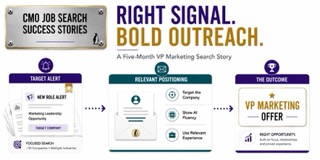
One Huddler turned a target-company alert into a Vice President of Marketing offer by pairing focused research with direct CEO outreach. Her five-month search shows how target lists, hands-on AI experience, industry expertise, peer feedback, and written career priorities can help senior marketers create opportunities, prepare for demanding interviews, and evaluate the right leadership role.
One Huddler had been searching for approximately five months when an alert surfaced an opening at a company already on her radar. She applied, but she did not leave the next move entirely to the formal hiring process.
She emailed the CEO directly, drawing from an earlier chapter of her career that connected with the company’s market. She used that experience in the subject line and gave the CEO a relevant reason to open the message.
During a Transition Team discussion, the Huddler reflected on the roles that technology and personal judgment played in the outreach.
“I think AI for the research and information was extremely valuable, but my outreach strategy and the way I operate is very anecdote based, and AI couldn’t help me with that.”
AI helped her find and research the opportunity. Selecting the experience most likely to resonate with the CEO required personal knowledge of her career and the company’s context. That combination turned a target-company alert into a conversation and eventually a Vice President of Marketing offer.
The Huddler maintained several target-company lists, including a narrower group in an industry where she already had relevant experience. Her broader list included approximately 50 organizations across several categories.
She created an AI agent to monitor those companies for signals such as leadership openings, funding announcements, mergers and acquisitions, executive changes, and other developments that could precede a marketing search.
The agent generated a daily brief, reducing the manual work involved in following dozens of companies. It required several iterations before the information became consistently useful. The system was not choosing her next job. It helped her notice when something changed at a company she had already decided was worth following.
One of those alerts eventually surfaced the role she landed.
The target list continued evolving as the Huddler encountered real opportunities. Her reaction to each company provided another source of information.
“I think I interview much better when I’m genuine and really excited about it. I don’t have a great poker face.”
The strongest opportunities were not simply companies willing to interview her. They involved industries, technologies, and business problems she genuinely wanted to discuss.
That interest shaped her direct outreach. Instead of sending the CEO a general résumé summary, she connected a specific part of her background with the company’s current environment. The message allowed the CEO to understand her experience in relation to the business rather than simply as a chronology of previous positions.
AI appeared throughout the interview process, including in questions that went beyond the standard discussion of marketing tools.
“I was blown away by the AI questions I was asked.”
The recruiter wanted to know about the last agent she had built, what had worked, where the experiment had failed, which tools she preferred, and how she might apply AI with a marketing team.
Before beginning her focused search, the Huddler had completed a six-week course on using AI agents in business. She continued experimenting afterward, giving her firsthand examples to discuss.
She could explain what she built, where the system broke down, how she refined it, and what she learned. That experience provided evidence of practical fluency rather than a collection of general talking points.
The process later included a conversation with an AI engineer. The Huddler needed to understand the technology well enough to discuss its value and explain it without presenting herself as the technical expert.
The later interview stages included a marketing assignment similar to a 30-, 60-, or 90-day plan. The Huddler organized her recommendations around five priorities, including positioning, product marketing, go-to-market enablement, partnerships, and referral opportunities.
Previous industry experience helped her identify possible partners and market opportunities that may have been less obvious to someone encountering the category for the first time. Some recommendations overlapped with systems the company had already begun developing. The overlap provided evidence that the Huddler and the team approached the business in compatible ways.
She also asked a CMO peer familiar with the company to review the materials before the final presentation. That outside perspective helped test the argument, assumptions, and recommendations. The assignment showed how the Huddler would approach the business, where her experience could create leverage, and how she incorporated informed feedback before presenting a recommendation.
By the final stages, the Huddler had another offer. Two options created leverage, but they also required a more deliberate comparison.
Earlier in the search, she had documented the factors that mattered most. These included meaningful industry impact, a technology-forward environment, exposure to an AI-driven operating model, access to senior leadership, competitive compensation, and continued opportunities to learn. She used a familiar analogy to describe the eventual tradeoff.
“It’s like finding a New York apartment. You can get a certain number of things on the checklist, and at some point you accept the trade-off and are excited about the thing ahead of you, even if you didn’t get every single thing.”
The written priorities gave her more than title to compare. She moved from a previous CMO position into a Vice President role because the opportunity offered more of the conditions she valued.
A title can move down while access, learning, influence, industry impact, or future growth move in a more attractive direction. A written framework can make those tradeoffs easier to evaluate before an offer deadline adds pressure.
After joining the company, the Huddler entered a marketing environment where AI was already embedded in workflows. Existing systems could transform product information into positioning materials, Q&A, presentations, and sales enablement. The increased production capacity created a new set of decisions.
“Just because we can doesn’t mean we should.”
Marketing still had to determine how much information customers could absorb, which developments deserved attention, and how new releases could be organized into a coherent experience. The team began considering release tiers, customer education, and the decision layer between what could be communicated and what buyers needed. The Huddler connected this experience with the expectations senior marketers continue to carry.
“You have to show your savvy, but you still have to have all the marketing leadership stuff that you need before.”
Positioning, customer judgment, executive communication, industry knowledge, and strategic prioritization remained essential within an AI-forward organization.
The Huddler also compared this process with her previous executive searches. One difference emerged outside the formal interview process.
“I definitely relied on peers more than I have in the past.”
She spoke with marketing leaders about their companies, their AI use, and the changes they were seeing across the market. A peer familiar with the eventual employer also reviewed her presentation before the final interview. Those conversations added current market context and an external source of feedback. They complemented the other components of the search rather than replacing them.
A target list narrowed her attention. An alert surfaced the opening. Direct outreach created access. Hands-on AI experience strengthened her interviews. Industry expertise differentiated the assignment. Written priorities helped her compare the offers.
The full process involved several systems, relationships, experiments, and decisions. Looking back on the five-month search, the Huddler offered one final perspective.
“You don’t have to do everything right. Just learn as you go.”
By the end of the process, the Huddler had built a more deliberate approach to finding, preparing for, and evaluating senior marketing opportunities.
Connect a specific piece of experience with the company’s current environment or business problem. Relevant context gives the CEO a stronger reason to respond than a general introduction.
Hands-on examples can include agents or workflows they have built, tools they have tested, experiments that failed, and what they changed afterward.
Consider business impact, industry fit, leadership access, decision authority, compensation, learning, and future growth alongside the title.
Trusted peers can challenge assumptions, review interview materials, provide company context, and help the candidate sharpen a point of view.
CMO Huddles has a dedicated Transition Team for experienced B2B marketing executives navigating what comes next.