
Back to Blogs
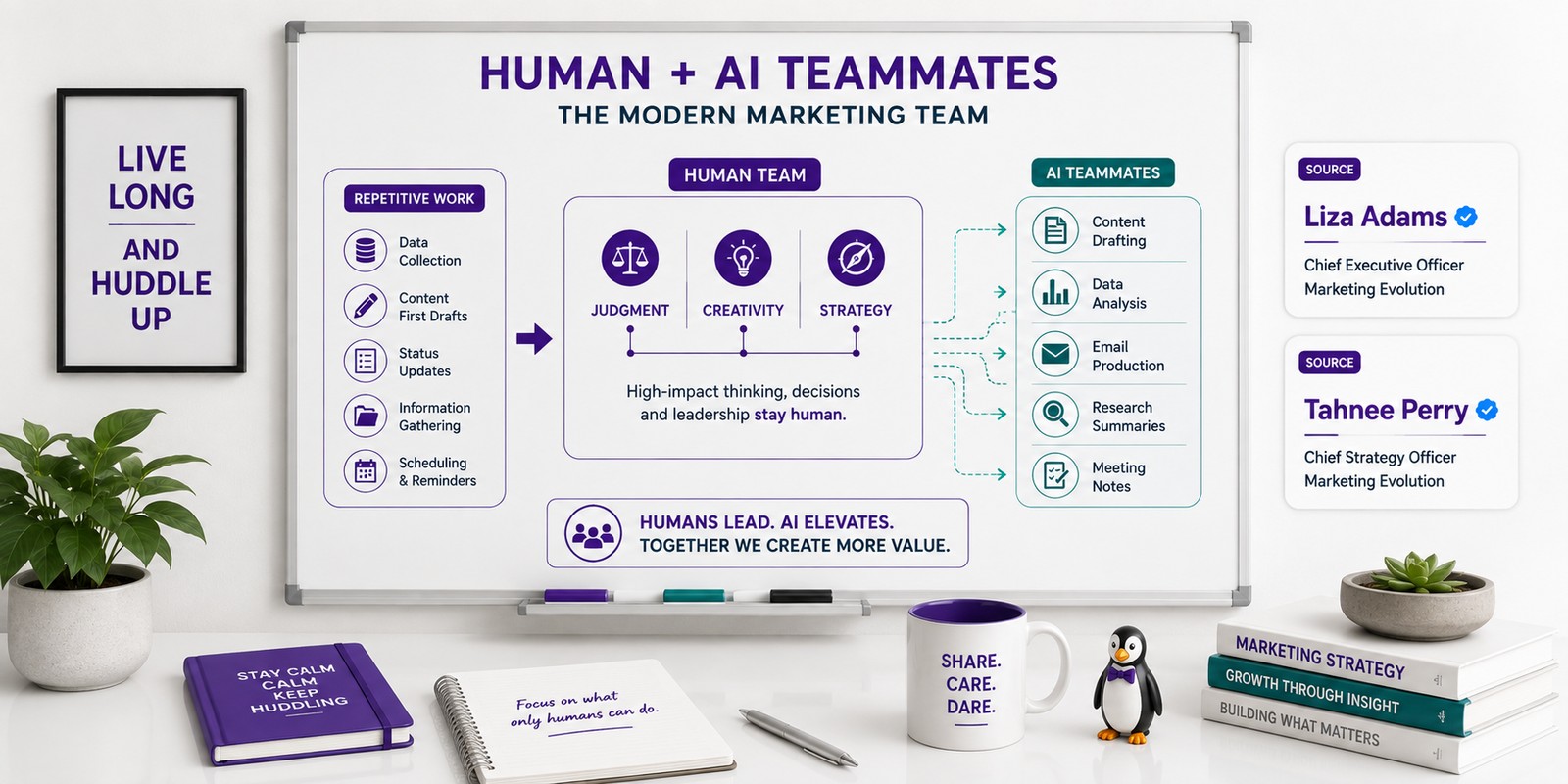
GenAI adoption changes marketing most when it changes how teams learn, collaborate, and divide work. Liza Adams and Tahnee Perry explain why training, trust, change management, and hands-on leadership matter more than another tool rollout. The opportunity is not efficiency alone. It is freeing people from repetitive work while protecting judgment, creativity, taste, and value.
Giving a marketing team access to GenAI does not create adoption.
People need to understand where the technology helps, where it falls short, how their work may change, and whether experimentation is genuinely supported. Without that context, a tool rollout can produce scattered usage, quiet resistance, or faster versions of work the team was already doing.
In a CMO Huddles Bonus Huddle, Liza Adams of GrowthPath Partners and Tahnee Perry explored GenAI as a people and operating-model challenge.
Their central point was clear: Meaningful adoption depends on culture.
A standard software rollout focuses on access, features, and compliance. GenAI changes more than the interface.
It affects how people research, write, analyze, create, and solve problems. It may also change which responsibilities belong to a person, an AI assistant, or a combined workflow.
That level of change requires:
Productivity gains mean little when employees do not trust the process or know how to apply the technology to their actual work.
Liza described a future in which organizations examine work at the task level instead of assuming every responsibility remains attached to the same role.
“We will go from org charts to work charts, where org charts will no longer just be human beings.”
In this model, people build, maintain, and manage AI teammates. Repetitive production can move toward AI, while people spend more time on segmentation, positioning, product-market fit, customer understanding, and strategic decisions.
The work chart provides a more useful question than “Which jobs can AI replace?” It asks which parts of the work benefit from automation and which still depend on human context.
Tahnee offered a particularly concise boundary:
“AI has no taste.”
GenAI can summarize existing information and produce plausible patterns. It is less reliable at determining what is distinctive, emotionally resonant, strategically brave, or true to a particular brand.
Human involvement remains especially valuable when the work requires:
The goal is not to keep humans inside every repetitive step. It is to preserve human judgment where sameness or error carries a meaningful cost.
Executives cannot guide a cultural shift entirely through policy.
Hands-on use helps leaders understand what GenAI does well, where outputs break down, and how much context the system needs. That experience makes it easier to evaluate employee concerns, investment requests, and proposed workflows.
It also changes the quality of leadership communication. Instead of describing AI as a general efficiency mandate, leaders can discuss specific work, tradeoffs, and opportunities.
That matters when teams are already worried about replacement.
A narrow efficiency story can quickly become a headcount story.
Liza suggested a broader framing: AI can remove repetitive work so marketing has more capacity for higher-value problems, including product-market fit, positioning, and customer understanding.
This does not eliminate economic pressure or the possibility that some roles will change. Tahnee argued for honesty about the effect automation may have on repetitive and entry-level work.
The stronger leadership position combines that honesty with reskilling, clearer role design, and a view of how people can contribute at a higher level.
Content volume or hours saved provide only a partial view of adoption.
The conversation suggested a broader measurement set:
Tahnee noted that removing unwanted repetitive work can also improve team sentiment. Happier teams may have more energy for curiosity, experimentation, and innovation.
That makes the human experience part of the transformation case, not a side effect.
A sustainable culture shift connects technology, people, and work.
The most useful questions are not limited to which tool the company will buy. They include:
GenAI becomes part of marketing culture when those questions become part of how the organization operates.
GenAI changes how work is divided, reviewed, and valued. Adoption therefore depends on trust, training, role clarity, management support, and safe experimentation in addition to technology access.
A work chart breaks roles into tasks and responsibilities, then identifies which work belongs with people, AI assistants, automation, or a combined workflow.
Humans remain particularly valuable when work requires taste, empathy, differentiation, ethical judgment, creativity, or deep organizational and customer context.
Useful measures include participation, skills, hours saved, workflow speed, quality, team sentiment, strategic capacity, and business impact.
Listen to the full conversation with Liza Adams and Tahnee Perry.
CMO Huddles helps B2B marketing leaders win by bringing together peers, fresh perspectives, and opportunities to build stronger personal brands. Want to join the huddle? Learn more about CMO Huddles and apply to join the community.