
Back to Blogs
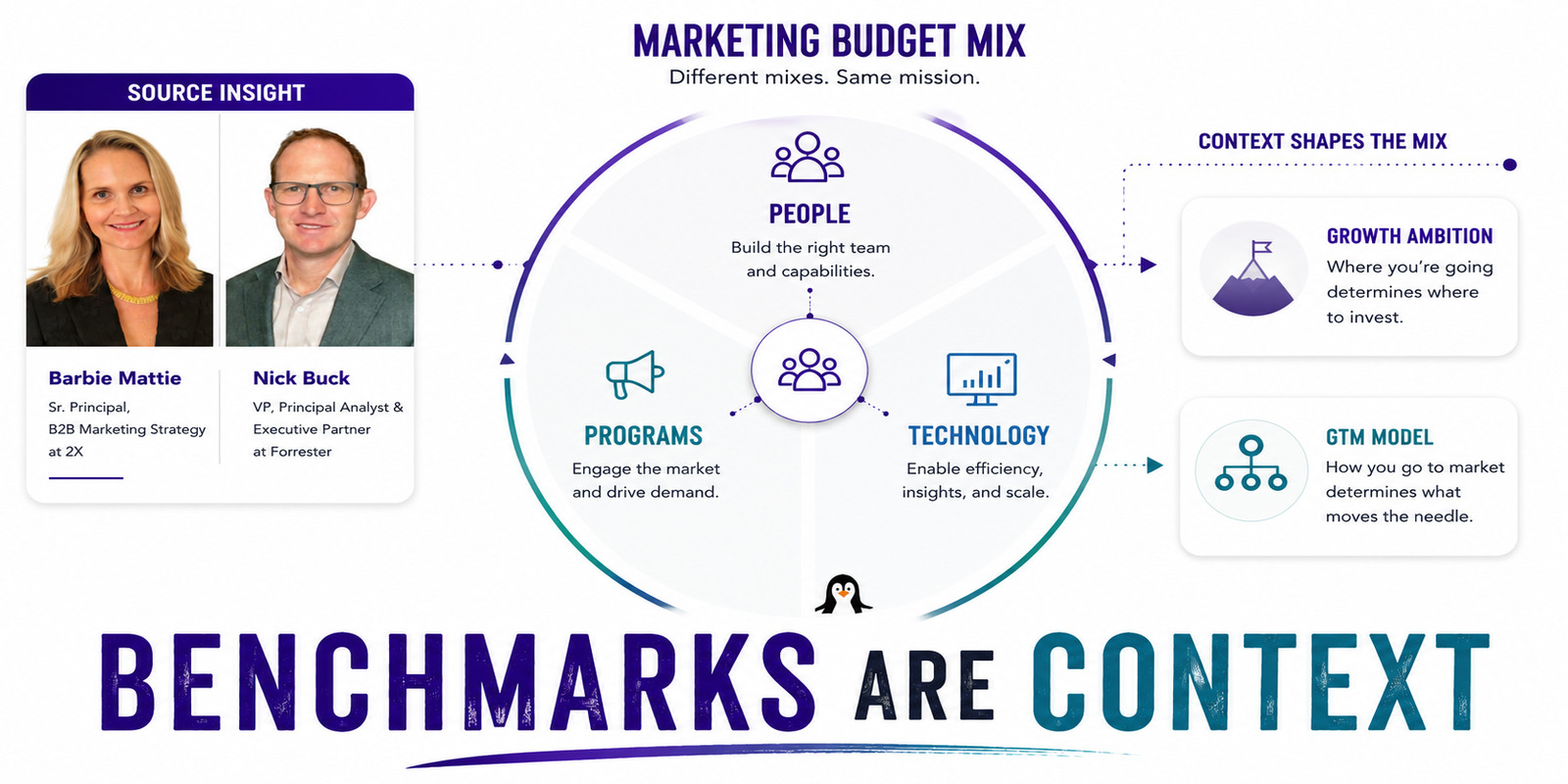
Historical Forrester research found that faster-growing B2B companies allocated more marketing budget to programs and less proportionally to personnel. Analysts Barbie Mattie and Nick Buck explain why the benchmark is useful as a comparison, not a current prescription. The lesson is to balance reputation, demand, engagement, enablement, customer growth, operations, and data around business priorities.
Budget benchmarks are tempting because they appear to offer a direct answer: Spend a particular percentage in the right category and growth will follow.
The reality is more conditional. Company stage, category maturity, sales model, growth expectations, geography, and existing capabilities all affect the appropriate allocation.
In a Renegade Marketers Unite conversation about Forrester’s B2B budget benchmarks, analysts Barbie Mattie and Nick Buck discussed research available in early 2023.
Because those findings reflect an earlier planning environment, they are best treated as historical evidence. They can help leaders challenge assumptions without serving as universal targets for a current budget.
The research found a relationship between stronger growth and a larger proportional investment in marketing programs. Higher-growth companies allocated less of the total marketing budget to personnel and more to work reaching customers and markets.
That does not make people less important. Programs require strategy, operations, data, creativity, and execution. The finding raises a different question: After paying for staffing and infrastructure, does the organization retain enough capacity to activate its strategy?
A marketing organization can become internally sophisticated while lacking the program investment needed to produce market impact. It may have strong leaders, capable specialists, and a complex technology stack, but too little funding to reach customers consistently.
The benchmark becomes useful when it prompts comparison. Is the allocation compatible with the growth plan? Are fixed costs crowding out customer-facing work? Are the programs adequately supported by people and technology?
Budget pressure can turn an integrated marketing plan into a competition among line items.
“Demand should not cannibalize the budget for reputation, engagement, and enablement. It all needs to work together to be integrated.”
Barbie’s warning addresses the pressure to direct nearly every discretionary dollar toward near-term acquisition.
Demand programs capture and accelerate interest, but they operate within conditions shaped by reputation, customer experience, content, sales readiness, and market understanding. A company that weakens those conditions may generate activity while making future acquisition more difficult.
Reputation helps the organization earn consideration. Engagement deepens relationships. Enablement helps sales and partners communicate value. Customer marketing supports retention, expansion, and advocacy.
Integration means understanding how each component affects the others. It does not require equal investment across every category. The mix reflects the company’s strategy and the constraint it is trying to address.
The 2023 research also examined how budget priorities change across the customer lifecycle.
“Make existing customers a material and elevated part of your plan for 2023. They are going to be your path to growth.”
The date is historical, but Nick’s strategic principle remains durable. Existing customers can contribute through renewal, expansion, advocacy, references, product insight, and reputation.
Customer marketing sometimes competes with acquisition programs because its outcomes sit across several departments. Marketing may support advocacy, customer success may own adoption, and sales may own expansion.
Shared ownership and measurement can make the investment easier to evaluate. Retention, expansion, participation, reference activity, product adoption, and customer-influenced pipeline can be viewed as parts of one growth system. A budget focused entirely on net-new acquisition may overlook a customer base capable of generating revenue and lowering perceived risk for future buyers.
Execution introduces another question about the capabilities supporting the budget.
“CMOs, your marketing ops leader is a four-leaf clover. You cannot get through this without having somebody with data and insights on your side and by your side.”
Marketing operations connects plans with execution and evidence. The function helps teams understand capacity, costs, workflow, data quality, technology, and performance.
Its value becomes particularly visible during budget pressure. Leaders need to know which programs contribute, which systems overlap, where work slows, and how proposed cuts affect the operating model.
Operations can also help determine whether the budget is being absorbed by unused technology or inefficient processes. A new platform may appear to expand capability while creating integration, training, and maintenance costs the team cannot sustain.
The purpose of marketing operations is larger than technology administration. It gives leaders the information and structure needed to make better allocation decisions.
A budget is a portfolio of connected choices. Evaluating every line independently can hide how the system works.
“We need to put ourselves in a position to have a truly aligned, orchestrated approach, and really understand, in the context of all the things that we can be doing, what the most important things are.”
Cutting an event may reduce content production, executive access, customer advocacy, and pipeline influence at once. Reducing brand investment may make demand programs less efficient. Removing operations capacity may weaken the organization’s ability to evaluate every other investment.
Orchestration does not protect every program. It creates a more accurate view of the consequences.
The analysis can begin with the outcome leadership wants to preserve. The team can then identify which capabilities contribute to that outcome, where dependencies exist, and what would happen if one part of the system disappeared.
Marketing technology can improve data, orchestration, personalization, and productivity. It can also consume budget without becoming part of the team’s daily work.
A technology review can examine license cost, adoption, overlap, integration, maintenance, data quality, and the decisions the platform supports. The presence of a capability in the stack does not mean the organization can use it effectively.
Consolidation may release budget for programs. In other situations, the organization may discover that poor implementation or limited training prevented a valuable platform from delivering its intended benefit.
The decision depends on the operating model. A cheaper stack that fragments data and slows execution may produce false savings. An expensive stack with limited adoption may be equally difficult to defend.
Historical benchmarks can help an organization challenge its assumptions. They cannot determine the correct allocation for a different company in a different market.
Useful comparisons include:
A company entering a category may need a different mix than an established market leader. A product-led business may allocate differently from an enterprise sales organization. A company with strong brand awareness may face a different constraint from one the market barely recognizes.
The benchmark creates context. Leadership still makes the allocation based on strategy, market conditions, capability, and expected outcomes.
No. They come from a Forrester discussion published in early 2023 and are presented as historical findings.
The research associated stronger growth with a larger proportional allocation to customer-facing marketing programs.
Not necessarily. The relevant question is whether staffing and infrastructure leave enough capacity to activate the growth strategy.
Marketing operations connects investment, workflows, data, technology, capacity, and performance so leaders can make better allocation decisions.
Listen to the original Forrester benchmark conversation.
CMO Huddles helps B2B marketing leaders win by bringing together peers, fresh perspectives, and opportunities to build stronger personal brands. Want to join the huddle? Learn more about CMO Huddles and join CMO Huddles Starter.