
Back to Blogs
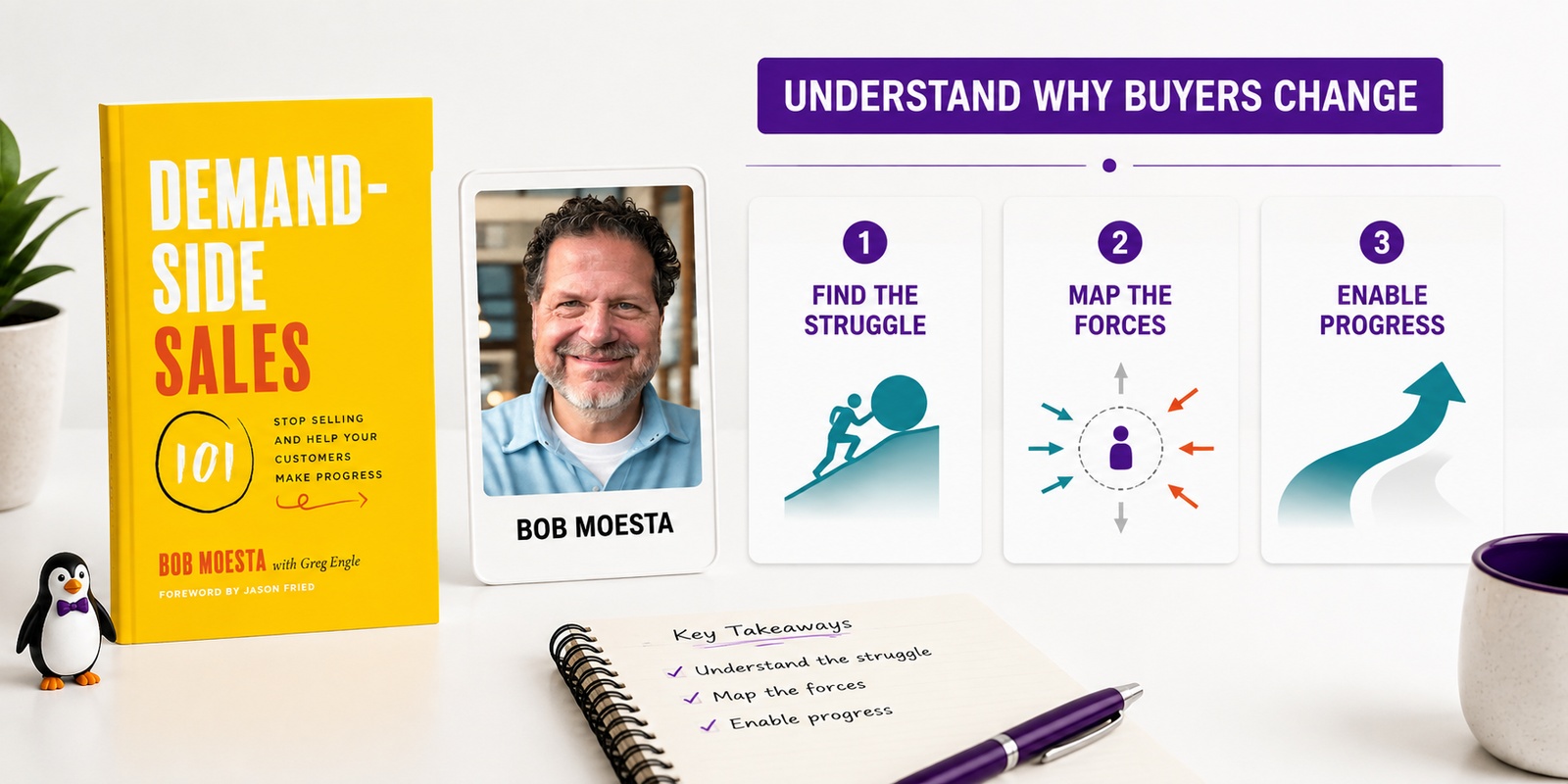
Demand-side sales reframes growth around the progress buyers are trying to make. Drawing on Bob Moesta’s Demand-Side Sales 101, this article explores struggling moments, the four forces behind decisions, buyer and user trade-offs, and customer interviews that reveal why change happens. The result is marketing that reduces friction and supports confident buying decisions for teams.
B2B buyers rarely wake up wanting another product. They begin looking when their current situation no longer works and the possibility of change becomes more attractive than staying put.
That distinction sits at the center of Demand-Side Sales 101 by Bob Moesta, co-founder of The Re-Wired Group. In a CMO Huddles Career Huddle, Bob explained how studying the circumstances behind real purchasing decisions can reveal more than feature requests, personas, or generalized pain points.
“People buy differently than how we sell.”
For marketing leaders, that idea shifts the focus from promoting a product to understanding the progress a buyer hopes to make.
Bob uses the phrase “struggling moment” to describe the point when someone first realizes that something needs to change. It is broader than a single pain point. It includes the buyer’s context, the outcome they want, and the consequences of doing nothing.
“If there’s no struggling moment, there is no demand.”
This framing can change how marketing interprets intent. Firmographics may identify a company that resembles previous customers, but they do not explain why that company might be ready to act today.
Interviews with recent buyers, lost prospects, and former customers can surface the events that created momentum. The most revealing questions tend to explore what changed, what alternatives were considered, what made the decision risky, and why the previous approach stopped feeling acceptable.
Demand-side sales organizes decision-making around four forces:
A purchase becomes more likely when push and pull outweigh anxiety and habit. Marketing can support that movement by making the future state tangible while addressing the uncertainty surrounding change.
This also creates a more useful view of objections. Security concerns, implementation questions, and internal politics are not simply barriers to overcome. They reveal the trade-offs buyers are evaluating.
Complex B2B purchases often involve people carrying different forms of risk. Bob suggested concentrating customer research on the person taking the political risk of changing the system, often called the champion or sponsor.
The buyer and the user may also evaluate value differently. The buyer may care about visibility, control, or economic impact. The user may care about usability and workflow disruption. Strong positioning acknowledges both without treating them as one averaged persona.
“The reason why you get hired is because the buyer can buy it. The reason why you get fired is because the users can’t use it.”
Marketing can help connect those perspectives through role-specific proof, implementation guidance, and stories showing how similar organizations managed the transition.
Bob distinguishes sales probability from sales causality. Funnel conversion rates show what happened across a group of opportunities. Buyer interviews help explain why a specific decision happened.
Useful interviews tend to follow events rather than opinions:
The resulting patterns can inform positioning, content, product decisions, and sales enablement without assuming that buyers can accurately prescribe the solution themselves.
Demand-side sales examines why buyers change, what progress they seek, and which forces shape the decision.
A struggling moment includes the buyer’s wider context, desired outcome, and readiness to change, not merely an isolated problem.
They are the push of the current situation, the pull of a better outcome, anxiety about change, and habit supporting the status quo.
Marketing can clarify the desired outcome, address decision risk, provide relevant proof, and help buying groups understand the trade-offs.
Listen to the full conversation with Bob Moesta.
CMO Huddles helps B2B marketing leaders win by bringing together peers, fresh perspectives, and opportunities to build stronger personal brands. Want to join the huddle? Learn more about CMO Huddles and apply to join the community.