
Back to Blogs
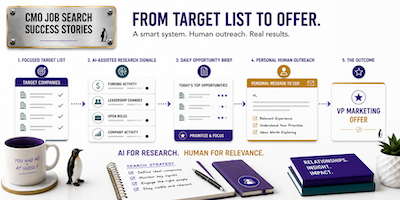
A marketing leader built an AI agent to monitor target companies for hiring signals. When the agent surfaced the right opportunity, the Huddler paired AI-powered research with a highly relevant email to the CEO. That combination opened the door to a fast-moving interview process and a new exciting role.
The fastest path to the next marketing leadership role is not necessarily applying to more jobs. For one marketing executive in the CMO Huddles Transition Team, the search started by getting more specific about what mattered in the next role and more current on where marketing was headed.
After leaving a previous company, the Huddler didn’t immediately launch into a full-time job search. Instead, they took a few weeks to reset, think through priorities, and complete a 6-week Harvard Data Science Institute Agentic AI course focused on building and using AI agents in business. That investment would become unexpectedly relevant.
The Huddler officially left the prior company in March and began a focused search in April. By roughly mid-July, the new role had started. The success combined three things that are increasingly important for senior marketers: A focused target list, AI-assisted research, and distinctly human outreach.
Rather than beginning with whatever executive marketing roles happened to be open, the Huddler built a focused list of companies that were genuinely interesting. The highest-priority list included roughly 15 companies in the energy and climate space, with additional lists across several other industries bringing the total to around 50 companies.
That focus became one of the strengths of the search. Instead of reacting to a stream of unrelated job postings, the Huddler could concentrate research on a defined set of companies and watch for signals that might indicate an opportunity. The company they ultimately joined was on that target list when the AI monitoring system surfaced its Head of Marketing opening.
The lesson was not that the list was too targeted. It was that the same targeted approach could have been applied to a larger universe of companies. At a growth-stage company, there may be only one senior marketing seat, so even a strong target list can produce relatively few openings at any given time.
Think about the executive job search the way a marketer thinks about an addressable market. Define the ICP carefully, prioritize companies that generate genuine enthusiasm, and then make sure the target universe is large enough to create sufficient opportunities. The Huddler's experience showed that focus and scale are not competing strategies. The goal is a larger list of companies you actually want to join, not a larger volume of indiscriminate applications.
The most distinctive part of the search was the system the Huddler built to monitor those target companies. Using Claude, an AI agent ran searches against the companies, sectors, and criteria that mattered, then assembled the results into a daily brief.
The system monitored signals including:
It took several iterations to make the output relevant, and the setup was not completely autonomous. Still, it replaced the repetitive work of manually checking dozens of companies and business signals every day.
Just as important was what was not automated. AI handled the research and preparation, but once an opportunity appeared, the personal outreach was human-written. The prep work could be automated, but deciding which past experience mattered to a particular executive required human judgment.
Eventually, the system surfaced a Head of Marketing opening at one of the target companies. The posted role was not exactly what the Huddler had envisioned, but the company itself was compelling enough to warrant an application.
The more consequential move came next: a cold email directly to the CEO. The two had never met, so this was not a warm introduction disguised as outbound. Instead of sending a generic introduction, the Huddler connected experience from an earlier role to the company's specific situation and used that connection in the subject line.
The CEO recognized the company referenced in the email. The message got opened, and the outreach got the candidate into the hiring process. The resume established credentials, but the email established relevance.
For executive candidates, that distinction matters. “I applied for your job” gives a CEO little reason to respond. Demonstrating that you have dealt with a business problem relevant to theirs creates a different conversation.
The preparation mattered even more because the prospective employer was an AI-first vertical technology company. The recruiter screen quickly moved beyond traditional executive interview questions and into hands-on AI experience.
The Huddler was asked about the last agent built, what had and had not worked when using AI, preferences among different tools, and lessons learned through experimentation. This was not a test of whether a candidate could talk intelligently about AI trends. It was a test of whether a marketing leader could operate with AI as part of the team.
The course and systems built during the search provided concrete experiences to discuss. For CMOs and senior marketers in transition, that suggests a new kind of interview preparation. Reading about AI may no longer be enough. Candidates may increasingly need examples of things they have built, tested, improved, or rejected.
There is a balance to strike. After starting the new role, the Huddler interviewed a candidate who was exceptionally AI-forward but had not prepared deeply enough for the core marketing responsibilities of the job. AI fluency is becoming part of the leadership toolkit, but it is not a substitute for marketing leadership.
After the recruiter screen came an interview with the CEO. At the end of the conversation, the CEO shared an uncomfortable fact: the company was already at the offer stage with somebody else. He nevertheless wanted other executives to meet the Huddler and asked whether a conversation with the VP of Sales could happen immediately.
The answer was yes. They spoke with the sales leader the next day and met the CEO in person the following Monday. Then came a marketing assignment and a full day of conversations with company leaders, product team members, potential direct reports, and even an AI engineer who tested whether The Huddler understood the product well enough to communicate it succinctly.
The assignment included a familiar 30-60-90 component, but it also required thinking through the realities of an AI-first company shipping product every week. The Huddler developed recommendations across marketing priorities, positioning, product go-to-market, thought leadership, potential partners, and referral opportunities.
Industry-specific ideas were particularly well received. That became another advantage of the target-company strategy: this was not simply a marketing opening. It was a business where experience from the Huddler's past could create immediate credibility.
Executive interview assignments are inherently imperfect. Candidates are being asked to make recommendations without access to everything they would know from inside the company. The Huddler's experience offers a useful way to approach that constraint.
They did enough research to form a point of view, identified the highest marketing priorities based on the available information, and made specific recommendations where industry knowledge created an advantage. Some assumptions turned out to be unnecessary because the company was already more sophisticated in those areas than expected.
That did not sink the presentation. Instead, it created an opportunity to recognize good work and demonstrate alignment. When the company had already built something similar to a recommendation, the Huddler could acknowledge that the teams were thinking about the problem in similar ways.
The goal of an executive assignment is not to magically know everything happening inside a company. It is to demonstrate how you think with incomplete information and how you respond when new information changes the picture.
During the process, the Huddler was also considering another offer. Having another option provided some confidence, but more importantly, the situation forced a return to priorities established before the search accelerated.
Those priorities included:
One thing the Huddler was willing to compromise on was title. The previous role carried a CMO title, while the new opportunity was a VP position.
The opportunity delivered the industry, technology exposure, reporting relationship, compensation, and business opportunity that mattered more than traditional career trajectory. It checked almost all of the important boxes.
That is why the priority list needs to exist before negotiations begin. A job search can easily turn into an optimization exercise for title or compensation because those factors are easy to compare. A written set of priorities makes it easier to judge the complete opportunity.
One of the most important lessons from the search had little to do with AI. The Huddler relied on peers more heavily than in previous searches, including bringing questions to the CMO Huddles community and talking with other marketing leaders about what they were doing with AI.
For another opportunity, a CMO friend who knew the company reviewed interview materials and provided feedback that significantly improved the work. Conversations with marketing peers also helped to stay current and continue improving throughout the search.
The takeaway was not that every part of the search was executed perfectly. It was that the Huddler learned along the way and used other people to get better. Senior-level searches can become isolating precisely when outside perspective is most useful.
Peers can challenge the story you are telling yourself about an opportunity, review a presentation before the executive team sees it, share what they are learning, and help you stay current while you are out of the seat. AI can make the research more efficient, but the network still makes the candidate better.
This Huddler's search offers a practical model for senior marketing leaders:
Phase One: Decide what matters before the search gets noisy, build a focused list of companies you genuinely want to join, and use AI to monitor signals instead of manually searching every day.
Phase Two: When those signals uncover an opportunity, turn the information into personal, relevant outreach rather than handing the relationship to AI. Build enough hands-on AI experience to discuss what you have actually learned, and prepare for executive interviews by demonstrating judgment rather than pretending to know what you cannot know.
Phase Three: Evaluate offers against the priorities that matter to you rather than title alone, and bring trusted peers into the process. Better information can help you find the opening, but relevance gets you into the conversation. Judgment, experience, and a little help from your network can help you win it.
AI can monitor target companies for signals such as leadership openings, funding, M&A activity, and executive changes, then aggregate that research into a useful brief. The Huddler found AI especially valuable for research and preparation while keeping personal outreach human.
This search suggests a useful division of labor: Use AI to gather and organize information, then use your own experience to determine the relevant story and write the outreach. At the executive level, personal context and credibility can be more valuable than a polished but generic message.
Be prepared to discuss actual experience, like agents built, what had and had not worked, tool preferences, and lessons learned. Candidates should develop hands-on examples while remaining prepared to demonstrate the core marketing leadership skills required for the role.
Not necessarily. One Huddler moved from a CMO title to a VP role because the opportunity matched higher priorities, including industry impact, technology exposure, CEO access, and compensation. The trade-off should be evaluated against the candidate's career priorities rather than title alone.
Peers can review interview materials, pressure-test opportunities, share current practices, provide advice, and help candidates continue learning. One Huddler relied on other marketing leaders more during this search than in previous searches and found their input valuable.