
Back to Blogs
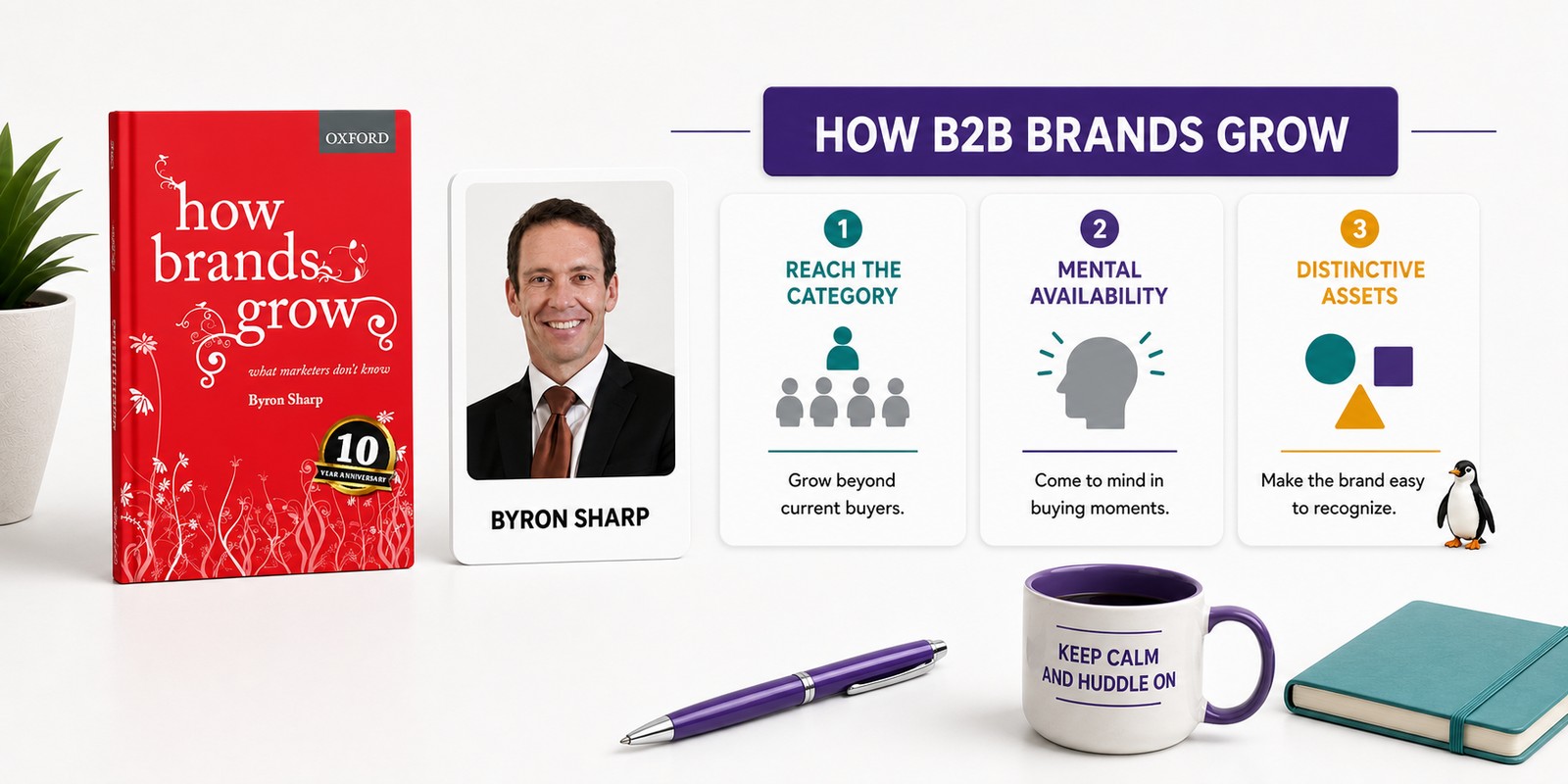
B2B brands grow by building mental availability before buyers enter the market and physical availability when purchasing begins. Professor Byron Sharp explains why broad reach, distinctive brand assets, category entry points, and consistent investment matter more than chasing only active buyers. Growth takes time, so early measures of memory and presence help credibly defend investment.
B2B marketing often concentrates spending on buyers who appear ready to purchase.
That investment supports physical availability: Making the company easy to notice, evaluate, approve, and buy from when demand becomes active.
Professor Byron Sharp, author of How Brands Grow and director of the Ehrenberg-Bass Institute for Marketing Science, argues that physical availability is only half the growth equation.
Brands also need mental availability among the much larger group of future buyers.
Physical availability helps a brand capture existing demand. In B2B, that may include:
Mental availability increases the chance that buyers notice or recall the brand when a relevant need emerges.
That work happens before the buying process begins, often while the audience is focused on other priorities.
“Point to every single valuable company in the world, and they’re valuable because they’ve got a lot of mental availability and physical availability.”
A brand that invests only in active demand may become increasingly dependent on expensive channels and last-minute sales intervention.
The familiar 95-5 rule is an illustration, not a universal fixed ratio. Its central point is that most potential B2B buyers are not actively purchasing at a given moment.
Those future buyers still matter.
If the brand waits until they enter the market, competitors with stronger mental availability may already have an advantage. Familiar brands are more likely to enter the initial consideration set, receive a response, or feel safer to a buying committee.
Mental availability therefore supports future physical availability.
Awareness alone does not guarantee that buyers will recall a company at a useful moment.
Byron described mental availability as the network of cues that brings a brand to mind when a business problem, priority, or buying situation appears.
These cues are often called category entry points. Examples might include:
Research can examine whether relevant buyers connect the brand with those situations, not merely whether they recognize its name.
Byron challenged the idea that product advertising and brand building are separate activities.
“Every product ad should build the brand. It should be unmistakably you.”
Distinctive assets help create that recognition. They may include colors, shapes, characters, sounds, phrases, or visual patterns that consistently identify the company.
The objective is not decoration. It is making each communication easier to attribute to the brand.
A product message can explain an immediate capability while also strengthening the memory structures that support future demand.
B2B reach accumulates slowly. There is no single media channel that reliably reaches every member of a specialized buying audience at once.
Large bursts of spending may create frequency among the easiest people to reach without meaningfully expanding the audience.
Byron offered a straightforward alternative:
“There is a trick: Take your budget and spread it out over time.”
Consistent presence increases the chance of reaching different buyers as they move through their own business cycles.
This makes time part of the growth strategy.
Mental availability takes time to produce commercial results because many people reached today will not buy immediately.
Earlier indicators can show whether the brand is gaining ground:
These measures do not replace revenue. They help explain whether the conditions that support future revenue are strengthening.
Mental availability is the likelihood that a buyer will notice or recall a brand when a relevant business need or purchasing situation arises.
Physical availability describes how easy the brand is to find, evaluate, approve, and purchase when a buyer enters the market.
They can serve different immediate objectives, but product communications can also build the brand by using consistent and distinctive assets.
Specialized audiences are difficult to reach all at once, and most potential buyers are not in the market at any given moment. Consistency allows reach and memory to accumulate.
Listen to Drew Neisser’s full conversation with Byron Sharp.
CMO Huddles helps B2B marketing leaders win by bringing together peers, fresh perspectives, and opportunities to build stronger personal brands. Want to join the huddle? Learn more about CMO Huddles and apply to join the community.