
Back to Blogs
Drew Neisser is the founder of CMO Huddles and a globally recognized authority on B2B marketing. He’s an AdAge columnist, LinkedIn TopVoice, leading CMO coach, podcast host & friend of penguins everywhere.
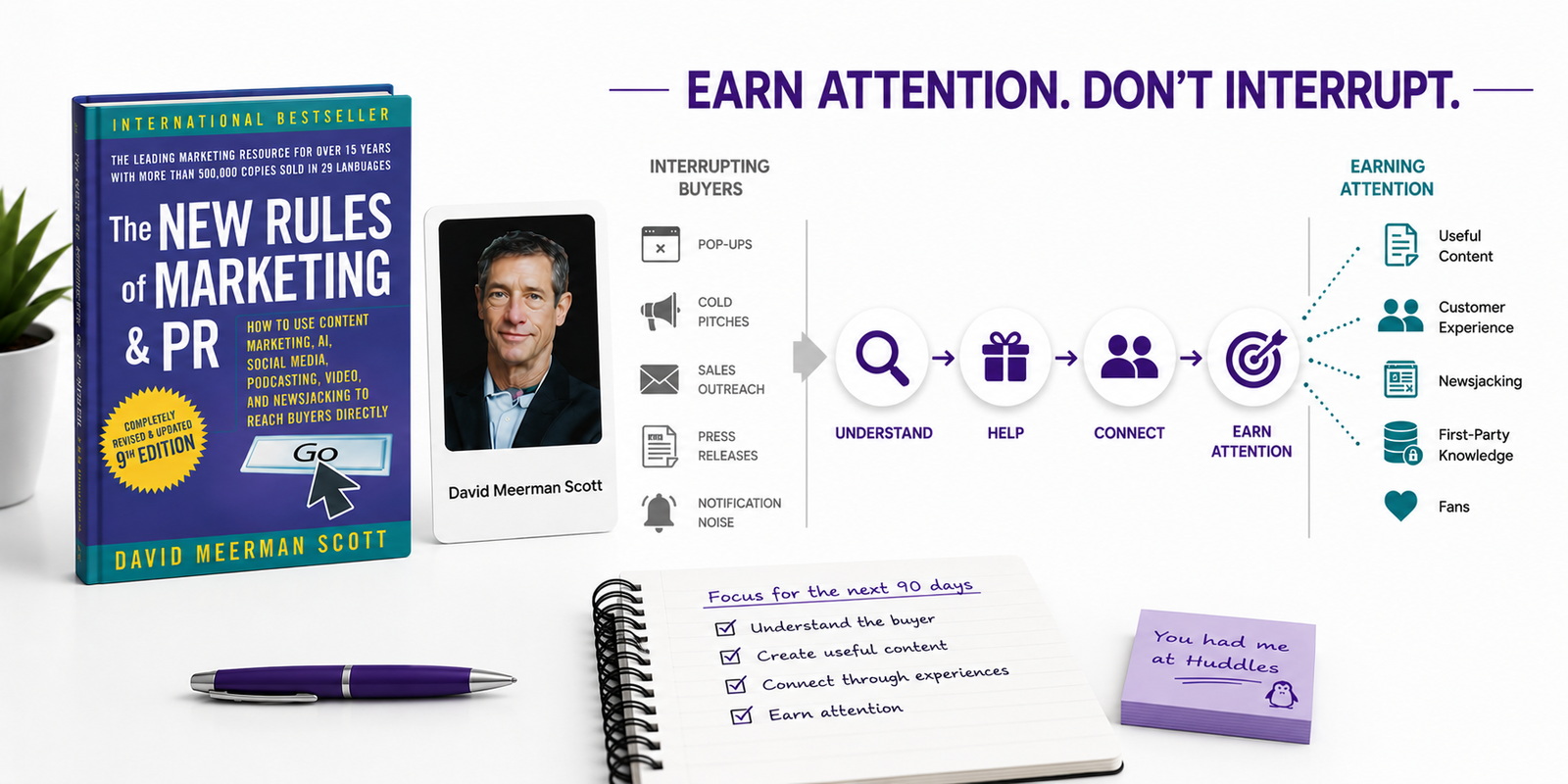
B2B buyers face more content than ever, much of it forgettable. David Meerman Scott argues attention goes to whoever is useful first, not whoever appears most. Drawing on his conversation with Drew Neisser about The New Rules of Marketing & PR, this piece explores audience understanding, generosity, responsible AI, newsjacking, and marketing-PR coordination strategies today.
David Meerman Scott wrote the first edition of The New Rules of Marketing & PR in 2007. Nine editions later, his core argument hasn't moved: Understand your audience, then create content for them. Social media, search, and generative AI have changed how that content gets delivered, but Scott argues none of it has changed the underlying idea.
"Even though it's 20 years later, marketing is still about creating interesting content, understanding the people you're trying to reach, and then creating the content for them," Scott told Drew Neisser in a CMO Huddles Expert Huddle.
Scott's own proof point is a surfboard. He's a surfer and an environmentalist, and one day he searched "wooden surfboards" and landed on Grain Surfboards, a company an hour from his house that runs a four-day build-your-own-surfboard class. He signed up before his wife had finished packing for her trip to Japan and put $1,500 on his card within ten minutes of visiting the site. Grain wasn't running a funnel. They understood the kind of customer they wanted to attract: a surfer, a craftsperson, someone who cared about materials, and built an offer that matched.
That's the test worth applying to your own content: Would this be worth someone's time even if they never buy from you? A surprising amount of B2B content doesn't pass that test, and the reason usually isn't quality. It's that the content was built for a channel instead of a person.
Many companies instinctively protect their methods. Grain Surfboards did the opposite, they sell the plans, and they'll teach you to build the board yourself at their factory. Scott sees the same principle at Design Ergonomics, a company that helps dentists design more efficient, less physically punishing practices. Founder Dave Ahern invites other dentists into his own office to watch him work, no purchase required.
It sounds like Ahern is training his competition. Scott's point is that he isn't, because most people who see the technique and want it will want Ahern's firm to install it. Scott argues that showing the method builds more trust than simply describing it, and trust is what actually shortens a B2B sales cycle. Many organizations instinctively gate their best material because it feels safer than giving it away. Scott argues that instinct is often protecting the wrong thing.
Scott suggests a more useful question isn't "what should we gate." It's "where could we afford to be more generous." Share the framework, not just the outcome. Let prospects sit in on the parts of a customer workshop that don't compromise anything proprietary. The goal isn't to give away proprietary value. It's to let prospective customers experience your expertise before asking them to buy.
"Artificial intelligence is simply data and math," Scott said.
Scott's advice is to ask two questions whenever evaluating an AI tool: Whose data is it using, and whose math is driving it? That framing shifts the conversation from AI hype to competitive advantage.
Public tools like ChatGPT are OpenAI's math running on public data, so a prompt like "write me a blog post" pulls from everyone's content and produces everyone's average. That's the part most AI marketing advice skips. Scott's advice is to point AI at your own material instead: Customer interviews, sales calls, product docs, twenty years of blog posts if you have them.
"Whatever company you work for, take its data and create a proprietary, private database, then use AI to interrogate the data in some way, to understand what your customers are doing, to understand what marketing strategies might work the best," Scott said.
Used that way, AI stops being a content generator and becomes a way to get more out of what you already know. That's also the part a competitor can't copy by subscribing to the same tool.
Twenty years ago, marketing chased demand and PR chased press, with a wall between them. Scott says that wall is gone, whether or not the org chart admits it.
A prospective customer might discover your company through a podcast, a LinkedIn post from your CEO, a conference talk, an AI-generated answer, or an actual news story. They don't know or care which department made it happen. They just experience the brand. When marketing and communications report to different people and tell slightly different stories, the buyer notices the seams even if no one internally does.
"Newsjacking is the art and science of injecting your ideas into a breaking news story," Scott said.
He coined the term, bought newsjacking.com, gave the idea away instead of trademarking it, and today it's in the Oxford English Dictionary with his name attached.
His honest framing of the odds: It works like venture investing. You place a lot of bets expecting most to go nowhere, a few to land okay, and one out of maybe 25 to actually break through. That's not a reason to skip it. It's a reason not to panic when a given newsjack falls flat, and not to force a take on every headline just because you can.
The prep happens before news breaks: Know which topics you can speak to credibly, know who on your team can go on record fast, and have a review process that can move in hours, not days.
"The more you can bring people in physical proximity with you and one another, the stronger the bonds will be, and the more likely they are to become fans," Scott said.
That's one reason he remains such a strong advocate for live events.
His favorite example is the Savannah Bananas. When Jesse Cole bought the struggling baseball team in 2016, attendance hovered around 200 people per game. Rather than trying to market baseball more aggressively, he redesigned the experience itself. Banana Ball introduced new rules, constant entertainment, and an atmosphere people couldn't wait to tell others about. The team now has a two-million-person ticket waitlist and even outdrew the Red Sox at Fenway Park during a 2024 game.
The lesson isn't that B2B marketing should look more like a baseball game.
It's that improving the customer experience often creates stronger marketing than improving the marketing alone.
For CMOs, those experiences might be customer advisory boards, executive roundtables, user communities, or workshops where customers solve real problems together. Those interactions build relationships that continue long after the event itself ends.
Marketing can introduce a company. Shared experiences give people something worth talking about afterward.
The channels have changed dramatically over the past two decades. Scott's central argument hasn't: understand your audience, be useful before asking for attention, and create experiences people genuinely want to talk about.
Organizations earn attention by understanding their audience, sharing useful expertise, and building trust over time, rather than relying on interruptive marketing.
Adding timely, relevant expertise to a story while it's still developing. It works best when a company has real expertise to add, not just an opinion to share.
Build a private, proprietary database from your own content and customer data, then use AI to interrogate it, rather than relying on public AI models trained on everyone else's content.
Grain and Design Ergonomics earn attention by teaching their expertise openly instead of protecting it. The Savannah Bananas earn it a different way, by rebuilding the product itself into something worth talking about. The common thread is that all three built something people wanted to experience before any of them tried to sell it.
Want to hear more? Listen to the full conversation with David Meerman Scott on Renegade Marketers Unite.
CMO Huddles helps B2B marketing leaders win by bringing together peers, fresh perspectives, and opportunities to build stronger personal brands. Want to join the huddle? Learn more about CMO Huddles and apply to join the community.