
Back to Blogs
Drew Neisser is the founder of CMO Huddles and a globally recognized authority on B2B marketing. He’s an AdAge columnist, LinkedIn TopVoice, leading CMO coach, podcast host & friend of penguins everywhere.
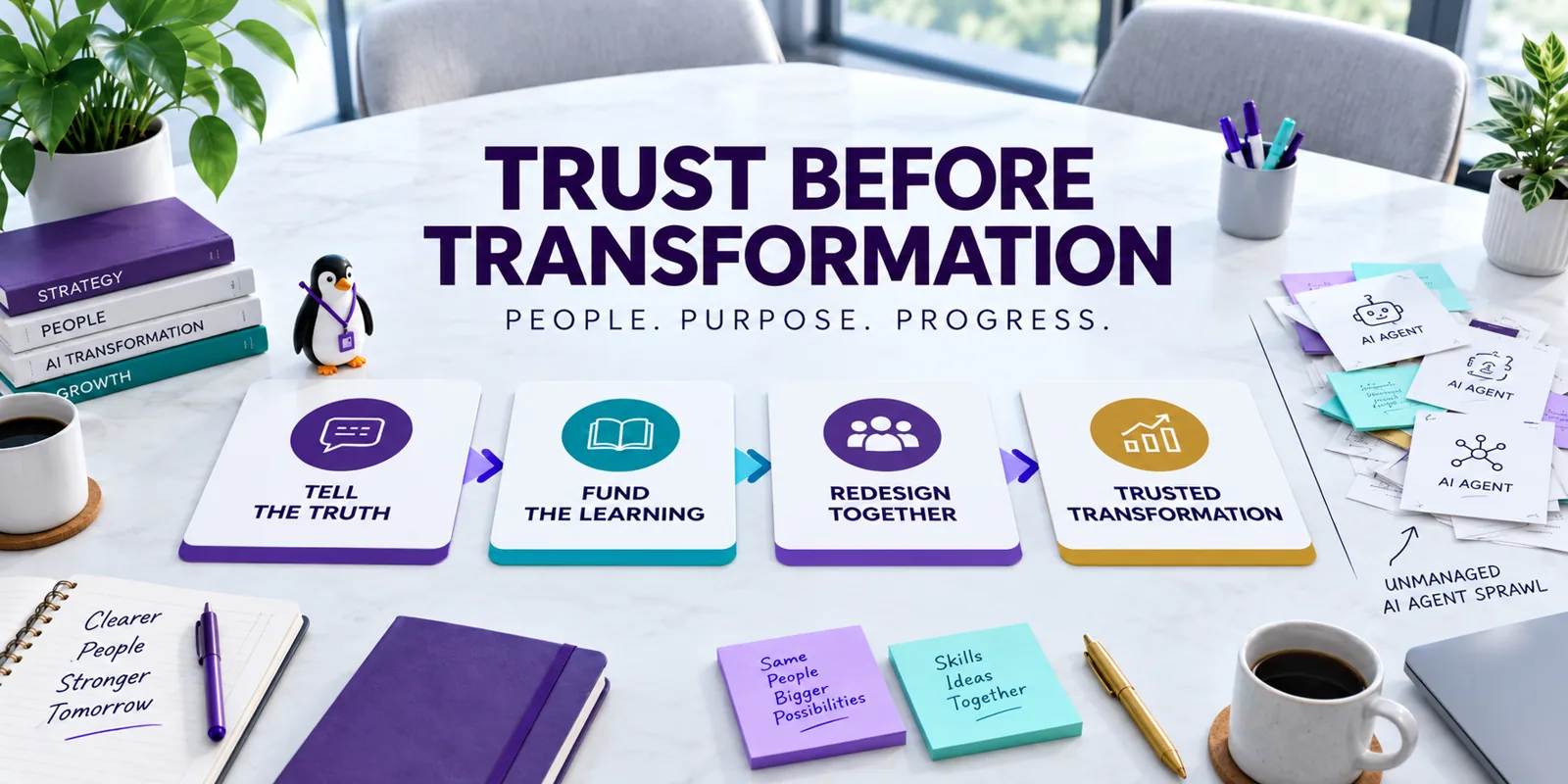
AI transformation succeeds only when employees trust the leaders directing it. Drawing on candid CMO conversations and current workforce research, this guide explains how marketing leaders can acknowledge job uncertainty, fund meaningful AI learning, involve employees in workflow redesign, govern agent sprawl, and build a more credible path toward an AI-empowered organization without empty promises.
A CMO recently shared a question their team has been asking as they learn to use AI: “Are we training the technology that might replace us?”
That question should stop every marketing leader in their tracks. The team was not refusing to change. They were attending workshops, testing tools, and exploring agents. But underneath that activity was a reasonable concern: “What does this mean for my job six months or a year from now?”
This is the AI conversation too many leadership teams are avoiding.
CMOs cannot promise that every role will survive unchanged. AI will eliminate some tasks, reshape many jobs, and contribute to decisions not to backfill certain positions. Pretending otherwise will not inspire adoption. It will erode the trust required to make transformation work.
The CMO’s team is hardly alone. According to Pew Research Center, 52% of U.S. workers are worried about how AI will be used in the workplace, while only 6% believe it will create more opportunities for them. One-third already feel overwhelmed.
Employers are also signaling that workforce reductions are part of the plan. The World Economic Forum’s Future of Jobs Report 2025 found that 40% of employers expect to reduce staff where AI can automate tasks. At the same time, 85% plan to prioritize upskilling, which captures the difficult reality facing CMOs: some work will disappear, some people will be redeployed, and nearly everyone will need new skills.
Trust begins by acknowledging all three possibilities.
One CMO described the budget pressure bluntly. AI tools, tokens, integration, governance, and maintenance do not arrive with a magical new funding pool. If someone leaves, leadership may need to decide whether to replace that person, redesign the role, or redirect some of the budget toward AI capabilities.
Employees can see that tradeoff even when leaders avoid discussing it.
Recent research makes the business implications clear. PwC’s global workforce study found that workers with the highest trust in their direct managers were 72% more motivated than those with the lowest trust. Yet only about half of respondents said they trusted top management. PwC’s conclusion is particularly relevant here: what executives describe as reallocating skills, employees may experience as a threat to their jobs and expertise.
The issue is not whether leaders have every answer. Nobody does. The issue is whether employees believe leadership will share what it knows, admit what it does not know, and treat people fairly as the work changes.
A CMO can say, “Your job is safe,” and lose credibility six months later. A stronger message is: “We cannot guarantee that every role will remain the same. We can give you visibility into where we are headed, invest in your ability to adapt, and involve you in redesigning the work.”
Candor may be uncomfortable. Ambiguity is worse.
Transparency does not require sharing every confidential workforce scenario. It does require explaining why the company is investing in AI, what business outcomes it expects, where roles may change, and how decisions will be made.
Our anonymous CMO is trying to frame AI literacy as career development, not merely company extraction. The goal is to help employees become stronger marketers whether they remain with the organization for two years or ten. That is a more credible value proposition than asking people to build agents at night and trust that everything will work out.
Leaders should also explain the economics. If a new system is expected to save money, say where. If the investment depends on eliminating manual work, describe which work. If recovered capacity will be redirected toward strategy, creativity, or customer experience, identify how that transition will happen.
Employees do not need certainty. They need honesty and evidence that leadership understands the human consequences of its decisions.
“Use AI” is not a development plan.
The CMO I spoke with is considering an AI literacy charter that includes ongoing training, hands-on workshops, approved use cases, and measurement. Just as importantly, the CMO is exploring protected learning time and marketing-specific instruction rather than generic demonstrations of whichever tool happens to be fashionable that week.
That distinction matters. Employees cannot be expected to master a new way of working while delivering the same workload, attending the same meetings, and absorbing continuous product and organizational change. When training is relegated to evenings and weekends, the company sends a clear message: transformation matters, but your development is your problem.
CMOs should establish a common foundation across the department, then create more advanced pathways for people whose roles require deeper expertise. The goal is not to turn every marketer into an agent builder. It is to ensure that everyone understands what AI can do, how to use approved tools, how their work may change, and where human judgment remains essential.
Gallup’s 2026 research found that half of surveyed CHROs lacked confidence in managers’ ability to guide employees’ AI use. Employees with AI-supportive managers, however, were more likely to report that their workplace culture had improved. That puts frontline managers squarely in the middle of the transformation. They need training, talking points, escalation paths, and enough clarity to answer questions without bluffing.
The third trust builder is participation. Employees know where processes break, which approvals add little value, and which supposedly simple tasks depend on judgment that never made it into the process documentation.
Invite them to map the work before deciding what to automate.
CMO Huddles’ Future of Marketing Organizations (FOMO) Task Force reached a similar conclusion: start with the business advantage you want to create, understand the work supporting it, and redesign the workflow before changing roles or reporting lines. Once a new workflow proves that it can improve quality, speed, or business performance, the organization can make better-informed decisions about responsibilities and structure.
This is also the best defense against agent sprawl. The anonymous CMO discovered that people were building agents throughout marketing without a common inventory, clear ownership, or confidence about which data each agent could access. The team now needs to prioritize use cases, identify what already exists, assign owners, and prevent multiple groups from building the same capability.
Employee participation does not mean a free-for-all. It means bringing the people closest to the work into a governed redesign process.
One CMO in a FOMO Task Force discussion described the current environment as “schizophrenic,” with bottom-up experimentation colliding with pressure from boards and CEOs. The warning was straightforward: organizations will not achieve adoption or productivity by overwhelming people.
AI efficiency claims tend to count what disappears while ignoring what gets created. Faster content generation can produce more material requiring review. More agents create maintenance, security, and cost-management work. Easier design tools allow employees throughout the company to produce materials bearing the corporate logo, leaving marketing to police brand quality and image provenance.
The anonymous CMO described seeing off-brand assets appearing in public and wondering, “Who created it?” Marketing then had to find, review, and correct the work. AI had accelerated production while quietly adding a cleanup function.
That is why leaders should measure the complete workflow. If AI saves four hours of production but creates three hours of review, correction, and governance, the company did not save four hours. If an agent works until its creator leaves and nobody understands how it was built, the organization has acquired technical debt with a cheerful interface.
Trust suffers when employees are told AI will reduce their workload while their lived experience says otherwise.
CMOs do not need to resolve the future of work before taking action. They can begin with three commitments:
Explain what is known, what remains uncertain, and how AI investments may affect tasks, roles, budgets, and hiring. Avoid promises you cannot keep. Communicate the decision criteria leadership will use when work changes.
Provide protected time, relevant training, approved tools, and practical workflows. Train managers to support adoption and difficult conversations. Make AI literacy broadly available so transformation does not divide the department into insiders and everyone else.
Map workflows with the people who perform them. Ask what should be automated, augmented, eliminated, or created. Test changes before restructuring the organization, then use evidence from the work to inform role and staffing decisions.
Trust will not eliminate anxiety. It can keep anxiety from turning into paralysis, resentment, or silent resistance.
AI transformation is often discussed as a technology, productivity, or organizational-design challenge. It is all of those things. But before employees will help rebuild the marketing function, they must believe leadership sees them as participants in the transformation rather than costs waiting to be removed.
That belief will be earned through decisions, not town-hall slogans.
At the CMO Super Huddle on October 22–23 in Palo Alto, we will continue this conversation as we share findings from the CMO Huddles Future of Marketing Org Design Task Force. We will examine how the work is changing, what that means for organizational design, and how CMOs can move forward without creating operational chaos or leaving their teams behind.
In the meantime, use the CMO Huddles AI Maturity Calculator to assess your organization across strategy, workflows, talent, governance, and measurement. The score matters less than the leadership conversation it starts.
AI adoption changes workflows, skills, budgets, and potentially jobs. Employees are more likely to participate constructively when leaders communicate honestly, invest in their development, and explain how decisions will be made.
No. CMOs should avoid guarantees they may be unable to keep. They can commit to transparency, responsible workforce planning, meaningful training, and fair opportunities for employees to adapt or move into new roles.
Leaders can acknowledge uncertainty, connect AI initiatives to clear business goals, provide protected learning time, train managers, involve employees in workflow redesign, and communicate regularly about what is changing.
No. Every marketer needs sufficient AI literacy to work safely and effectively, but advanced development can be concentrated among designated specialists or teams. Employees should understand how to use shared capabilities without being expected to build everything themselves.
Start by mapping and redesigning the work. Test new workflows, establish ownership, and measure quality, cost, and business outcomes. Let demonstrated changes in the work guide decisions about roles, reporting lines, and resource allocation.