
Back to Blogs
Drew Neisser is the founder of CMO Huddles and a globally recognized authority on B2B marketing. He’s an AdAge columnist, LinkedIn TopVoice, leading CMO coach, podcast host & friend of penguins everywhere.
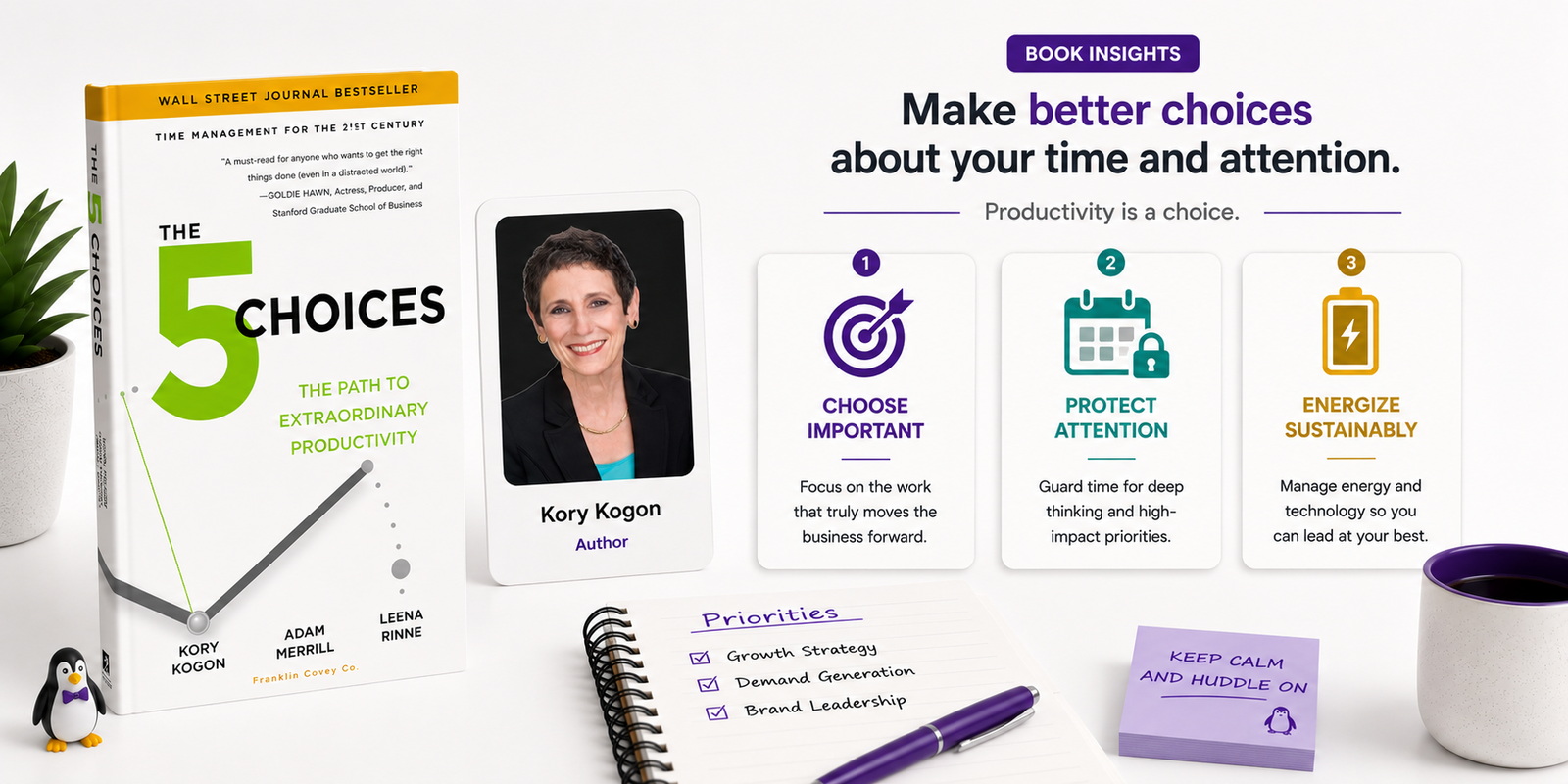
CMOs usually do not need another productivity hack. They need more time and attention for the strategic work only they can do. In The 5 Choices: The Path to Extraordinary Productivity, Kory Kogon argues that creating that room comes from making better decisions about attention, priorities, technology, and energy, not simply working longer hours.
Marketing leaders spend their days managing board expectations, pipeline pressure, executive meetings, hiring, and a constant stream of requests that often present themselves as urgent, and now Slack, Teams, email, and AI tools compete for the same attention. At its core, this book is about protecting enough time and attention for the strategic work only a CMO can do.
That's the problem Kory Kogon addressed in a CMO Huddles Expert Huddle built around her book The 5 Choices: The Path to Extraordinary Productivity. Her argument is that productivity is less about squeezing more into the day and more about making better decisions about attention, priorities, technology, and energy. Drawing on neuroscience, Kogon explains that productivity is as much about how the brain manages attention and decisions as it is about how people manage their calendars.
Kogon argues that knowledge workers, including CMOs, are paid to think, innovate, create, and execute. When attention gets fragmented across the day, leaders have less time for the judgment and strategic thinking they're actually there to provide.
Drew Neisser started with a challenge every CMO recognizes: Too many meetings.
Kogon doesn't treat meeting overload as inevitable. She encourages leaders to revisit recurring meetings regularly and ask a few simple questions: Does this meeting still need to exist? Does everyone invited actually need to attend? Could it run 45 minutes instead of 60? Could it become a written update instead?
Cutting one recurring meeting doesn't just return an hour to the CMO who called it. It returns that hour to everyone who was going to attend.
Most CMOs have a clear sense of their strategic priorities. The harder part is protecting them once the week actually starts. A sales escalation, a message from the CEO marked urgent, a board request, a campaign issue: Each one might deserve attention on its own, but together they can consume the whole week.
Kogon's framework sorts work into four categories: Important and urgent, which covers real crises; important but not urgent, which covers strategy, planning, and capability building; urgent but not important, which covers interruptions someone else could handle; and neither, which is low-value activity. The category Kogon believes is most likely to get skipped is the second one, because strengthening customer insight or developing future leaders rarely arrives with the same sense of urgency, even though it's usually the work that creates the biggest long-term advantage.
"Get out of reactive mode and get into proactive mode," Kogon said.
Some of that urgency is self-inflicted. Kogon pointed out that leaders often train their organizations to treat them as the answer to everything by responding to every email immediately, accepting every meeting, and staying the only person who knows where information lives. Before blaming a demanding CEO, she suggested looking at what's within a CMO's own control first.
That doesn't mean every urgent request can be waved off. When a CEO treats every new ask as the top priority, Kogon's advice wasn't to push back directly, it was to make the tradeoff visible: "We can absolutely move this forward. Which priority would you like us to delay?" That single question turns a debate about urgency into a conversation about what actually gets built.
Kogon challenged an assumption a lot of CMOs carry without examining it: Being extraordinary means excelling at every part of the job. It doesn't. Extraordinary productivity comes from making a real contribution in the handful of roles that matter most right now, which for a CMO might mean enterprise strategist, customer advocate, growth leader, brand steward, or team builder, depending on the company and the moment.
The distinction that makes this useful is specificity. "Be a great CMO" doesn't give anyone a way to decide what deserves their time today. "Give the executive team the clearest understanding of customers and markets" does. Once a CMO names the two or three roles that actually matter right now, deciding what to say yes to gets a lot easier.
Stephen Covey's jar metaphor still holds: Fill it with gravel first and the big rocks never fit. For a CMO, the gravel is endless, emails, approvals, status meetings, calendar invites, and none of it is bad on its own. It just shouldn't determine the week's priorities.
Kogon recommends identifying a handful of important outcomes before opening the inbox each week, then putting those commitments directly on the calendar. A task list captures intentions. A calendar protects them. "The probability of accomplishment goes up 200 to 300% the more specific we get around goal setting," she said.
The part most executives skip is leaving room for the unexpected. Kogon suggests not scheduling more than half the calendar, since something will always intervene, and counterintuitively, that open space is often what makes it possible to get to the big rocks at all.
Kogon argues the bigger problem isn't the technology itself, it's the habit of letting every notification interrupt. CMOs are expected to stay reachable across email, Slack, Teams, texts, and now AI tools, and each one arrives feeling urgent. As Kogon describes it, leaders are making more decisions than ever while their attention is under constant attack.
Her fix isn't disconnecting. It's making technology earn attention: Turning off nonessential notifications, routing low-priority email with rules, closing messaging apps during focused work, and treating the inbox as a place to make a decision once rather than reread a message five times.
The same discipline applies in person. Checking email while someone is talking may feel like multitasking to the CMO doing it. To the person talking, it reads as being ignored, and the research backs that up: multitasking isn't doing two things at once, it's switching rapidly between them, and it costs both focus and decision quality.
Many productivity conversations focus on calendars and task lists. Kogon ends somewhere more fundamental: Energy. It's easy for leaders to treat sleep, exercise, and recovery as rewards they'll earn once the work is finished. But because the work is never really done, they're often the easiest things to postpone. She names five energy drivers:
None of these are novel ideas. What's striking is how often senior leaders let late-night meetings, early global calls, and constant availability become the default anyway, at a real cost to decision quality, creativity, and patience.
Kogon offered her own example. She once ran global programs that required both early-morning and late-night sessions to cover every region, until she simply said no. She expected pushback. Instead, the schedule got rebuilt around her. Her point wasn't that every hard request can be declined, it was that a lot of demanding schedules survive only because nobody has questioned them yet.
The goal isn't to eliminate urgent work. It's to make sure important work doesn't continually lose out to it. Making that shift creates more room for the strategic thinking, judgment, and leadership only they can provide.
CMOs sit at the intersection of strategy, growth, customers, sales, and executive leadership, which creates constant interruptions and makes it hard to protect time for long-term strategic work.
The few high-impact priorities only the CMO can move forward, such as strategy, customer understanding, executive alignment, and major growth initiatives. Scheduling them first keeps reactive work from consuming the week.
Review recurring meetings regularly, shorten default lengths, remove unnecessary attendees, replace status meetings with written updates where possible, and cut meetings that no longer support real decisions.
Kogon argues that the biggest challenge is protecting enough time and attention for strategic work amid a constant stream of urgent demands.
Want to hear more? Listen to the full conversation with Kory Kogon on Renegade Marketers Unite.
CMO Huddles helps B2B marketing leaders win by bringing together peers, fresh perspectives, and opportunities to build stronger personal brands. Want to join the huddle? Learn more about CMO Huddles and apply to join the community.