
Back to Blogs
Drew Neisser is the founder of CMO Huddles and a globally recognized authority on B2B marketing. He’s an AdAge columnist, LinkedIn TopVoice, leading CMO coach, podcast host & friend of penguins everywhere.
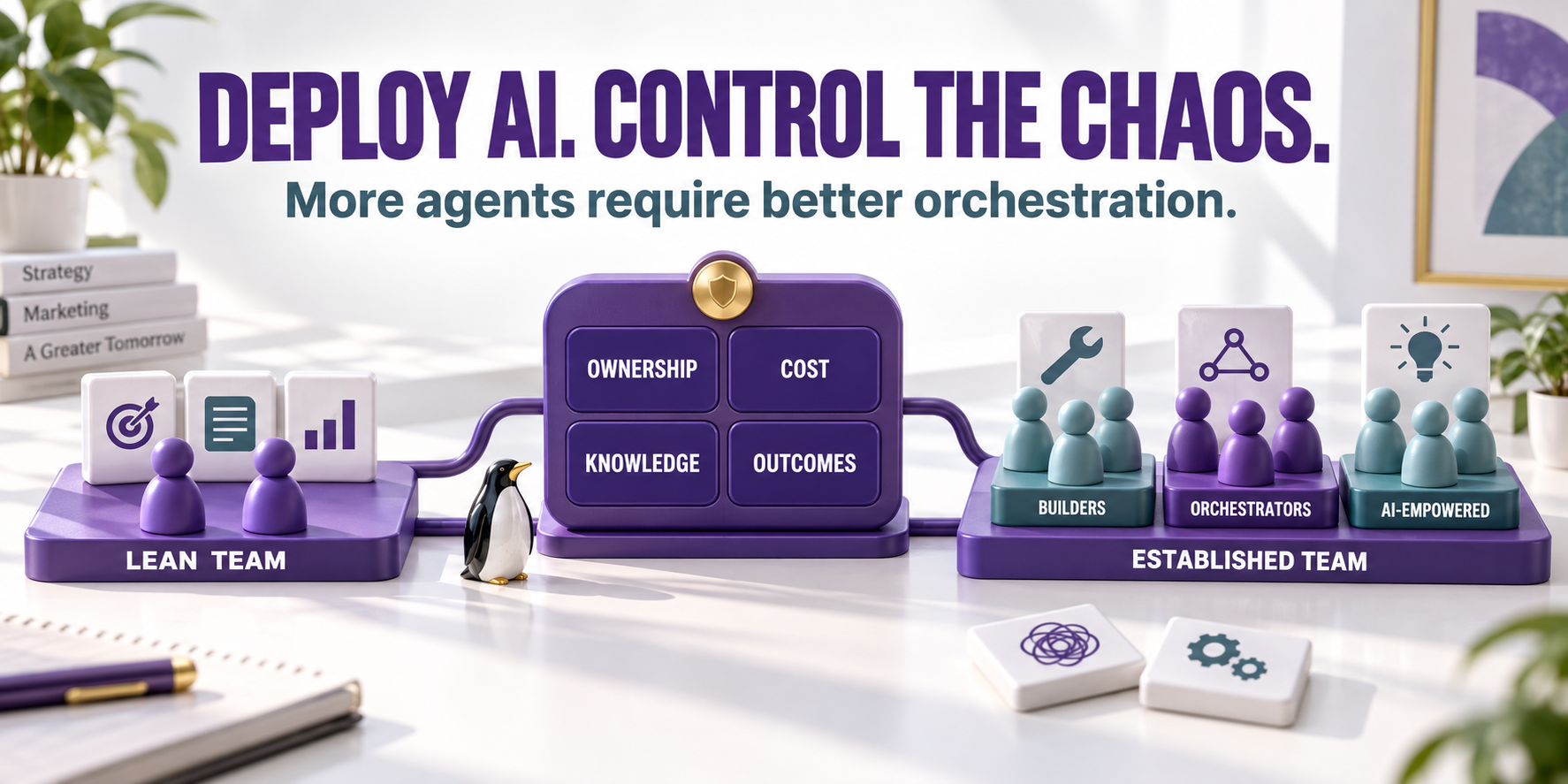
Two B2B CMOs are taking different paths to AI deployment: one uses agents to fill gaps on a lean team; the other is transforming an established organization through builders, orchestrators, and upskilling. Their shared warning is clear: without disciplined ownership, connected knowledge, cost controls, and outcome measurement, useful experimentation can quickly become expensive operational chaos.
Building an AI agent is getting easier by the day. Managing a growing collection of agents, keeping their information accurate, controlling their costs, and proving that they improve the business is considerably harder.
Recent conversations with two experienced B2B CMOs revealed two distinct approaches to this challenge. One leads a lean marketing organization and uses agents to provide capabilities the company cannot justify hiring individually. The other leads a much larger team and is focused on transforming existing talent, identifying advanced builders, and developing people who can orchestrate increasingly complex AI-enabled workflows.
The environments are different, but the destination looks surprisingly similar. Both CMOs are moving beyond isolated productivity experiments and rebuilding how marketing work gets done. Both are also discovering that the greatest risk may be neither employee resistance nor model performance.
It is operational chaos.
Agent sprawl and rising AI costs can quickly turn promising experiments into a new version of martech sprawl. The labels have changed, but the familiar questions remain: Who owns this? What does it cost? Which source is correct? What happens when it breaks? Does anyone still remember why it was bought or built?
The lean-team CMO is filling organizational gaps with specialized agents. The team has created systems for competitive intelligence, regulatory monitoring, prospect research, account targeting, answer-engine visibility, and content development. Work that might previously have required several specialists can now be handled by a combination of agents and human oversight.
“I have a lot of gaps that I currently have filled by robots,” the lean-team CMO explained. This approach is pragmatic: identify work the organization needs, determine where AI can perform it reliably, and reserve scarce human capacity for judgment, approval, and the activities that require relationships.
The established-team CMO is taking a more evolutionary approach. The organization already has experienced marketers with valuable institutional and category knowledge. Rather than replacing them or immediately restructuring the department, the CMO is asking, “How can we identify the builders and the orchestrators? How can we upskill everyone, identify the advanced builders, and then shift the work?”
This model recognizes that AI fluency will not look the same across every role. Some marketers will become skilled users. Others will build workflows and agents. A smaller group will orchestrate interconnected systems, determine where human intervention belongs, and ensure that the work advances business priorities.
Neither model is inherently superior. Team size, organizational maturity, technical infrastructure, business complexity, and available talent should determine the approach. The useful lesson is that AI deployment should begin with the work the company needs accomplished, rather than an arbitrary target for agents built or employees eliminated.
The lean-team CMO’s most useful agents address identifiable business problems. One monitors competitive and regulatory developments, then makes that intelligence available to the go-to-market organization. Instead of searching through outdated battle cards, an employee can ask how to position the company against a competitor in a particular customer context.
Another workflow improves prospecting by looking beyond job titles. Since titles can hide substantial differences in actual responsibilities, the agent reviews career histories and other signals to determine whether a prospect has the experience relevant to the company’s solution.
“I’m building target account lists and prospect lists that are rock solid in the exact right people,” the lean-team CMO said. The agent has a defined job, a useful output, and a clear connection to pipeline.
At the larger organization, agents help identify account-interest signals before sellers recognize them, activate competitive win-back programs, scale downstream content assets, and detect patterns in large datasets. AI-enabled analysis also revealed that content syndication was creating a significant lift in website traffic, followed by greater activity in other channels and stronger pipeline.
That insight changed a media-planning decision. The team had occasionally delayed syndication while waiting for a stronger asset, but the analysis suggested that maintaining market presence mattered more than waiting for perfection. As the established-team CMO explained, “We realized we can’t wait. We have to get something out there, because when we slow that down, everything declines.”
Useful agents begin with useful questions.
Before approving another build, CMOs should be able to name the business problem, the intended user, the source information, the human owner, the expected outcome, and the conditions under which the agent should be retired. If those answers are missing, the organization may be accumulating demonstrations rather than capabilities.
Both conversations exposed the importance of a shared intelligence layer. An agent working from incomplete, outdated, or contradictory information can produce a polished answer that is confidently wrong. Add dozens of independently developed agents, each drawing from different sources, and those inconsistencies multiply.
The lean-team CMO described the current knowledge environment as a collection of useful “islands of information.” The next step is connecting them without allowing a general-purpose system to blend unrelated claims or invent unsupported conclusions.
“I need it to be like a train switcher,” the lean-team CMO explained. The system must recognize the question, route it to the appropriate knowledge source, and respect a hierarchy of authority when internal experts disagree.
The established-team CMO faces the same issue at greater scale. The agents need access to company, customer, campaign, and market intelligence, but that access must be governed. The challenge is collecting the right data, determining which sources are authoritative, deciding how often they are updated, assigning responsibility for contradictions, and defining what an agent should do when the evidence is incomplete.
A company brain needs a nervous system and a fact-checker.
CMOs should resist the temptation to connect every agent to every information source. Topic-specific knowledge systems, explicit source hierarchies, retrieval rules, and escalation paths will produce more reliable results than a giant pool of content with no clear boundaries.
Agent sprawl often begins innocently. A marketer builds a useful workflow. A colleague copies it. Someone creates a variation for another team. The original builder leaves, the data source changes, and three months later nobody knows why four agents are producing four different answers.
The established-team CMO sees orchestration as a core leadership capability. “It is in the orchestration,” the CMO said. “It’s knowing enough and knowing what you need.” Senior marketing leaders do not need to personally build every agent, but they do need to understand how the system works, where expertise is required, and who is accountable for its output.
Every production agent should have a named human owner, documented purpose, approved data sources, expected users, maintenance schedule, cost threshold, and review process. Teams also need a registry that shows which agents exist, where they operate, which other systems they touch, and whether they are still active.
An agent without an owner is a future archaeology project.
Ownership also means taking responsibility for outcomes. If an agent recommends an account, drafts a claim, initiates outreach, or changes a campaign, someone must remain accountable for the quality and consequences of that work. Giving AI more autonomy increases the importance of human accountability.
The established-team CMO has refreshed much of the AI-related stack without increasing the marketing budget because the company is currently funding the investment centrally. That arrangement is not expected to last forever.
“The company is paying for our AI, and so I believe that will change,” the CMO said. Eventually, technology costs, token usage, infrastructure, implementation, security, and support will compete with headcount and program spending.
The lean-team CMO is already confronting hidden costs. Some agents cannot connect directly to core systems because the auditing and security requirements would require a substantial additional investment. “All these agents that I’m running stop at the information,” the CMO said. They can generate useful intelligence, but humans or intermediary systems must complete the final action.
This is why comparisons between an agent and an employee are often misleading. The relevant calculation includes the model, integration, data preparation, testing, monitoring, maintenance, human review, security, and failure costs. It should also include the value of the employee’s institutional knowledge, customer understanding, and ability to operate across ambiguous situations.
For experienced marketers in complex categories, upskilling can be more valuable than replacement. As the established-team CMO put it, “For people who know the business so well and are strong marketers, it’s better to see if they can develop the mindset of a builder, an orchestrator, and a user of AI rather than completely replace them.”
AI can generate more work than an organization can absorb. The lean team’s visibility-monitoring system can identify content gaps and produce multiple draft assets every week. The harder question is who will review, approve, publish, distribute, and improve them.
“We have the content,” the lean-team CMO said. “We just don’t have any place specific to put it.” The comment captures an emerging problem: production capacity is accelerating faster than editorial, legal, distribution, and measurement capacity.
The larger organization faces the same challenge when AI creates downstream assets at scale. The core creative idea still begins with people, while AI expands that idea across formats and channels. The efficiency is real, but only if the workflow includes quality standards, approval rights, and a destination for the output.
CMOs should therefore map the entire workflow before automating its most visible step. If an agent creates ten times more content but the same two people must review every asset, the organization has moved the bottleneck rather than removed it. The better design may generate fewer drafts, apply stricter filters earlier, or automate low-risk approvals while escalating only the exceptions.
Agent counts, prompts submitted, hours saved, and assets generated can help diagnose adoption, but none proves business value. The two CMOs are looking for evidence tied to account engagement, pipeline, competitive win-backs, market visibility, customer retention, and team capacity.
This distinction matters because AI makes activity incredibly cheap. Marketing can produce more emails, pages, posts, reports, and recommendations than any team could reasonably consume. Without outcome measures, the organization may spend more money processing an expanding volume of mediocre work.
CMOs should establish a baseline before deployment and define the expected change. Did the agent improve account selection? Did it increase response quality? Did it uncover a signal earlier? Did it reduce the cost or cycle time of a complete workflow? Did it help create more qualified pipeline?
The dashboard should reveal whether the business improved, not merely whether the agent stayed busy.
The experiences of these two CMOs point to a practical framework:
The goal is to create enough discipline that successful experiments can become reliable organizational capabilities without choking off the experimentation required to find them.
AI deployment will look different for a lean marketing team than for an established global organization. Every CMO, however, needs a clear view of the company’s readiness across strategy, talent, data, technology, governance, workflows, and measurement.
Use the CMO Huddles AI Maturity Calculator to benchmark your organization and identify where enthusiasm may be running ahead of operational readiness.
Building agents is getting easier. Building an AI-empowered marketing organization still requires leadership.
Agent sprawl occurs when teams create multiple AI agents without centralized visibility, ownership, documentation, or maintenance. It can lead to duplicated work, contradictory answers, uncontrolled costs, security risks, and workflows that fail when their original builders leave.
Yes. The owner should be accountable for the agent’s purpose, data sources, output quality, operating cost, maintenance, and business results. Ownership does not require manually reviewing every action, but it does require monitoring performance and addressing exceptions.
Most organizations will need both. Existing marketers bring institutional knowledge, customer understanding, and functional expertise, while specialists can provide technical architecture and governance capabilities. The right mix depends on the complexity of the workflows and the current team’s willingness and ability to adapt.
Include model and token charges, software licenses, integrations, data preparation, security, testing, monitoring, maintenance, and human review. Compare that total with the cost and performance of the current workflow rather than comparing the agent narrowly with one employee.
Define the business outcome and baseline before deployment. Useful measures may include cycle time, conversion, pipeline quality, customer retention, account engagement, error rates, or the cost of completing an entire workflow. Output volume alone is insufficient.