
Back to Blogs
Drew Neisser is the founder of CMO Huddles and a globally recognized authority on B2B marketing. He’s an AdAge columnist, LinkedIn TopVoice, leading CMO coach, podcast host & friend of penguins everywhere.
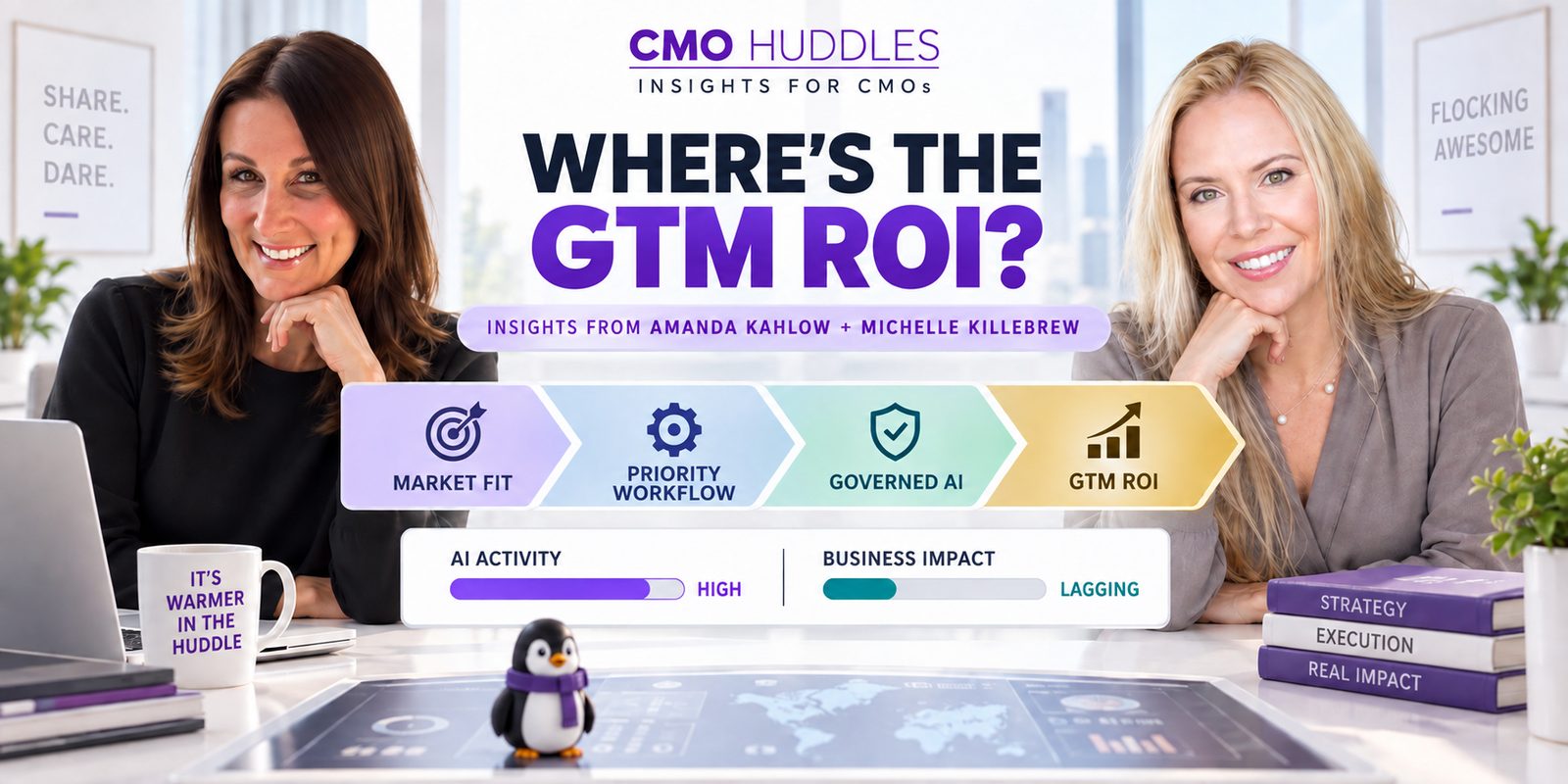
AI adoption is spreading faster than most companies can manage it. Amanda Kahlow and Michelle Killebrew explain why executive ownership, market alignment, standardized workflows, cross-functional coordination, cost controls, and maintenance matter. Their message for CMOs is clear: experimentation should continue, but leadership must turn scattered activity into a governed operating system tied to business outcomes.
Amanda Kahlow recently told me about a public company that trained employees to build AI agents and emerged with 15,000 of them. She estimated that 80% had “massive overlap,” then asked the question every CFO will eventually ask: “How much wasted time across that company to build all of those duplicative agents?”
The experiment succeeded at generating activity and exposed a much larger management problem. When every employee becomes an AI builder without a shared architecture, the organization can end up with thousands of overlapping solutions, inconsistent answers, invisible costs, and a growing maintenance burden.
Amanda, Founder and CEO of 1mind and previously Founder and CEO of 6sense, supports broad AI literacy. “We need to teach all of our employees at every level how to embrace AI,” she said. Her concern is that companies expect individual contributors to independently discover the efficiency and growth gains boards are demanding.
“The imperative is on the C level. It’s not on our ICs,” Amanda said.
That distinction matters. Employees should experiment, learn, and surface promising uses. Executives must determine which business outcomes matter, which workflows deserve investment, which tools should become standard, and who owns quality, cost, governance, and business impact.
The hard part of enterprise AI is becoming a management challenge.
Back-to-back with my conversation with Amanda, I caught up with Michelle Killebrew, Founder and Chief Go-to-Market Strategist at Pegasus Strategy Co. Michelle works across marketing, sales, technology, and implementation, giving her a useful view of where AI ambition collides with operating reality.
When I asked whether she was seeing significant ROI wins from clients’ AI implementations, her answer was admirably concise: “No. Not yet.”
Companies are building agents, connecting tools, and automating tasks. Many still lack baselines, complete cost models, shared ownership, or a defined business outcome. The activity is easy to demonstrate, while the impact remains stubbornly difficult to quantify.
Michelle traced part of the problem to the first wave of executive mandates. CEOs told functional leaders to “do AI,” and each department tried to get its own house in order. “You’re not going to try and figure it out across functions if you don’t have your own house in order,” she explained. The predictable result was deeper silos, not enterprise transformation.
Marketing built marketing agents. Sales built sales agents. Customer success and product launched their own experiments. Each team may have improved individual tasks while the customer journey, data model, handoffs, and measurement system remained disconnected.
Faster silos are still silos.
Amanda’s top-down argument could be misread as a call for command-and-control AI. That would trade one problem for another. Executives cannot identify every useful prompt, workflow, or frontline opportunity from a conference room.
A better model combines bottom-up discovery with top-down orchestration. Employees explore and report what works. Leadership establishes priorities, selects reusable approaches, assigns owners, and scales the strongest workflows across the organization.
Amanda described the desired specificity this way: “This is the right tool, this is the right process to get A, B, and C done in your day.” For recurring customer-facing work, leaders should be able to explain how teams prepare for meetings, conduct calls, retrieve product knowledge, document decisions, and receive coaching.
That level of standardization turns a clever individual shortcut into an organizational capability. You can train, measure, secure, maintain, and improve the workflow. New employees inherit a working system instead of an archaeological site filled with abandoned prompts.
The models and tools will keep changing. Clear ownership and repeatable management disciplines should age better.
Michelle adds an important strategic warning to Amanda’s management case. Companies can become so focused on AI efficiency that they lose sight of whether the underlying offering still fits the market.
“Everybody’s so focused on AI efficiency that nobody’s actually looking at their offerings and audience alignment,” Michelle said. “Does your solution still work? Everybody’s needs have changed.”
Her question for leadership teams is direct: “Do you need to evolve your offerings for your current client, or do you need to evolve your audience to your current offering?”
This is product marketing at its most consequential. AI can generate more campaigns, accelerate follow-up, personalize content, and increase seller capacity. Those gains create little value when the offering no longer solves a pressing problem, or the company is speaking to the wrong audience.
Before scaling an AI workflow, CMOs should revisit customer conversations, lost deals, product usage, competitive movement, and changing buyer priorities. The first management decision may involve the market, not the model.
Speed becomes valuable after leadership confirms the destination.
Many CMOs in the CMO Huddles community already manage responsibilities beyond the traditional marketing department. They influence revenue operations, customer experience, sales development, partnerships, product marketing, digital commerce, and corporate strategy. That broader remit makes CMOs natural candidates to help connect AI initiatives across the customer journey.
Michelle believes the next phase will require “collaboration from the top of the house” around cross-functional business planning and orchestration. Marketing cannot optimize demand creation while sales changes qualification, product changes the offering, customer success changes adoption, and IT changes the approved technology stack without a shared view of the customer and the desired outcome.
The organizing unit should be the workflow, not the department. A buyer-research workflow may touch marketing, sales, data, and product. A meeting-preparation workflow may require CRM history, product documentation, customer health, competitive intelligence, and approved messaging. A retention workflow may cross customer success, product, finance, and marketing.
Mapping the work across those boundaries reveals duplicated effort, broken handoffs, missing data, and moments where human judgment remains essential. It also gives the executive team something concrete to redesign before moving boxes on an org chart.
Amanda sees rapid product innovation as a knowledge-management problem. “Nobody’s brain has the capacity to keep up with the pace of our product innovation today,” she said. Product releases now arrive on a “weekly, daily cycle” that sellers, customer-success teams, and even founders cannot fully absorb.
A governed AI system can connect to product documentation, release information, and the product experience itself. It can then support live demonstrations, answer detailed buyer questions, and keep customer-facing teams up to date. “AI can focus on understanding the features, understanding the depth, and talking to that next level of detail that buyers are looking for,” Amanda explained.
This use case offers more organizational value than producing additional email variations. It closes the gap between product innovation and the company’s ability to explain, sell, support, and monetize that innovation.
Amanda repeatedly returned to another useful test: deploy AI “where there’s no business model for a human.” Her example is putting sales-engineer-level expertise on early-stage calls where assigning an actual sales engineer would be uneconomical. “Put a sales engineer on every single SDR call,” she said.
The strongest AI use cases may be the ones that create capabilities the company could never afford to staff conventionally. They still need measurable outcomes, human accountability, and an experience that builds buyer trust.
Michelle’s caution becomes especially relevant after an agent launches. Models change, data sources drift, instructions become outdated, security requirements evolve, and usage costs increase. “You have to manage drift,” she said. “It’s not a set it and forget it.”
Employees maintaining these systems can become part-time developers, quality-assurance managers, security reviewers, and governance officers while keeping their original jobs. The time spent managing an agent belongs in the ROI calculation.
CMOs should account for model fees, token consumption, integrations, engineering support, data preparation, testing, monitoring, security, human review, training, maintenance, and retirement. They should also ask what stops working when the person who built Agent #14 leaves.
Amanda flagged the same concern as more sophisticated capabilities become available: “There is gonna be some amazing things that we can do, but we need to put controls on this.”
Controls should help the organization scale what works. A policy that only lists prohibited behavior protects the company but doesn't show employees how to create value. Effective governance defines approved tools and data, human-review requirements, cost thresholds, owners, performance standards, escalation paths, and retirement criteria.
The conversations with Amanda and Michelle point to seven management decisions that should precede broad deployment.
1. What business outcome are we improving? Choose a measurable objective such as win rate, pipeline velocity, retention, customer satisfaction, cost per opportunity, or revenue per employee. “Use more AI” cannot carry the weight of a strategy.
2. Does the offering still fit the market? Revalidate the audience, need, value proposition, and competitive position before using AI to accelerate execution.
3. Which cross-functional workflow constrains the outcome? Map the work from beginning to end, including data inputs, handoffs, approvals, exceptions, and customer touchpoints.
4. What should employees explore, and what should the company standardize? Preserve structured experimentation while creating a path to select, document, and scale the strongest approach.
5. Who owns the system throughout its life? Assign responsibility for performance, data quality, security, cost, maintenance, human review, and eventual retirement.
6. What are the full economics? Compare total operating cost with revenue gained, costs avoided, capacity created, risk reduced, or improved customer outcomes.
7. Where does human judgment create the most value? Let AI handle retrieval, repetition, and technically scalable work while people own relationships, strategy, exceptions, trust, and high-stakes decisions.
This framework will evolve as the technology changes quickly. The management questions should remain useful even as today’s preferred models and platforms become tomorrow’s legacy stack.
AI adoption has moved beyond buying licenses and encouraging experimentation. The next phase requires an operating model that connects strategy, workflows, people, data, governance, economics, and measurement.
CMOs are well positioned to help lead that work because they already operate across customer needs, market dynamics, revenue priorities, technology, and organizational change. The opportunity expands when marketing leaders can translate between business outcomes and the systems required to produce them.
One conclusion I shared with Amanda remains central: AI is a means to an end. The end may be faster growth, stronger conversion, lower acquisition costs, better retention, improved customer experiences, or new capabilities that human economics previously made impossible.
Leadership determines whether scattered experiments become a durable advantage.
CMOs can assess their current readiness with the CMO Huddles AI Maturity Calculator, developed with Benchmarkit. It evaluates strategy and leadership, workflow operationalization, talent and change readiness, governance and investment discipline, and measurement and business impact.
Qualified B2B marketing leaders can also continue this conversation at the CMO Super Huddle in Palo Alto. Amanda Kahlow will be among the leaders sharing how companies can become more AI-empowered while keeping people, trust, and business outcomes at the center.
Disclosure: 1mind is a Founding Sponsor of the CMO Super Huddle. I was a fan of Amanda and Mindy, 1mind’s GTM Superhuman, before the sponsorship, and repeated exposure hasn't reduced my enthusiasm.
Both levels have essential roles. Employees should explore problems and test practical solutions, while executives define business priorities, approved systems, governance, investment criteria, and the process for scaling what works.
Maintain an enterprise inventory of agents and AI-enabled workflows. Record each system’s purpose, users, owner, data sources, operating cost, maintenance requirements, dependencies, and performance metrics. Review the inventory regularly and consolidate overlapping systems.
Ownership should follow the business outcome rather than defaulting automatically to IT or the department that purchased the tool. A cross-functional executive sponsor should be accountable, supported by named operational, technical, data, and governance owners.
Buy when a managed solution can satisfy the requirement with acceptable economics, integration, security, and flexibility. Build when proprietary knowledge, workflow differentiation, or strategic control creates enough value to justify the continuing maintenance burden.
Review frequency should match risk and business importance. High-impact customer-facing systems may require continuous monitoring and frequent quality checks, while lower-risk internal tools can follow a monthly or quarterly review cycle. Every system should have clear triggers for intervention or retirement.