
Back to Blogs
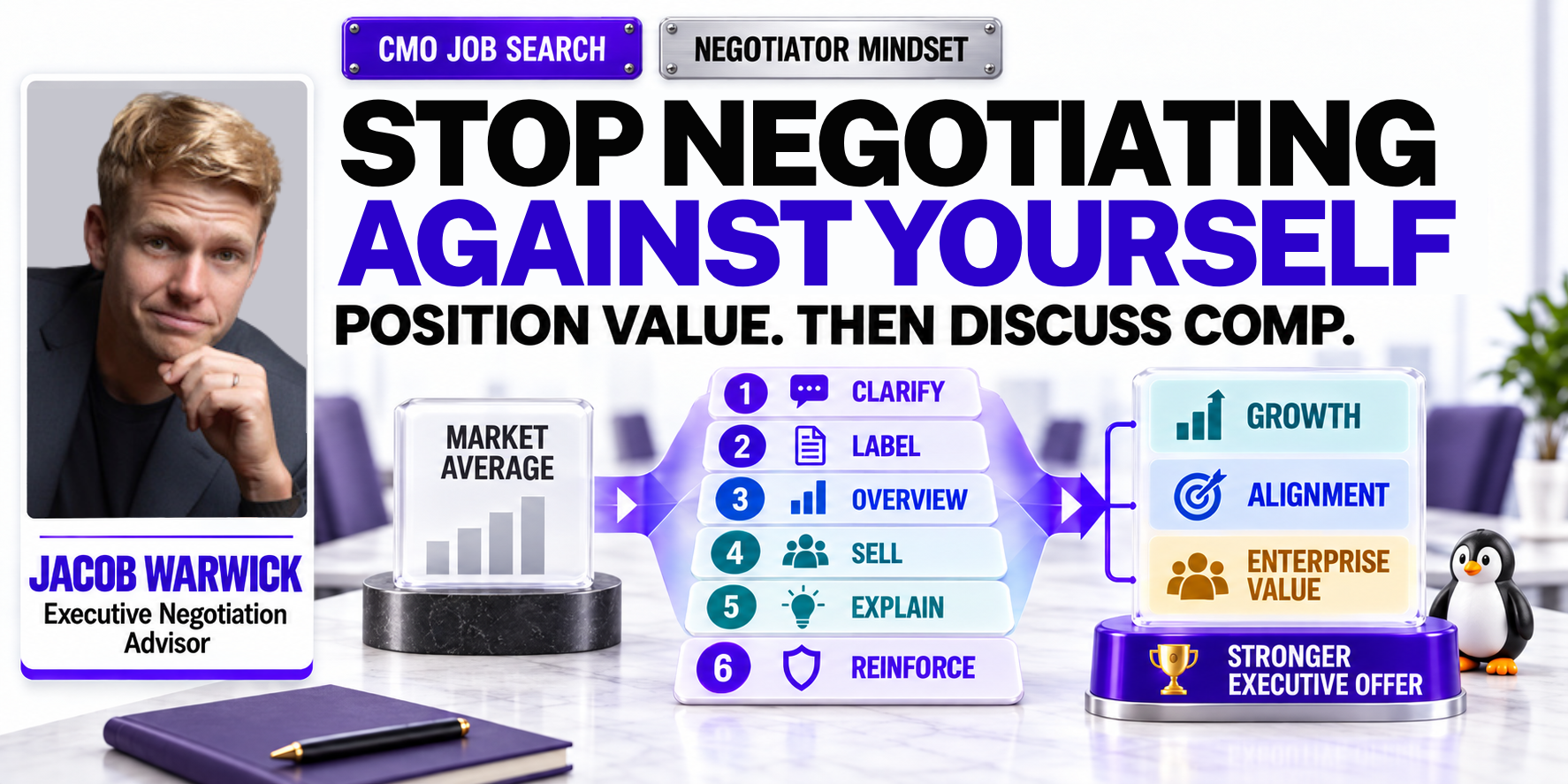
CMOs often cap their own compensation by treating industry benchmarks as fixed limits. Executive negotiation advisor Jacob Warwick recommends a different approach: uncover the company’s highest-value problem, position yourself as the unusually qualified solution, and use his CLOSER framework to make the desired business outcome tangible before discussing tactics or pay.
Many CMOs walk into compensation discussions having already decided what they are worth. They research industry benchmarks, adjust for company size, and settle on a number that feels ambitious but defensible. If the average base salary for the role is $350,000, they assume the conversation should begin and end somewhere near $350,000.
According to Jacob, that is precisely the problem. “They tend to negotiate against themselves a lot more than they need to,” he told me, because they “limit their own opportunities preemptively.” By accepting a benchmark as a boundary, CMOs turn themselves into commodities before the negotiation even begins.
Benchmarks should inform the conversation without determining the outcome. Jacob’s alternative is a bolder negotiator mindset supported by a repeatable framework for discovering and communicating the value a CMO can create.
Jacob’s perspective comes partly from seeing how executives in other functions approach compensation. After spending more time with product leaders, he noticed that “they ask almost the exact same questions as everyone in the CMO communities does, except their questions start at like two and a half million dollars a year.” Many were less experienced than the marketers he advised, but they approached the market with dramatically different assumptions about their potential value.
The specific examples are startling. Jacob described directors of product earning more than $1 million and sometimes more than $2 million annually, including a director at one major frontier-model company earning $4.5 million and a senior manager at another earning $3.5 million.
I challenged him on those figures because they sounded beyond exceptional. Surely these companies had identified rare individuals for unusually valuable roles. Jacob’s reply shifted the emphasis from inherent rarity to deliberate positioning: “The person did a very good job of positioning as a unicorn.”
These executives did not discover their value by consulting an industry salary survey. They uncovered the business problem, connected themselves to an unusually valuable outcome, and negotiated from there.
Jacob is not suggesting that every CMO can demand seven figures and expect an offer by Friday. He is arguing that CMOs should stop treating compensation structures as inviolable laws of nature.
Early-stage companies and sophisticated enterprises offer different opportunities. At startups, “none of the rules are written,” which creates room to negotiate equity, scope, incentives, and other terms even when cash is limited. At large companies, the rules may seem fixed, but Jacob regularly sees exceptions made for candidates viewed as uniquely valuable.
That requires asking for terms most candidates would never consider. As Jacob put it, “You have to ask unusual things if you expect to be compensated unusually,” and “you should never be so sure of your worth that you wouldn’t accept more.”
When candidates enter the room declaring, “I’m worth X,” they reduce the discussion to a market comparison. The employer almost always has more compensation data and greater negotiating experience, so Jacob advises candidates to enter with a different assumption: the outcome has not yet been determined. “If you think the outcome is predetermined, or you think the outcome is not predetermined, you’re right,” he said, because that belief shapes the questions you ask, the opportunities you uncover, and the value you learn to articulate.
The path to better compensation does not begin with asking for more money. It begins with understanding why the company needs this CMO.
A company that has been operating for a decade may have employed four or five previous marketing leaders. Each one left behind expectations, disappointments, and lessons, creating an opportunity to “learn from the failures of those CMOs” and position yourself as the leader who will not repeat them. Jacob recommends asking, “What are the things that you really loved about them, and what did you despise?”
The answers reveal where the bodies are buried. If prior CMOs struggled to connect marketing investments to revenue, demonstrate how you have built credibility with finance. If they could not align sales and marketing, uncover what broke down and show how you approached that relationship differently.
CMOs should be especially curious when meeting with the CFO. Jacob recommends acknowledging that finance and marketing often have a contentious relationship, then asking what marketing teams have done in the past that drove the CFO nuts. Once the CFO describes the pain, the candidate can become the antidote by responding with empathy instead of a rehearsed defense of marketing; as Jacob observed, “Logic and credibility gets you in the room, but it doesn’t keep you there.”
Jacob also challenged marketers to break out of their functional echo chamber. Marketing leaders often complain that CEOs, CFOs, and boards don't understand the value of marketing, but Jacob believes “we have to take ownership of communicating what value we bring to the table.” Otherwise, “that mentality keeps us small” and makes it easier for other functions to absorb marketing’s responsibilities.
Great CMOs do far more than run campaigns. They help the company understand its market, sharpen its positioning, improve its offering, align the go-to-market organization, and solve growth problems that cross functional boundaries. Candidates who present themselves narrowly as marketing operators make it easier for employers to compare them with every other qualified marketing operator, while candidates who connect themselves to a high-value business problem change the basis of comparison.
During our conversation, I pushed back on the idea that marketing results depend entirely on the CMO. Product readiness, market conditions, sales execution, and corporate strategy can all elevate or undermine marketing performance. Jacob acknowledged the risk but held his ground: “You have to take on unusual risk to get unusual comp,” and a candidate who is unwilling to become “the tall poppy” should not expect an exceptional package.
To help executives structure these conversations, Jacob uses the CLOSER framework. It can guide discussions with recruiters, CEOs, CFOs, board members, and investors.
Start by clarifying why you are in the room. Ask what excites the interviewer about your background or which experiences made them want to meet you. Their answer reveals the value they already associate with you and gives you something meaningful to develop.
Identify the problem as you currently understand it, then invite correction. You might say, “It sounds like the company needs to improve pipeline predictability while repositioning itself in a changing market. What am I missing?” This demonstrates that you have listened without pretending you already know everything.
Summarize what you have learned from the recruiter, leadership team, and other stakeholders. Review what the company has already tried, where alignment exists, and where different executives may be seeing the problem differently. The goal is to establish a shared understanding before presenting yourself as the solution.
Jacob’s most memorable phrase is “sell the vacation.” Rather than immediately explaining every campaign, hire, or element of a 30-60-90-day plan, help the executive envision the desired business outcome.
His analogy is literal. If someone wants to visit Hawaii, don't start by debating trains, boats, and connecting flights. Start with the experience they want to have when they arrive, then work backward to the route and resources.
This shift can also reset the compensation discussion. Jacob explained that if the CMO can help increase ARR by $100 million and add far more to the company’s value, “paying you 500 grand is not that hard.” Compensation looks different when it is evaluated against the value of the outcome rather than the median salary for the title.
For a board member, selling the vacation could mean imagining a meeting six months from now in which the growth story is credible, marketing and sales are aligned, and the executive who advocated for hiring you can enter the room with confidence. Jacob uses “we” language to help the decision-maker picture the candidate inside that successful future rather than drowning the conversation in tactical details that may change within weeks.
Only after establishing the problem and desired outcome should you explain your credentials, plan, and approach. Jacob believes most candidates begin here, before they have enough context to know which parts of their experience matter. In his words, “If you start with explaining, you don’t have any context to do a good job.”
Close by reinforcing the positive outcomes, areas of alignment, and momentum developed during the conversation. Help everyone leave with a shared picture of the problem, the destination, and why you are unusually well suited to help the company get there.
Although this advice is especially valuable for CMOs pursuing their next role, the negotiator mindset does not become irrelevant after the employment agreement is signed. CMOs negotiate continuously for budget, headcount, strategic priorities, organizational support, and realistic expectations.
Jacob noted that CMOs are among the few executives who retain him for ongoing support “because they have to do so many damn negotiations internally all the time.” The same CLOSER framework applies: clarify why the conversation matters, label the problem, establish a common understanding, make the business outcome tangible, explain the investment, and reinforce the shared value.
The goal is not to become more aggressive. It is to become more curious, more empathetic, and more effective at connecting your leadership to outcomes the business values.
Jacob Warwick will join us at the CMO Super Huddle on October 23 to help B2B marketing leaders stop negotiating against themselves. Given how often CMOs must negotiate their value, resources, and mandate, this conversation could pay for the entire trip.
Many CMOs research average compensation for a company’s size and treat that benchmark as the maximum the market will bear. Jacob Warwick argues that this turns an executive into a commodity before the company and candidate have established the value the role could create.
Start by understanding the business problem, the shortcomings of previous marketing leaders, and the outcome the executive team values most. Then position your experience against that pain and negotiate compensation in relation to the business value you can help create, not only the median salary for the title.
CLOSER stands for Clarify, Label, Overview, Sell the Vacation, Explain, and Reinforce. The framework helps candidates understand why they are in the room, define the problem, align on context, make the desired outcome tangible, address concerns, and reinforce momentum.
It means helping the decision-maker envision the successful business outcome before diving into tactical details. Just as a traveler first imagines the experience of the destination, an executive should be able to picture what success with the candidate will feel like and accomplish.
Yes. CMOs continue negotiating for budget, headcount, priorities, organizational support, and realistic expectations. The same framework can help align internal stakeholders around a shared problem, outcome, and investment.
Join Jacob Warwick and fellow B2B marketing leaders at the 2026 CMO Super Huddle, October 22–23 in Palo Alto. Sharpen your approach to communicating your value, learn from your peers, and leave with ideas you can put to work. Explore the agenda and reserve your spot.