
Back to Blogs
A useful AI pilot should help you make a decision about how work gets done. This article pairs three marketing leaders’ experiences with practical exercises for defining a workflow, evaluating a test, and preparing a result that another team can assess.
The AI demo gets applause. Then Monday arrives, someone has to use the thing, and the team discovers that nobody agreed on what happens when its answer is wrong. An impressive prototype has acquired a rather ordinary management problem.
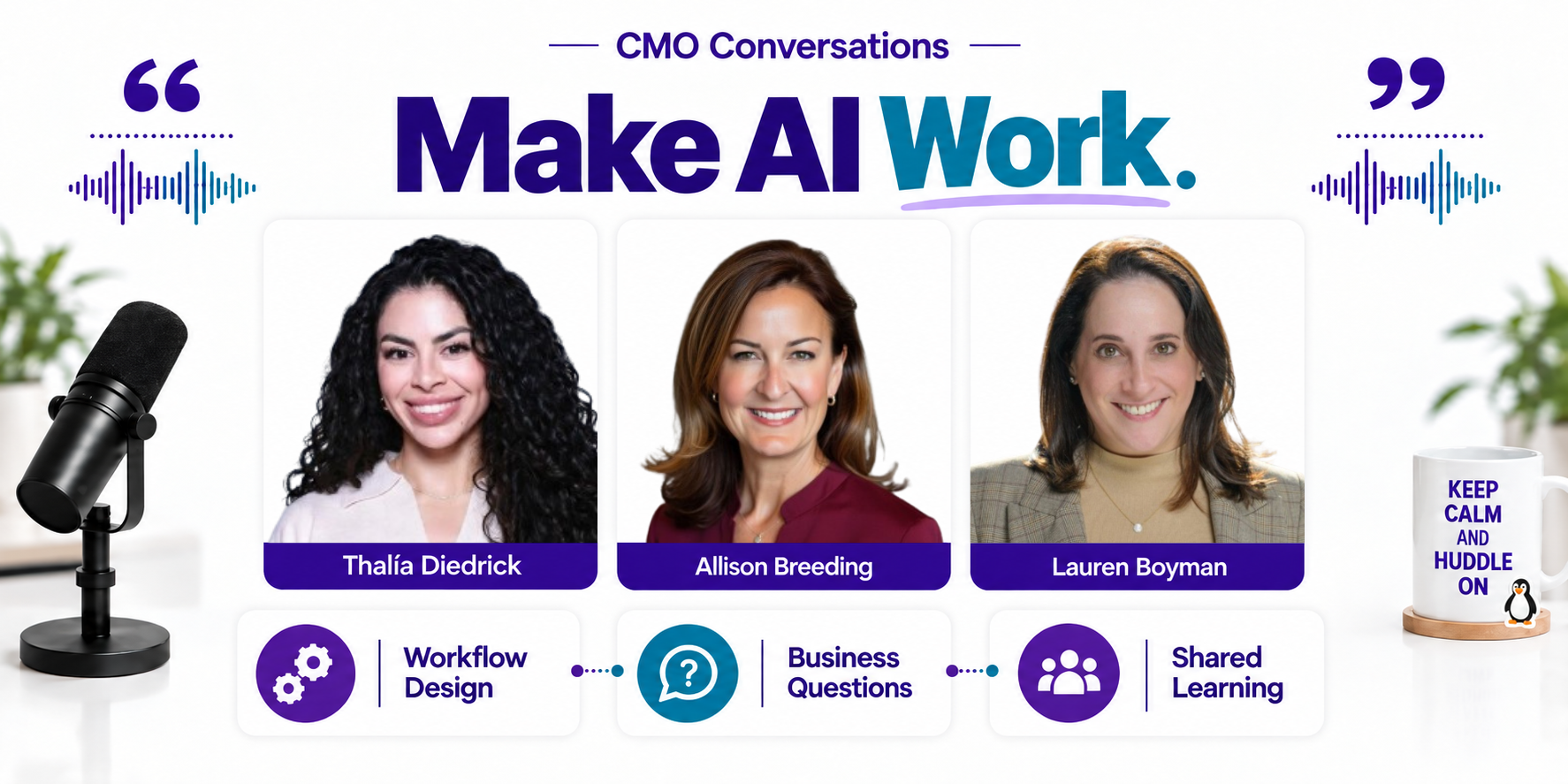
In CMO Huddles conversation, Thalía Diedrick of GoTu, Allison Breeding of Direct Travel, and Lauren Boyman of KPMG discussed their approaches. Their experiences offer three starting points for a CMO planning the next experiment.
Diedrick described Sprint, GoTu’s custom AI project manager, which follows up on tasks and receives context from colleagues. As she put it, “So the real shift wasn't even the tool, it was changing how we interact with technology.”
A practical way to apply that lesson is to write the job description for a proposed workflow before choosing how to build it. List the information it receives, the work it produces, and the decisions a person must retain. Add a concrete example of a request it should decline or send for review.
For a campaign-status assistant, that might mean summarizing confirmed updates while leaving any change to a launch date with the campaign owner. Test what happens when a meeting note and the project tracker disagree. The interesting result is whether the assistant identifies the conflict and gets it to the right person.
Try the same exercise with a colleague who wasn’t involved in the design. If they can’t tell where the assistant’s responsibility ends, the brief needs another pass.
Breeding described business-focused hackathons and a central role for revenue operations in vetting ideas. Her approach pairs team experimentation with a place to evaluate proposals.
To apply that in a workshop, give each group the same short submission format: the problem, the intended user, the current process, and the result that would justify another test. Require a demonstration using an ordinary task and a deliberately awkward one.
Imagine a proposal to help field marketers find approved materials. Test whether someone can locate the right asset for a specific audience, region, and campaign. Include an outdated version in the test set to see whether the system selects it or explains why it shouldn’t.
Then ask the marketer to complete the task without coaching from the builder. A successful demo is more convincing when its creator doesn’t have to narrate around the potholes.
Boyman described marketing as an internal proving ground for KPMG’s client work. She also highlighted enabling routine creative production within brand guidelines.
For your own pilot, prepare a one-page decision note that another department could evaluate. Explain what changed, show a sample of the output, and identify what still needed correction. Record the conditions under which you tested it so readers can judge whether their own situation is comparable.
Suppose a regional team can now produce an approved event graphic without submitting a routine request. The decision note should show whether the final graphic met the brief, how much review it required, and which exceptions still went to a designer. That gives the next team something firmer than a claim that everyone is moving faster.
Invite a colleague from outside marketing to challenge the result. If their use case exposes a missing requirement, add it to the next test before describing the workflow as ready for wider use.
For the next pilot review, ask for one of three recommendations: expand the test, revise it, or stop. Attach the evidence, an owner, and a review date to whichever recommendation you choose.
That creates a useful assignment for the CMO: keep the business question visible while the team works through the details. The next impressive demo will still be welcome. It will also have to explain what changed for the person doing the job.
Pick a bounded task with an identifiable user and an output you can inspect. Define a successful result before the pilot begins, and include someone who regularly performs the task in the evaluation.
Show a normal task, a difficult case, and what happens when the system lacks enough information. Have a person outside the build team try it so the demonstration doesn’t depend on expert coaching.
Provide the business question, test conditions, sample outputs, required corrections, and unresolved limits. Invite the receiving team to assess whether the workflow fits its own requirements before extending the pilot.
Agree on stop criteria before starting. If the output repeatedly fails an essential requirement or the review burden outweighs its usefulness, document what you learned and decide whether a different approach deserves a test.
Roles as introduced in the episode: Thalía Diedrick, VP of Marketing at GoTu; Allison Breeding, CMO of Direct Travel; Lauren Boyman, CMO of KPMG Americas.
For the leaders’ full perspectives, listen to the conversation on Renegade Marketers Unite.