
Back to Blogs
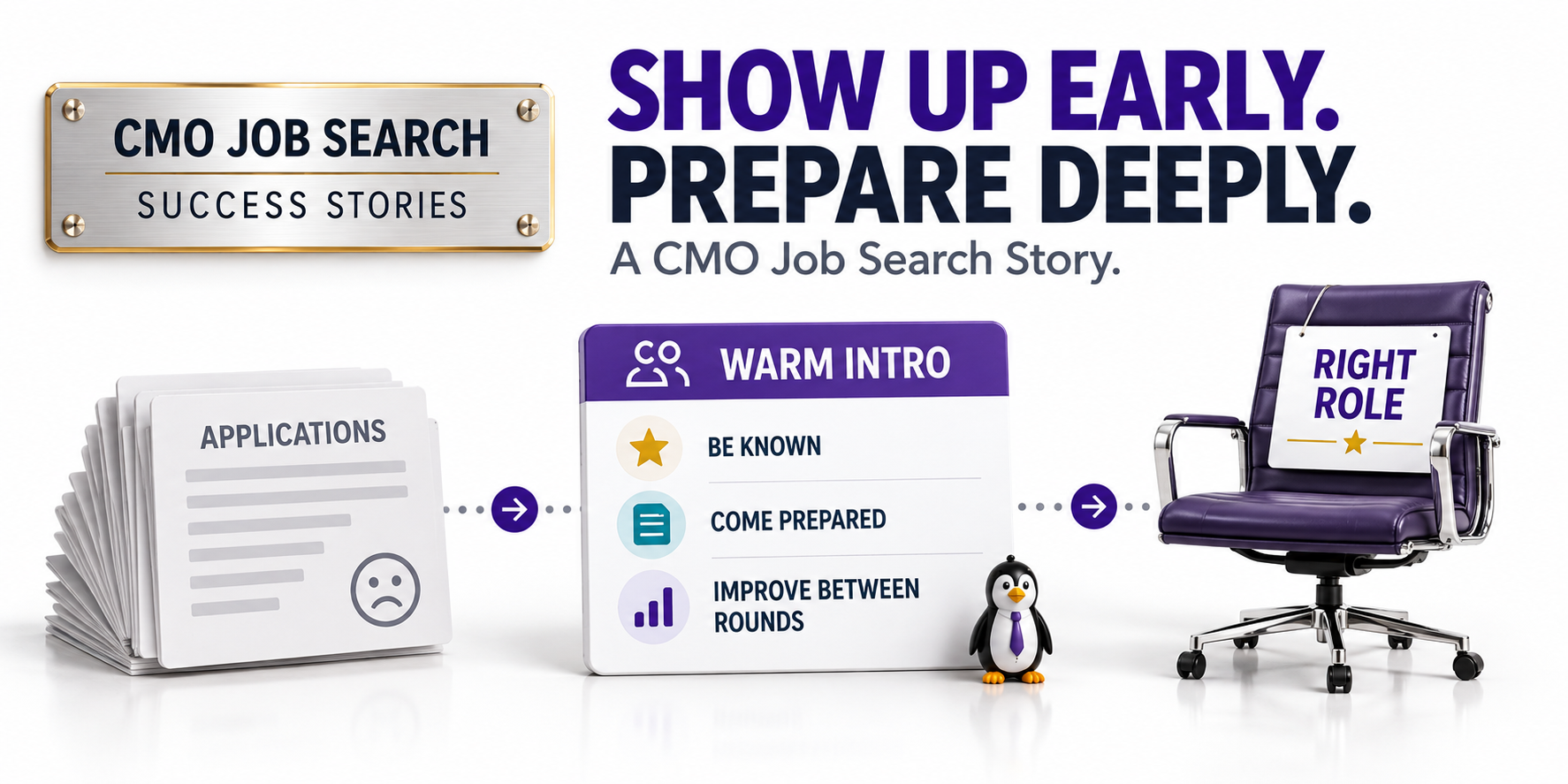
After reaching the final round seven times, one senior marketing leader changed how she approached the search. The role she ultimately accepted came through a trusted community introduction, but the process worked because she arrived prepared with hypotheses, proof points, tailored follow-up, and a stronger way to improve between interviews.
One Huddler's opportunity that finally landed came from a place many CMOs know they should invest in, but often struggle to use well: community. A fellow marketing leader in the fitness technology world knew the founders of a company, recognized the possible fit, and made the introduction.
That introduction mattered because the candidate had already spent months becoming visible in the right rooms. She focused her time on a few communities where she could show up consistently, including CMO Huddles, Pavilion, and CMO Coffee Talk, then used those rooms to contribute what she was learning instead of only asking for help.
Role landed: Senior marketing leadership role
Networking was part of the story, but the useful lesson was more specific than "go network." The Huddler identified the communities where senior marketing leaders were already sharing opportunities and advice, then made sure people knew what she was looking for and what she could contribute.
She showed up for Huddles, calls, events, and in-person gatherings. When she learned something useful about AI, LinkedIn branding, or the job-search process, she shared it so people could associate her with practical value before a role ever appeared.
Her point was simple: people are willing to help, but they need enough context to connect you with the right opportunity. When an opening crosses someone's desk, you want them to think, "that sounds like her."
Once the warm introduction happened, preparation became the differentiator. From the first conversation, she showed that she had already studied the company, understood that two businesses had merged, saw that a new product had launched, and had early hypotheses about what marketing needed to solve.
The Huddler brought a short deck, only five or six slides, built with AI on purpose. The deck gave her a way to show proof points, assumptions, and an initial view of how she would approach the role.
For CMOs, that kind of preparation is increasingly important. Companies want to know what you have done, but they also want to see how quickly you can make sense of their business, especially when the market is moving fast and AI is changing how go-to-market teams operate.
A strong candidate does not need perfect information from the outside. A strong candidate shows how they think, names their assumptions, and invites the company into a better conversation.
Her follow-up process was fast and specific. Within about five hours of each conversation, she sent a note that pulled out one or two things that stood out, reinforced what she was excited about, and connected the conversation to next steps.
Granola helped because it captured the discussion while she stayed present in the interview. Afterward, she could review the notes, identify the strongest moments, and avoid the generic follow-up emails that sound polite but forgettable.
The process was simple enough to repeat after every interview:
The biggest change came after several near-misses. She had reached the final round repeatedly, and instead of assuming the market was the only problem, she started looking closely at how she was showing up.
She used ChatGPT to review transcripts and score interviews. If the feedback said an example was weak, she asked why. If it pointed out that she missed the numbers, she made reminders before the next call. If it said she rambled, she practiced landing the plane faster.
She also recorded herself and reviewed the recordings in three passes:
The goal was never to become over-rehearsed. It was to make the strongest version of her story easier to access under pressure.
When Drew asked what changed between the roles she nearly landed and the role she accepted, she pointed to mindset. After the fifth near-miss, she stopped approaching every conversation from a place of chasing and started treating the search as a process where she also had choices to make.
That shift affected how she interviewed. She still prepared, still cared, and still wanted the role, but she was no longer trying to win approval from every company in the market.
For senior leaders, that matters because confidence is visible. It shows up in how you answer questions, how you frame tradeoffs, how you tell your story, and how you evaluate whether the company is right for you.
This story has plenty of modern job-search tactics, from AI-assisted decks to transcript-based interview coaching. The deeper lesson is that the tactics worked because they were part of a disciplined system.
Looking back, she said she would do three things differently if she were starting again:
That is useful advice for any CMO in transition. The next role may come through a community, a recruiter, a board connection, or a former colleague, but the work starts earlier. Be known, be prepared, and keep improving after every conversation.
CMOs can earn more warm introductions by showing up consistently in the right executive communities, sharing useful insights, being clear about what they are looking for, and helping others before making asks. The goal is to be known for specific value so people can connect you to the right opportunity when it appears.
A CMO should prepare a clear career story, relevant proof points, thoughtful hypotheses about the business, and a point of view on how they would approach the role. For senior roles, companies want to see how the candidate thinks, how quickly they learn, and how they connect marketing priorities to business needs.
AI can help analyze interview transcripts, summarize key moments, flag rambling or weak examples, identify missing metrics, and suggest stronger answer structures. It is most useful as a feedback tool after real conversations, because it can reveal patterns the candidate may miss in the moment.
Mindset affects how candidates show up in interviews, peer conversations, and follow-up. A long search can make rejection feel personal, so CMOs need practical support, repeatable preparation, and a way to separate each outcome from their professional worth.