
Back to Blogs
Drew Neisser is the founder of CMO Huddles and a globally recognized authority on B2B marketing. He’s an AdAge columnist, LinkedIn TopVoice, leading CMO coach, podcast host & friend of penguins everywhere.
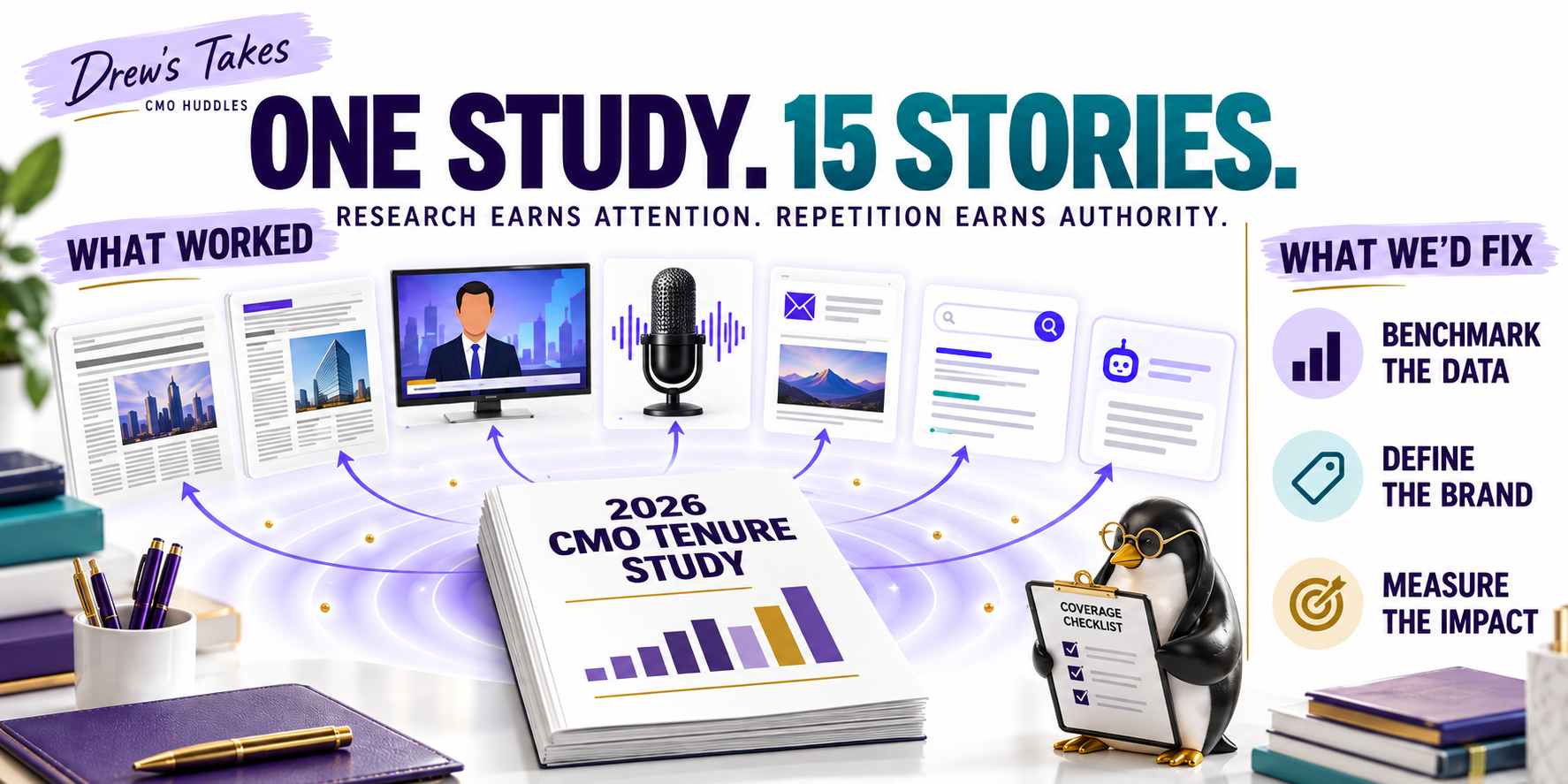
Original research can generate earned media, strengthen community value, and improve visibility in AI answers, but only when the topic matters and execution is disciplined. Here is how CMO Huddles, Findem, and Bospar turned a CMO tenure study into roughly 15 stories, plus the launch lessons we will apply next year to make it stronger.
Original research still works. In fact, it may be more valuable than ever because a strong study can serve your community, generate earned media, anchor months of content, and give AI engines credible third-party sources to reference.
The catch is that the research must be genuinely useful. Random surveys designed solely to manufacture headlines usually smell like random surveys designed solely to manufacture headlines.
Research is an authority asset.
Our recently released 2026 CMO Tenure Study, created with Findem, is a case study in progress. The study has already generated roughly 15 tracked articles and placements, including coverage from Ad Age, Digiday, MediaPost, Marketing Dive, Destination CRM, Bizcommunity, and several specialist marketing outlets. It also produced invitations to contribute articles, appear on podcasts, and speak with potential partners.
Plenty went right. We also left several opportunities on the table.
We began with a question our community asks constantly: Why do CMOs seem to have so little time to make an impact?
CMO Huddles and Findem worked together to identify the questions and data points that would be most valuable to marketing leaders. Findem then mined its massive people-data platform, identified the most revealing patterns, and charted the key findings across historical tenure cohorts and more than 13,000 current CMOs at U.S. companies with at least 100 employees.
Findem supplied far more than a database. Its team helped determine which cuts of the data were meaningful, feasible, and likely to illuminate the realities facing CMOs. I then wrote the study using Findem’s data, analysis, and charts, translating the findings into a larger story about CMO careers, role design, ownership structure, and organizational expectations.
The audience validation came on launch day. We revealed the findings during a September 29 Expert Huddle, where attendance was strong and the discussion was lively. We also shared a recap with our community, prompting numerous responses that described the information as helpful, fascinating, and highly relevant.
That reaction confirmed that the research had succeeded at its first job: creating value for the CMOs we serve.
Our media campaign began roughly two weeks before the public launch. CMO Huddles and Bospar, our San Francisco-based PR agency, worked closely together on the release, positioning, and pitch strategy. Bospar then contacted selected reporters under embargo, giving them time to examine the methodology, interview sources, compare our findings with other tenure studies, and develop their own angles.
On September 29, we officially announced the research during our Expert Huddle and distributed the press release. Coordinating the webinar and release gave the launch a clear moment while allowing embargoed reporters to prepare more substantive coverage.
Bospar handled most of the direct media outreach beyond the wire distribution. Its relationships helped the research rise above inboxes overflowing with generic and increasingly AI-generated pitches.
Distribution creates availability. Relationships create coverage.
We also distributed the release through EIN Presswire using a special three-release package. The service generated broad pickup across local news sites, industry feeds, aggregators, research databases, and platforms including AP News and the Nexstar network.
The economics were attractive. EIN currently lists a single release at $149, with bulk packages reducing the per-release price further. By comparison, Business Wire currently lists a starting price of $475 for a 400-word release with local U.S. distribution; broader circuits, additional words, and multimedia can increase that cost.
That does not make the services interchangeable. Business Wire offers reach, infrastructure, and editorial support that may justify the premium for certain announcements. For our purposes, EIN gave us broad distribution at a reasonable cost, while Bospar’s direct outreach generated much of the meaningful editorial coverage.
A newswire can expand the footprint of a story, but it cannot replace a strong angle, credible data, or trusted media relationships.
The PR payoff now extends beyond immediate readership and referral traffic. AI engines frequently rely on authoritative third-party sources when constructing answers, making earned media part of a brand’s long-term information footprint.
Muck Rack analyzed more than one million links cited by ChatGPT, Claude, Gemini, and Perplexity between July and December 2025. About 25% came from journalistic sources, while press releases accounted for roughly 1%. The exact mix will keep changing, but the direction is clear: credible editorial coverage can influence how AI systems understand a company, topic, or executive.
This is another reason original research compounds. A proprietary study gives reporters something worth covering, creates independent validation, earns links, and establishes facts that may continue surfacing in traditional search and AI-generated answers.
Several reporters compared our findings with research from Spencer Stuart and Forrester. That was completely reasonable. We had debated whether to include those comparisons in our report and decided against it.
In retrospect, that was a mistake.
Spencer Stuart’s 2026 study examined 346 named CMOs at S&P 500 companies and reported an average tenure of 4.1 years. Our research included more than 13,000 current CMOs at companies with at least 100 employees, along with a separate historical cohort analysis. We also reported medians in several places, while Spencer Stuart reported averages.
Those numbers answer different questions about very different populations. They are not necessarily contradictory, but we should have explained the distinctions ourselves. MediaPost and Marketing Dive did a fair job of adding this context, but we made reporters do work that should have been included in our materials.
Forrester’s research covered the Fortune 500 and examined the changing prevalence and influence of the CMO title. Again, that universe and research question differed from ours. A simple comparison chart covering sample, company universe, methodology, time period, and use of averages versus medians would have prevented confusion and made every story stronger.
CMO Huddles is relatively new to receiving this level of media attention. Unfortunately, we neglected to give reporters a simple, consistent explanation of what the organization is.
The results were instructive. Digiday called CMO Huddles a “networking platform.” Ad Age described us as a “community group.” Destination CRM called us “a peer community for marketing leaders,” while Marketing Dive came closest with “a peer community focused on B2B marketers.”
Some descriptions were reasonably accurate. Others missed important parts of the story. None of this was the reporters’ fault. We left a blank, and they filled it.
This is PR 101, and all of us missed it.
Every research-launch package should include approved one-sentence and paragraph-length descriptions of every participating organization. The language should explain what the company is, who it serves, and why it has standing to speak about the subject.
For future releases, ours might read: “CMO Huddles is the #1 community for B2B marketing leaders.”
This language should appear in the report, press release, media pitch, methodology page, spokesperson briefing, and downloadable press materials. Consistency also matters beyond the immediate coverage because those descriptions may eventually influence how search engines and AI platforms understand the organization.
If you do not define your company, the market will happily do it for you.
Next time, we will provide more than a report and press release. The supporting package should include:
This preparation should begin while the research questions are being developed. Waiting until the report is finished limits the angles reporters can pursue and the additional data the research partner can provide.
At last count, the research had generated roughly 15 tracked articles and placements. The story has now moved into broadcast media as well. Business journalist Jane King, founder and CEO of LilaMax Media and well known for her daily reports from the New York Stock Exchange, covered the study in one of her syndicated business segments. Thus far, we know that Good Day Lubbock has aired the report, and additional station pickups may follow.
That is an important reminder that research coverage can continue expanding after launch week. A strong data point can travel from a report to a press release, trade publication, podcast, newsletter, television segment, AI answer, and future article. Each new format gives the research another opportunity to reach an audience that would never download the original study.
It is too early to calculate the full business impact of this launch. We have seen encouraging signals: podcast invitations, an opportunity to contribute a bylined article to the ANA, increased partner interest, strong community participation, and now a syndicated television report from Jane King and LilaMax Media.
We still need to monitor referral traffic, branded search, report downloads, community inquiries, backlinks, newsletter growth, additional station pickups, and whether CMO Huddles appears more frequently and accurately in relevant AI answers. Even then, attribution will be imperfect. A prospect may encounter an article, see the television segment, find the study referenced elsewhere, ask an AI assistant about CMO tenure, and visit our site weeks later.
The goal is contribution, not attribution theater.
For the next study, we should establish traffic and AI-visibility baselines before launch. We can then track a fixed set of questions across AI platforms, monitor which sources they cite, and examine whether our core findings and company descriptions become more accurate over time.
The most exciting part of this project may be what happens after the initial coverage cycle. We now have credible baseline data, an established methodology, media awareness, and a community eager to understand how the CMO role is changing.
A 2027 edition will let us measure change against a benchmark we established ourselves. Instead of introducing an isolated collection of statistics, we can report whether tenure is rising or falling, whether hiring patterns are shifting, and whether the differences among public, private equity-backed, and venture-backed companies are widening.
We can also deepen the story with questions uncovered during this first study. With 60% of the CMOs appointed in 2026 serving in the role for the first time, we would love to know whether first-time CMOs have shorter or longer tenures than executives who have already held the title two or three times.
Other promising questions include:
Some of these questions may exceed what the available data can answer. They still provide a roadmap for deeper analysis, qualitative interviews, and complementary research.
This is where proprietary research begins to compound. The first study establishes the baseline. Each successive edition adds historical context, better questions, stronger media relationships, and greater authority.
When one research project leaves you with more valuable questions than you started with, you may have created something worth owning.
For CMOs considering proprietary research, I would recommend three actions:
Our tenure study succeeded because the question mattered, the data was substantial, Findem was a strong research partner, and Bospar knew how to turn the findings into a media story. It can succeed again at a higher level because we now know where the launch could have been sharper.
Good research earns attention. Repeated good research earns authority.
One strong annual benchmark is a practical starting point because it creates a baseline and allows year-over-year comparisons. Companies with sufficient data, editorial resources, and audience demand may build toward one meaningful study per quarter. Quality and repeatability matter more than volume.
Bring communications and PR into the process while research questions are still being developed. Early involvement helps identify newsworthy cuts, methodology questions, competitive benchmarks, visuals, and follow-up data reporters may request.
No. A wire service can broaden distribution, improve availability, and create a searchable record. Substantive earned coverage usually requires a strong story, relevant targeting, responsive experts, and trusted relationships with reporters.
Establish a fixed set of relevant buyer and category questions before launch, record how major AI platforms answer them and which sources they cite, and repeat the exercise after coverage appears. Treat changes as evidence of contribution rather than perfect attribution because AI answers and citation behavior change frequently.