
Back to Blogs
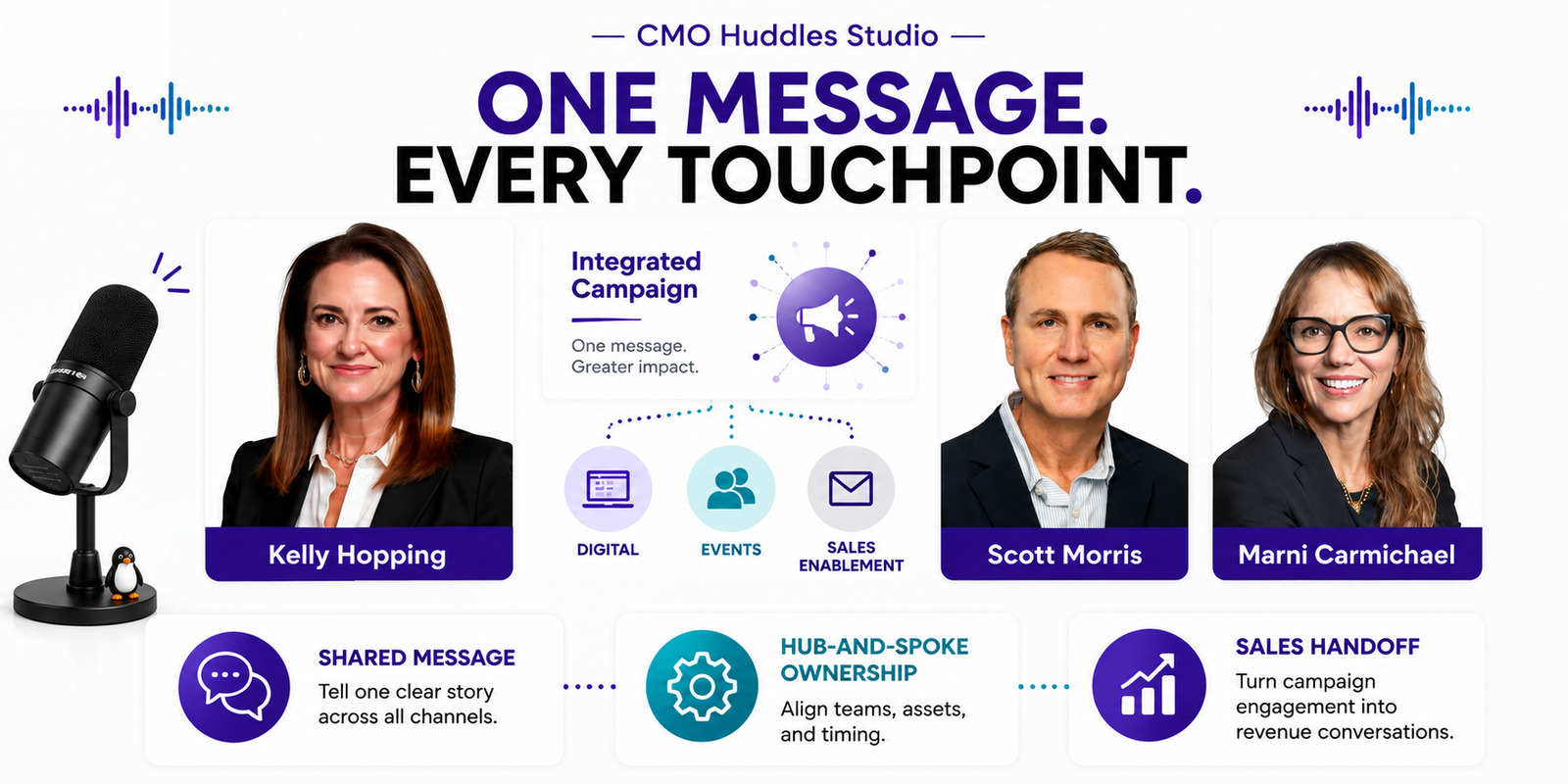
Integrated B2B campaigns make one strategic message recognizable across brand, demand, sales, partners, and customer touchpoints. Kelly Hopping, Scott Morris, and Marni Carmichael explain how company goals, hub-and-spoke ownership, quarterly planning, seller enablement, clear handoffs, and connected measurement help teams adapt the story for different audiences without allowing channels or functions to pull it apart.
An integrated campaign is not a collection of coordinated launch dates. It is a business priority expressed through one recognizable idea, adapted for different audiences and carried through every relevant interaction.
That requires a clear connection between company strategy, campaign strategy, and channel execution. Kelly Hopping, then CMO of Demandbase, described that hierarchy:
“Everything should ladder down. If you know who you are as a company, your value proposition, your differentiation. Then when you build out your messaging hierarchy, it applies on the product and campaign side.”
This foundation gives teams room to adapt without fragmenting the story. A finance leader, technical evaluator, and end user may need different proof, language, and calls to action. Those variations can still reinforce the same central message and differentiated value.
Without that hierarchy, each function fills the gap independently. Brand develops one narrative, demand generation optimizes another, product marketing emphasizes features, and sellers create their own version. Every piece may be professionally executed while the buyer receives no coherent reason to believe.
Integration is difficult when every channel owns its execution but no one owns the whole campaign. A hub-and-spoke model can solve that problem by giving a central team responsibility for the campaign strategy while channel specialists shape how it comes to life.
Scott Morris, then CMO of Sprout Social, explained:
“I'm a big believer in the hub and spoke model. You can build out a dedicated campaign team that can really own the campaigns, both strategically and in terms of how you execute and operate.”
The hub does not need to produce every asset. Its job is to protect the campaign’s business objective, audience, message, sequence, and measurement. The spokes bring expertise in content, paid media, communications, events, web, lifecycle marketing, field marketing, and sales enablement.
This structure creates an accountable center without reducing channel experts to order takers. It also gives the organization a place to resolve conflicts. When one team wants more product detail and another wants a broader brand story, the campaign strategy provides the basis for the decision.
Ownership becomes especially important when a campaign is expected to serve both brand and demand. Scott observed that many integrated campaigns begin with pipeline because that is the most immediate and measurable objective. Once the operating motion is established, brand channels such as PR, social, and thought leadership can extend the same idea.
He put the relationship plainly: “A really great campaign delivers on both.” The balance depends partly on the KPIs attached to the work. If every measure concerns immediate pipeline, the campaign will naturally become demand-heavy. Including awareness, engagement, and perception measures gives the team permission to build future demand while capturing current interest.
Quarterly planning can create enough lead time to coordinate the message, creative, audience, channels, sales preparation, and measurement. The goal is not to lock every detail months in advance. It is to make the major decisions early enough that teams are not discovering dependencies after launch.
A useful campaign brief can establish:
This brief becomes a working agreement rather than a document marketing completes and distributes. Product, sales, communications, customer teams, and channel owners can identify gaps while there is still time to correct them.
Marni Carmichael, then CMO of ImageSource, described how the FreeMove campaign was divided by quarter, creative, vertical audience, and execution. Existing content performance, RFP participation, customer evidence, SEO input, and sales feedback all informed the work.
Some early creative was discarded after more contributors entered the process. That was not wasted integration. It prevented a weaker interpretation from reaching the market and allowed the campaign to benefit from expertise beyond the initial team.
Sales enablement is not a final distribution step. Sellers and SDRs need to understand the campaign’s premise, recognize the signals it generates, and know what to do when a buyer engages.
Marni explained how the operating connection worked:
“We're integrating sales enablement and the BDR teams in the campaign strategy. We can see who's interacting with touch points and have trigger points at which we roll that to an SDR to contact.”
This approach turns the campaign into a coordinated buyer experience. Marketing creates awareness and engagement, the data identifies meaningful behavior, and sales follows with context that continues the same conversation.
Clear handoff rules can define which behaviors trigger outreach, how quickly follow-up occurs, what information accompanies the lead, and which message the seller continues. Without those agreements, campaign interest can sit untouched or receive a generic response that breaks the narrative.
Seller feedback also improves the campaign. Marni’s team collected observations from account executives about what resonated in buyer conversations and used them to sharpen the message. Integration therefore continued after launch instead of ending when the assets went live.
Customer evidence can make an integrated campaign more credible and more useful. A customer story may support PR, sales conversations, webinars, social content, events, and late-stage validation while reinforcing the same campaign message.
Partners can extend reach and add authority when their role is natural to the buyer’s problem. Bringing them into planning early makes it possible to align language, timing, offers, and responsibilities. Adding them after the campaign is built often produces a disconnected co-marketing asset rather than a stronger buyer experience.
The same principle applies internally. Kelly’s approach connected company and pipeline goals to campaign themes, partner opportunities, channels, and enablement. Integration became a shared operating system, not a request for several teams to promote the same asset.
No single metric can explain an integrated campaign. Awareness, engagement, lead progression, sales activity, opportunity creation, deal movement, and revenue may appear at different stages and on different timelines.
A connected measurement model can include:
The purpose is not to claim credit for every interaction. It is to determine whether the campaign is creating a recognizable journey and helping the business move the intended audience toward action.
Reviewing these measures together also prevents channels from optimizing against one another. A paid program may introduce the idea, thought leadership may deepen it, an event may create conversation, and sales may convert the opportunity. The value lies in the sequence, not in forcing one touchpoint to win the attribution contest.
An integrated campaign carries one strategic idea across the relevant buyer journey. Channel execution, sales enablement, partner participation, handoffs, and measurement reinforce the same objective instead of operating as separate promotions.
Not necessarily. The organization does need clear ownership of the complete campaign. A dedicated hub can provide that ownership, while smaller teams may assign the role to a campaign lead supported by channel specialists.
The central idea remains consistent while the context, proof, language, and call to action change for each persona. The variations clarify why the same value matters to different members of the buying group.
Sales and SDR leaders can contribute during campaign planning, particularly when defining audience needs, handoffs, triggers, follow-up expectations, and enablement. Their feedback after launch helps the campaign improve.
The campaign can use one idea to build recognition and create action. Brand measures capture awareness and engagement, while demand measures track account behavior, opportunity progression, and revenue contribution.
Listen to the full conversation with Kelly Hopping, Scott Morris, and Marni Carmichael.
CMO Huddles helps B2B marketing leaders win by bringing together peers, fresh perspectives, and opportunities to build stronger personal brands. Want to join the huddle? Learn more about CMO Huddles and join CMO Huddles Starter.