
Back to Blogs
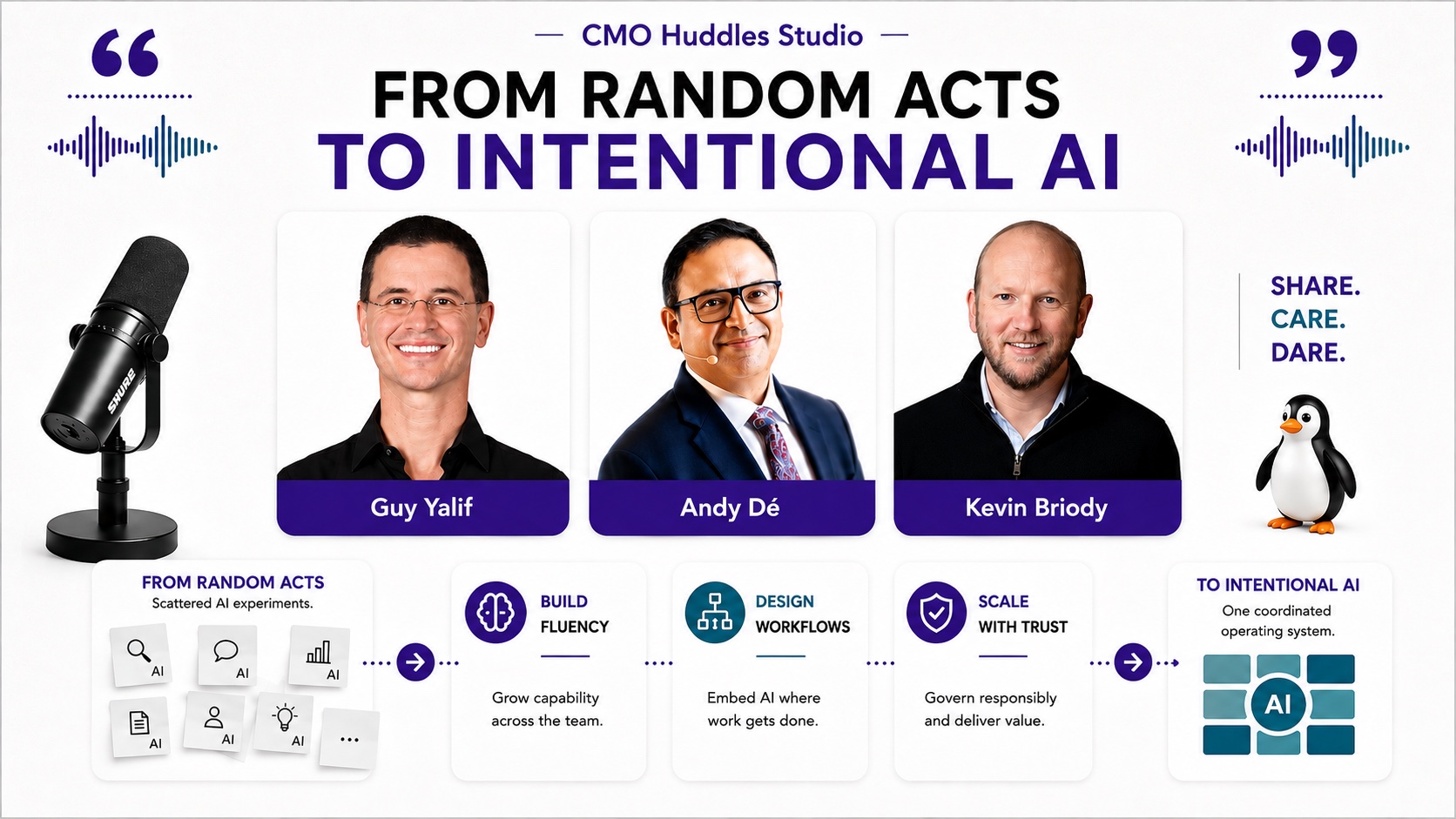
Intentional AI adoption replaces scattered experimentation with priorities, fluency, workflows, and governance. Guy Yalif, Andy Dé, and Kevin Briody explain why operationalizing AI is a change-management challenge as much as a technical one. Councils, champions, process-first pilots, vendor discipline, and outcome-based measurement can help experiments become repeatable capabilities without losing human judgment or customer trust.
Early AI experimentation often spreads through individual curiosity. Employees test tools, save time, and develop personal techniques. That energy is useful, but it does not automatically create an organizational capability.
A CMO Huddles Studio conversation about intentional AI adoption brought together Guy Yalif, Andy Dé, and Kevin Briody.
“Our successful peers will stop treating AI adoption as tech and start treating it as a major change management effort.”
Guy’s distinction places people, workflows, priorities, and learning alongside technology. AI adoption becomes part of how the organization changes behavior, distributes knowledge, and redesigns work.
AI fluency does not appear evenly across a team. Some employees remain cautious, others use basic tools, and a smaller group begins redesigning workflows.
Guy described six stages that move from approval and experimentation through organization, task automation, superhuman scale, and entirely new workflows. The model gives leaders a way to understand where different parts of the organization are operating.
Training can then reflect the stage. A beginner may need safe access, practical examples, and prompting basics. An advanced builder may need APIs, data connections, and permission to develop workflows spanning several functions.
A maturity model also protects teams from unrealistic expectations. Leaders can recognize progress without pretending that access to a tool means the organization has achieved operational adoption.
Andy described a four-part sequence for examining potential workflows: “Why, what, how, so what.”
The “why” identifies the problem. The “what” defines the work or outcome. The “how” considers the workflow and technology. The “so what” connects the effort with a result the business recognizes.
Beginning with a tool can produce a technically impressive solution for an insignificant problem. Beginning with the process exposes bottlenecks, handoffs, quality issues, and business consequences.
The final question prevents an experiment from ending with time saved. It connects the workflow with customer experience, pipeline, retention, cost, capacity, or another meaningful result.
AI councils can establish guardrails, accelerate approvals, and share useful practices. They become less effective when they operate only as control bodies.
A strong council combines governance with enablement. It can maintain approved tools, document risks, share workflows, coordinate with legal and IT, and create a faster path for low-risk experimentation.
Champions extend that work into individual teams. They help colleagues adapt examples to real responsibilities and surface problems the central group might not see.
A workflow developed in content may help sales enablement. A research approach created in product marketing may support customer success. Shared demonstrations allow those ideas to travel across organizational boundaries.
The council creates coherence, while champions create reach.
Employees often adopt AI tools before formal approval processes catch up. Blocking every new application can push experimentation underground, while unrestricted adoption can expose sensitive data and create tool sprawl.
A fast-track approval process offers another option. Legal, security, privacy, and IT teams can evaluate lower-risk tools quickly while maintaining clear restrictions around customer, financial, and confidential information.
The organization can also define a grace period followed by enforcement of approved standards. That approach acknowledges bottom-up experimentation while establishing expectations as workflows become more important.
Governance earns greater cooperation when it helps people move safely instead of simply slowing them down.
The rapid growth of AI vendors creates opportunity and risk. A promising tool may disappear, change pricing, weaken support, or fail to integrate with the broader stack.
Kevin emphasized platform discipline, including contracts, data practices, integrations, and vendor longevity. The same rigor applied to core MarTech becomes relevant as AI moves into important workflows.
A pilot can test usefulness without making the company structurally dependent on an unproven vendor. Portability and access to underlying data can reduce the cost of future change.
The review can also distinguish between a valuable new capability and a feature likely to appear inside an existing platform. That discipline helps control a stack that could otherwise expand with every experiment.
“2025 has been a big year of disruption and experimentation. 2026 is really about operationalizing AI and ingraining it into your marketing team. It’s a culture and people challenge as much as anything else.”
Employees may interpret efficiency language as a threat. Buyers may reject an interaction that feels automated in the wrong moment.
Intentional adoption considers both experiences. Employees need clarity about how AI changes the work, which skills are becoming more valuable, and where human judgment remains essential. Customers need an experience appropriate to the context and stakes.
A faster workflow may create value, but speed alone does not determine quality. The customer or employee still experiences the result.
“AI is the new UI. Your buyers are looking for you via prompt.”
Buyers may encounter an AI-generated comparison, answer, or recommendation before visiting a company’s website. Clear positioning, structured information, credible evidence, and authoritative content help systems understand what the company offers and when it is relevant.
The foundations remain familiar. Marketing still needs accurate information, distinctive expertise, technical accessibility, and content aligned with real buyer questions.
The discovery environment is changing, but chasing every new acronym can distract from making the company’s value easier for people and machines to interpret.
Usage data can indicate whether employees are experimenting. It does not establish that the organization is producing better work.
Useful measures depend on the workflow. They may include cycle time, quality, customer response, conversion, cost, capacity, pipeline progression, or a new capability that was previously impractical.
A workflow deserves to scale when it repeatedly improves something the organization values without introducing unacceptable risk.
That evidence turns a collection of experiments into an operating model. Teams can see what to continue, what to change, and what no longer deserves attention.
It is a coordinated approach connecting AI learning, workflows, governance, technology, and measurement with defined business priorities.
It can establish guardrails, accelerate appropriate experiments, share practices, and coordinate with legal, IT, and business teams.
Workflow analysis reveals the business problem, dependencies, review requirements, and outcome the technology needs to improve.
Human judgment, transparent standards, appropriate data practices, and careful selection of automated interactions help preserve the experience.
Listen to the full conversation with Guy Yalif, Andy Dé, and Kevin Briody.
CMO Huddles helps B2B marketing leaders win by bringing together peers, fresh perspectives, and opportunities to build stronger personal brands. Want to join the huddle? Learn more about CMO Huddles and join CMO Huddles Starter.