
Back to Blogs
Drew Neisser is the founder of CMO Huddles and a globally recognized authority on B2B marketing. He’s an AdAge columnist, LinkedIn TopVoice, leading CMO coach, podcast host & friend of penguins everywhere.
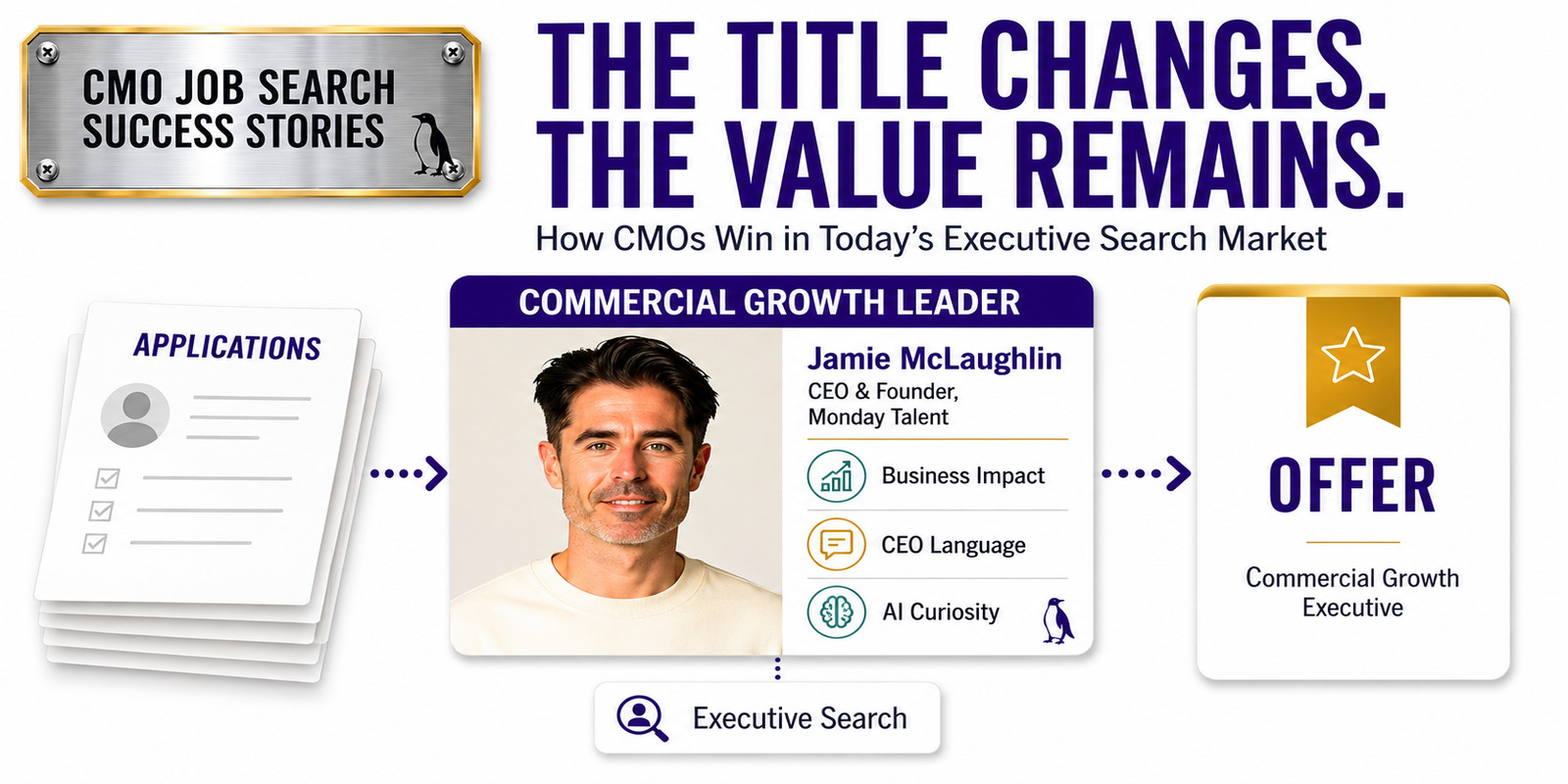
The CMO title is under pressure, but senior marketing leadership is not disappearing. Recruiter Jamie McLaughlin explains how broader commercial titles, growth expectations, AI fluency, and demand generation priorities are reshaping executive searches. For B2B CMOs in transition, stronger positioning comes from translating marketing experience into business impact, commercial value, and language CEOs immediately understand.
For B2B CMOs in transition, the job market can feel like a bad magic trick. The marketing function still matters. The business still needs growth. The brand still needs adult supervision. And yet, somehow, the CMO role keeps vanishing from the org chart.
Jamie McLaughlin, CEO and Founder of Monday-Talent, sees this tension up close. His firm places roughly 30 heads of marketing and CMOs a year, and his view of the current market is blunt.
“The CMO job title is disappearing,” Jamie told me. “Marketers aren’t, nor is the function.”
That distinction matters. The title may be under pressure, but the work is not going away. In fact, the work may be getting harder, broader, and more commercially exposed.
Recent research backs up the direction, if not the obituary. Forrester’s 2026 Fortune 500 analysis found that only 36% of companies now use the Chief Marketing Officer title, down from 49% the prior year. Marketing executives who sit on the executive team or report to the CEO are now present at 52% of Fortune 500 companies, down from 58% in 2025. Spencer Stuart’s 2026 CMO tenure research found that 31% of S&P 500 companies do not have a CMO, while average CMO tenure sits at 4.1 years.
So, is the title disappearing? In some places, yes. Is senior marketing leadership disappearing? Not unless CEOs have found a magical growth wand hidden behind the sales dashboard. Spoiler: They have not.
Jamie is seeing more companies rethink the senior marketing role before they refill it.
“They’re replacing a retiring CMO,” he said of one recent client, “they want to reimagine the role, but they’re probably more likely going to land on the CRO job title, potentially, or even the CBO job title, depending on the organization.”
This is the real story. The “M” in CMO is being challenged by broader commercial titles: Chief Revenue Officer, Chief Growth Officer, Chief Brand Officer, Chief Customer Officer, Chief Commercial Officer. Sometimes this reflects a thoughtful redesign. Sometimes it reflects confusion wearing a better suit.
Jamie’s point is that demand for marketing has not disappeared. But the standalone, highly paid CMO role is being questioned.
“The demand for marketing is still there,” he said, “but whether someone wants to pay a CMO a million dollars plus a year to be on the books, to do that function alone, that is in debate.”
That debate is now part of every CMO job search, whether stated or not. The CEO may not ask, “Why are you worth the compensation package?” But the question is lurking in the room, probably sitting next to the board member who wants pipeline yesterday.
CMOs need to understand the buyer. In this case, the buyer is the CEO, founder, board, or private equity sponsor deciding whether to hire a senior marketing leader.
Their question is not, “Do we need marketing?” Their question is, “What will this marketing leader materially change?”
Jamie sees CEOs asking for growth, efficiency, commercial clarity, and technology fluency. They want proof that a marketing leader can move the business, not just manage the department. “Any searches that we’re doing at the moment,” Jamie said, “it is about demand generation, it’s about pushing the bottom line, it’s about building tech stacks and understanding technology.”
That does not mean every CMO should become a demand-gen specialist. It does mean CMOs need to show how their leadership connects to revenue, market momentum, customer understanding, and company value.
If your story starts with campaigns, it may be too small. If it starts with the business problem, you are closer.
The strongest candidates Jamie is seeing have a pattern. “The main theme is high growth,” he said. “They’ve come from high-growth businesses, even if they’re not necessarily stepping into a high-growth business.”
Clients want to know what changed under your leadership. “How did you get from A to B,” Jamie said, “how did you do it, and how much did it cost, and what was the ROI on that?”
That is the positioning challenge for CMOs. You cannot simply say you built brand, transformed messaging, improved alignment, or modernized the tech stack. Those may all be true. They may also sound abstract to a CEO who is trying to decide whether to spend heavily on a senior hire.
Better positioning sounds like this:
That last point matters. Perfect success stories can sound suspicious. Thoughtful learning stories sound like leadership.
One of the recurring frustrations in the CMO market is that CEOs say they want business leaders, but then hire as if marketing equals demand generation.
Jamie sees this too. When clients ask for a demand-heavy marketer, he tries to give them what they asked for while also expanding their view of what they may actually need. “My job is always to give my clients choice, and educate them throughout the process,” he said.
That education often happens through the candidate slate. “You slowly start to usher in candidates that are much more holistic in their approach to marketing,” Jamie said.
This is where CMOs need to be careful. If asked, “Are you a brand marketer or a demand marketer?” the answer should not be a philosophical sigh followed by a TED Talk on full-funnel integration. True as that may be, it may not help you get to the next round.
Jamie’s practical advice is to read the company’s needs and answer in that context. “Take a look at what the company needs and is,” he said, “and then answer it that way.”
The better answer is not evasive. It is connective.
For example: “For this company, I’d start with demand because the pipeline challenge is immediate. But I would not treat demand as a standalone motion. In my experience, the best demand engines are built on clear positioning, customer insight, sales alignment, and disciplined measurement.”
That answer lets you meet the CEO where they are without reducing yourself to a single tactic in executive clothing.
AI is now part of every marketing leadership conversation. But the market is still figuring out how to evaluate AI capability. “You’ve got to say AI every three sentences,” Jamie joked.
So far, he is not seeing many hiring processes require full AI case studies with hard outcomes. The technology is too new, the operating models are still shifting, and many companies are still in the experimentation stage. “It’s more, what have you done and why,” Jamie said, “rather than give me all the tangible outcomes, given how new a lot of this stuff is.”
That is useful guidance for CMOs in transition. You do not need to pretend that every AI pilot delivered a provable revenue miracle. Please do not. The market has enough fairy dust.
You do need to show intellectual curiosity, experimentation, and judgment. Jamie described the more attractive leaders as people who “stop and read and look and understand.”
In practical terms, prepare to discuss:
Jamie is not buying the phrase “AI native,” and neither am I. “No one could possibly be AI native,” he said, “because no one was born into an AI world.”
Unless you are a bot. In which case, congratulations on reading this far, and please stop applying for CMO jobs.
Jamie made a point that CMOs should tape to their laptop before interviews: Marketing can sound abstract to non-marketers. “Marketing can be quite notional,” he said. “It can be a bit abstract sometimes.”
That is deadly in an interview. If the CEO is already uncertain about the value of a senior marketing hire, abstract language will make the role feel optional.
Translate everything into business language.
Instead of: “We repositioned the brand.” Say: “The company was losing enterprise deals because buyers could not distinguish us from lower-cost competitors. We rebuilt the positioning around the business problem, trained sales on the new narrative, and changed the website, outbound, analyst story, and customer proof. Six months later, enterprise win rates improved and discounting pressure eased.”
Instead of: “We improved sales and marketing alignment.” Say: “Sales and marketing were working from different definitions of the buyer. We rebuilt the ICP, changed lead scoring, rewrote the SDR talk track, and created a weekly pipeline council. The result was fewer junk leads, better conversion, and a healthier relationship with sales.”
Instead of: “We built the brand. Say: “We created a clearer reason to believe, then activated it across category education, executive thought leadership, customer evidence, and analyst conversations so demand creation did not depend entirely on paid acquisition.”
That is the difference between sounding like a functional leader and sounding like a business leader with a marketing lens.
CMOs often approach recruiters only when they need a job. That is understandable. It is also too narrow.
Recruiters like Jamie are market sensors. They hear what CEOs say they want, what boards are pressuring them to find, where job specs are unrealistic, and which candidate stories are landing.
Most of Monday-Talent’s candidate conversations happen organically. “Often through introductions,” Jamie said. “People reach out to me via LinkedIn, of course, and then we’re reaching out to people all the time because we’re trying to talk to them about our specific roles.”
The lesson is not “spam every recruiter you can find.” The lesson is to make yourself easy to understand, easy to remember, and easy to recommend.
That means your LinkedIn profile, resume, and intro conversations should answer three questions fast:
If a recruiter has to decode your value, you are making them work too hard. Recruiters are busy. CEOs are impatient. Boards are allergic to ambiguity. Do the positioning work for them.
The CMO title may be under pressure, but the need for senior marketing leadership is not going away. What is going away is the luxury of vague value.
Jamie’s market read is a useful wake-up call. Companies still need leaders who understand customers, culture, category dynamics, brand, demand, technology, and growth. But they may not call that person a CMO. They may call them a CRO, CGO, CBO, Chief Customer Officer, or something equally acronymic and mildly suspicious.
Your job is not to defend the title. Your job is to make the value unmistakable.
Show commercial impact. Connect short-term demand to long-term market creation. Demonstrate AI curiosity without pretending the robots have solved everything. Speak in CEO language. Bring proof. Bring judgment. Bring stories.
And if you are a CMO in transition, join us on October 6 at 1pm ET for a CMO Huddles Transition Team AMA with Jamie McLaughlin. We will dig into what he is seeing, what CEOs are asking for, and how CMOs can position themselves to land the right next role.
Not everywhere, but it is clearly under pressure. Some companies are replacing or reframing the CMO role under titles like Chief Growth Officer, Chief Revenue Officer, Chief Brand Officer, or Chief Customer Officer. The bigger issue is not the title itself. It is whether CEOs see senior marketing leadership as commercially essential.
CEOs want marketing leaders who can connect strategy to growth. That includes demand generation, brand differentiation, technology fluency, sales alignment, customer insight, and measurable business impact. The strongest candidates explain how marketing changes company outcomes, not just marketing activity.
Answer in the context of the company’s current need, then show how brand and demand work together. If the company has an urgent pipeline problem, acknowledge it directly. Then explain how positioning, customer insight, and sales alignment make demand generation more effective.
CMOs should be ready to discuss what they have tested, what they have learned, and how they are thinking about AI’s impact on marketing teams, workflows, and buyer behavior. Most companies are not expecting perfect AI case studies yet, but they do expect curiosity, judgment, and practical experimentation.
Be specific about the business situations where you are strongest. Recruiters need to understand your value quickly: The growth problems you solve, the stage of company where you thrive, the teams you have built, and the measurable outcomes you have helped create.
CMO Huddles helps B2B marketing leaders win by bringing together peers, fresh perspectives, and opportunities to build stronger personal brands. Want to join the huddle? Learn more about CMO Huddles and apply to join the community.