
Back to Blogs
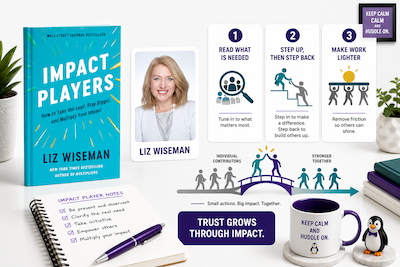
Impact players distinguish themselves by finding the work that matters in ambiguous situations, stepping forward without crowding out colleagues, adapting as conditions change, and making difficult work easier for others. Liz Wiseman’s research gives CMOs a framework for developing trusted problem solvers while avoiding the expectation that high impact requires heroic overwork or personal sacrifice.
High-performing employees and impact players are not separated by intelligence, effort, or technical ability. The difference becomes visible when the work no longer fits neatly within the plan.
Liz Wiseman, CEO of the Wiseman Group and author of Impact Players, studied approximately 170 managers across nine respected employers. She compared capable contributors with people who created extraordinary value.
Ordinary contributors performed their assigned responsibilities well. Impact players distinguished themselves when ownership was unclear, priorities changed, and problems crossed functional boundaries.
Marketing organizations contain many clearly defined responsibilities. The most consequential business problems often appear between them.
A slowing sales cycle may involve positioning, product experience, sales execution, pricing, customer proof, or all five. An employee focused solely on completing the marketing task may miss the larger constraint.
Impact players look beyond the boundaries of the job description and ask what would create the most value now.
“Impact players aren’t waiting to be anointed, they’re not waiting to be asked. They’re stepping up and leading.”
The interpretation is not that employees need to assume every unowned responsibility. It is that they remain alert to problems and opportunities the formal structure has not adequately addressed.
For a CMO, this may mean helping resolve an issue that is not technically owned by marketing but prevents marketing from succeeding.
Liz shared the story of a Unilever product manager whose launch faced months of supply-chain delays. Instead of accepting that she could not market a product that was unavailable, the manager worked with supply-chain colleagues to identify and address the causes.
The delay reportedly fell from six months to approximately six weeks, restoring millions to the forecast.
The product manager did not attempt to take over supply chain. She engaged because the unresolved problem prevented the business from achieving the intended result.
Liz found a consistent pattern in her research: impact players often define their value as solving problems and identifying opportunities. Their titles establish expertise and responsibility, but do not prevent them from helping where the business most needs progress.
Taking initiative can become counterproductive when it turns into permanent control or leaves colleagues feeling displaced.
“Impact players are quick to lead, but they’re also quick to step back and create room for other people, which is why people don’t tend to resent them.”
An impact player may establish momentum, clarify the problem, and coordinate an initial response. Once the right owner or team is ready, that person can shift into a supporting role.
This ability matters in cross-functional marketing work. A CMO may need to convene a response to a customer-experience problem without claiming ownership of every operational decision. A team member may lead an urgent launch issue, then return authority to the product leader once the immediate obstacle is resolved.
The goal is progress rather than possession.
Reliable team members reduce the management burden because leaders trust them to carry work through changing conditions. Liz described this as a positive version of “fire and forget”: once the request is made, the leader can believe it is as good as done.
That reliability does not require solitary effort. Impact players recruit the help, authority, and decisions needed to finish.
They may return to a leader with a clear update: the problem is understood, work is moving, and specific support is required. This differs from handing the entire issue back to the boss.
The person retains responsibility for progress while making productive use of the organization around them.
Marketing plans rarely operate against fixed targets. Products evolve, budgets move, customer preferences change, and leadership revises priorities.
Impact players do not treat the original plan as more important than the current reality. They seek feedback, update their understanding, and adjust their approach.
Liz compared this mindset with beginning each day under the assumption that the world changed overnight. The objective may remain valid, but the route to it may need revision.
Adaptability is different from chasing every new request. An impact player can distinguish between a meaningful change in conditions and a distraction that would pull the work away from its purpose.
The fifth practice in Liz’s framework is making work light. This does not mean treating serious problems as trivial or masking excessive workload with forced positivity.
It means reducing unnecessary friction, bringing clarity to ambiguity, and helping colleagues carry difficult work without adding drama.
Under sustained pressure, teams remember the people who make progress feel possible. These colleagues organize the problem, clarify what matters, share credit, communicate calmly, and help others contribute effectively.
The behavior can coexist with honest conversations about capacity. Making work light does not require pretending that a 20% budget cut and a 20% target increase represent a simple challenge.
An organization cannot build a team of impact players if recognition consistently goes to the person closest to the final result.
“If you want an entire team of impact players, you’ve got to be the kind of person who tracks and celebrates the assists, not just the person who spikes the ball, but the person who consistently sets up the ball.”
Marketing outcomes depend on contributions that may be difficult to see. Operations may repair the data, product marketing may sharpen the narrative, customer marketing may secure the proof, and demand generation may activate it.
Recognizing the assist tells the team that enabling other people’s success is part of impact. It also discourages competition for the most visible work.
The impact-player framework can be misread as permission to give the most reliable employees every difficult assignment.
That creates burnout, dependency, and resentment. A leader who rewards impact with unlimited work eventually teaches talented employees to hide their capacity.
CMOs can develop impact players more sustainably by:
Impact comes from judgment and adaptability, not from working the longest hours.
Liz’s five practices can be translated into questions for marketing leadership:
These questions can support coaching, hiring, project reviews, and team recognition without turning “impact player” into another label for the people who accept the most work.
Both may be capable and hardworking. Impact players become especially valuable in ambiguous situations because they identify needed work, take initiative, adapt, and help others make progress.
No. It means recognizing important problems that fall between functions and helping the organization address them without permanently taking over another team’s responsibilities.
Yes. Leaders can coach people to look for the larger problem, request feedback, adapt, collaborate, and finish work with the right organizational support.
They can match authority with responsibility, remove lower-value work, distribute stretch assignments, recognize assists, and avoid treating reliability as unlimited capacity.
Listen to the full conversation with Liz Wiseman.
CMO Huddles helps B2B marketing leaders win by bringing together peers, fresh perspectives, and opportunities to build stronger personal brands. Want to join the huddle? Learn more about CMO Huddles and join CMO Huddles Starter.