
Back to Blogs
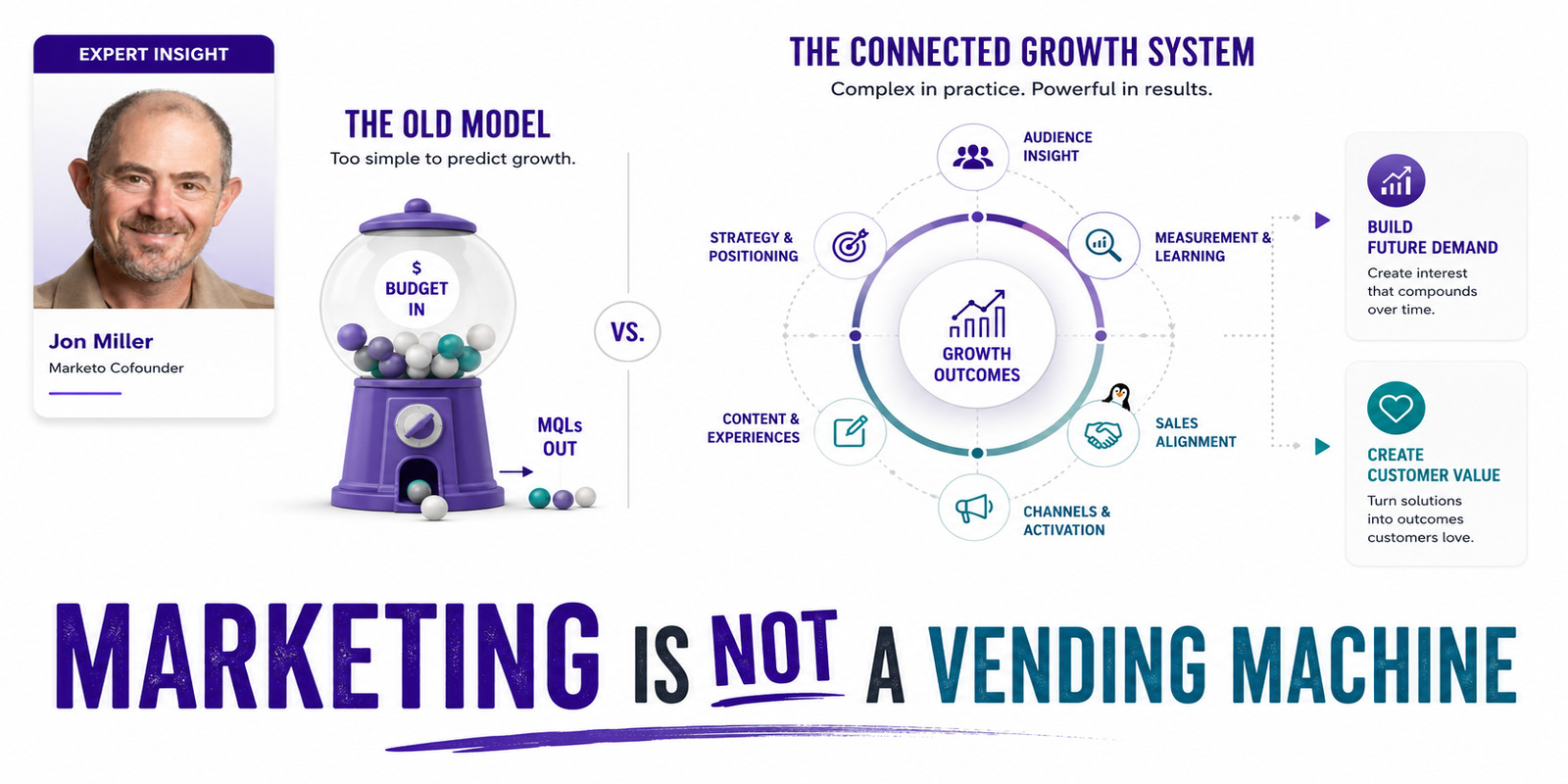
Marketing cannot reliably produce revenue on command by feeding campaigns into a lead-generation machine. Marketo and Engagio co-founder Jon Miller explains why product-market fit, positioning, reputation, customer value, brand investment, and revenue-team collaboration shape growth. Escaping the MQL trap begins with recognizing how little demand is immediately available and how much marketing happens before measurement.
The gumball-machine model of marketing is wonderfully simple: Insert budget, activate campaigns, generate leads, and receive pipeline. Real B2B buying is less obedient.
In a Renegade Marketers Unite conversation about rethinking marketing, Jon Miller, co-founder of Marketo and Engagio, examined how an emphasis on measurable demand generation can distort marketing priorities.
“The gumball machine mindset caused us to over-rotate into marketing that is highly measurable and focused on capturing existing demand, and under-invested in building brand and awareness for future demand.”
The metaphor explains why teams may appear productive while becoming less capable of creating future growth. Campaigns generate activity, dashboards report conversions, and the organization expects another budget increase to produce a corresponding increase in pipeline. That relationship becomes unreliable when the market is not ready, the product does not fit, or buyers cannot distinguish the company from its competitors.
The marketing-qualified lead gave marketing a visible unit to produce and sales a defined object to accept or reject. It also encouraged teams to treat an individual response as evidence of buying intent.
Complex B2B purchases rarely behave that way. Several people may participate, most research happens privately, and one content interaction may reveal interest without indicating a buying decision.
Optimizing around MQL volume can reward campaigns that produce inexpensive responses instead of meaningful account progress. A team may meet its lead target while sales sees weak fit, limited buying intent, or contacts with no influence over the decision.
The model can also create conflict. Marketing points to the number of leads delivered. Sales points to the lack of conversion. Each side can defend its metric without learning much about why customers did or did not progress.
Moving beyond MQLs does not require abandoning measurement. It broadens the view to include buying groups, account activity, opportunity quality, commercial outcomes, and the conditions that help opportunities form.
That tension brings the discussion back to the conditions surrounding every campaign.
“You’ve got to focus on the core of what marketing should be about, things like product-market fit, positioning, and reputation. Those are going to dominate over anything you might be doing in demand.”
A campaign cannot permanently compensate for an offer buyers do not value. Lead generation also becomes more expensive when a company is unfamiliar, poorly differentiated, or difficult to trust.
Product-market fit determines whether the solution addresses a meaningful need. Positioning helps buyers understand who the solution is for and why it matters. Reputation affects whether the company earns consideration.
Demand programs work within those conditions. When the fundamentals are strong, campaigns have something credible to activate. When they are weak, even efficient acquisition tactics may produce limited commercial progress.
This expands the CMO’s measurement conversation. A disappointing campaign result may reflect targeting or execution. It may also expose a positioning, product, pricing, reputation, or market-timing problem.
The widely discussed 95/5 heuristic suggests that most potential buyers are not actively in market at a given moment. The precise ratio varies by category, but the strategic implication remains useful.
A marketing system focused almost entirely on immediate conversion competes for a relatively small pool of active demand. It gives limited attention to future buyers who are learning, forming preferences, or accepting the status quo.
Brand, original research, useful content, community, customer evidence, and distinctive ideas help a company become familiar before a formal buying process begins. These investments give future buyers something to remember when their circumstances change.
Their influence can be harder to attribute because it develops over time and may occur outside trackable channels. That does not make the work commercially irrelevant. It makes the measurement problem more complex. A balanced plan can capture available demand while continuing to build recognition and preference among the larger market.
Brand and demand are often treated as competing budget categories. In practice, demand programs operate differently when buyers already know, understand, and trust the company.
Recognition can improve response rates. Clear positioning can increase conversion. Reputation can help a company survive a buying group’s early effort to reduce the vendor list.
Brand investment may also reduce the burden placed on every individual campaign. A prospect who already understands the company does not need one advertisement or email to explain the entire value proposition.
This does not remove the need for accountability. It expands the evidence marketing examines, including branded search, direct traffic, competitive consideration, reputation, customer advocacy, and conversion among familiar audiences.
Short-term acquisition pressure can cause companies to optimize the transaction while weakening the customer experience.
The revenue system includes what happens after the contract. Retention, expansion, advocacy, and reputation depend on whether the organization fulfills the promise marketing and sales made.
Marketing can contribute by surfacing customer insight, clarifying expectations, and telling stories grounded in delivered value. Customer success and product teams can reveal where the experience supports or undermines the market promise.
A company that treats every interaction as an opportunity to extract a conversion may become easier to measure and harder to trust. Customer value gives the growth system a stronger foundation because successful customers influence future demand through retention, expansion, references, and reputation.
Revenue emerges from product, sales, marketing, customer success, market conditions, and customer behavior. No single department independently controls the outcome.
“The CMOs who are the most effective at collaborating with their peers and helping to lead these dialogues around the business fundamentals will be the ones that are most successful in the next 15 years.”
Shared goals and account-level visibility create a more useful operating model than arguments over sourced pipeline. Teams can examine which problems prevent progress and coordinate around the complete system.
Marketing may identify an awareness or positioning problem. Sales may expose friction within the buying committee. Customer success may show that the promise does not match the delivered experience. Product may reveal why adoption stalls.
The value comes from combining those perspectives. Collaboration makes it possible to address the system instead of assigning ownership of the symptom.
AI-assisted discovery changes how buyers encounter, summarize, and compare information. A buyer may receive an answer without visiting the original source.
Jon framed the content challenge clearly: “The content you create has to be so relevant that an AI summary can’t ignore it.”
Original research, distinctive expertise, useful frameworks, and credible customer evidence become more important in this environment. Content volume alone is unlikely to create durable visibility when AI systems can summarize dozens of similar pages.
The company needs something worth finding and citing. That may come from proprietary evidence, practical experience, a differentiated point of view, or a genuinely useful tool.
The gumball-machine metaphor persists because it offers predictability. The danger appears when the organization mistakes a convenient reporting model for the way growth actually works.
A healthier system connects product-market fit, positioning, reputation, future demand, active demand, sales execution, customer value, and revenue-team collaboration. Measurement remains important, but it serves the system instead of reducing it to one output.
Pipeline still matters. The larger question is whether the business is creating the conditions that make healthy pipeline more likely to emerge, progress, and become lasting customer value.
It is the belief that adding campaign budget will predictably produce leads and revenue regardless of market conditions or business fundamentals.
They can reward response volume without revealing buying-group progress, opportunity quality, or commercial value.
No. It places demand generation within a broader system that includes brand, positioning, reputation, customer value, and collaboration.
It reminds marketers that most potential buyers may not be purchasing today, so future demand also deserves attention.
Listen to the full conversation with Jon Miller.
CMO Huddles helps B2B marketing leaders win by bringing together peers, fresh perspectives, and opportunities to build stronger personal brands. Want to join the huddle? Learn more about CMO Huddles and join CMO Huddles Starter.