
Back to Blogs
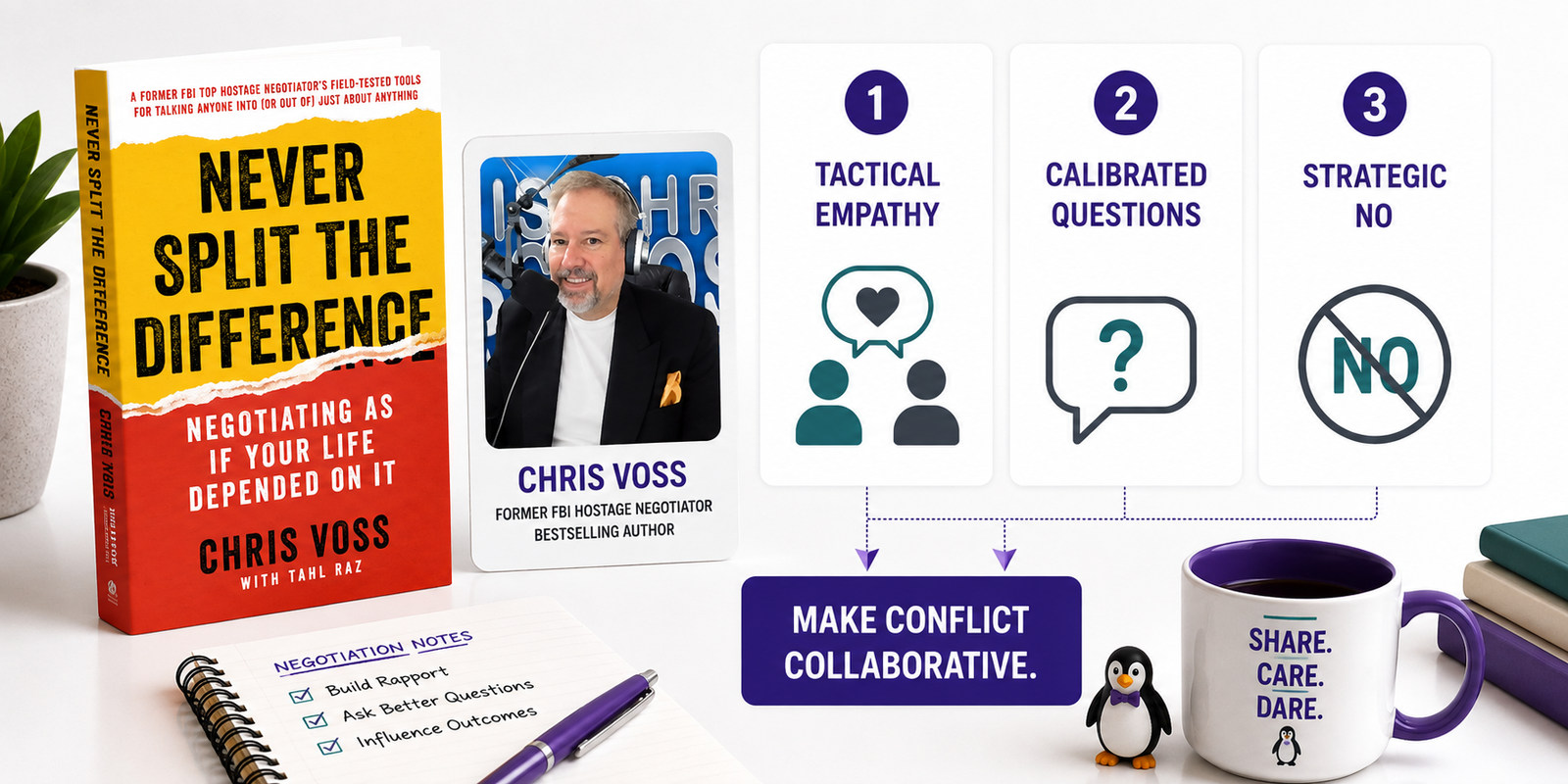
CMOs negotiate constantly: budgets, priorities, compensation, vendors, timelines, and role scope. Former FBI negotiator Chris Voss argues that productive negotiation begins with tactical empathy, listening, calibrated questions, and enough comfort with conflict to explore the constraint. These methods help leaders replace forced compromise with collaborative decisions that participants understand, influence, and can implement together.
Marketing leaders negotiate whenever resources and expectations diverge. A CEO may reduce the budget without changing the growth target. Sales may request support that conflicts with agreed priorities. A vendor may resist changes to price or scope. A candidate may need to clarify severance, authority, or compensation before accepting a role.
In Never Split the Difference, former FBI hostage negotiator Chris Voss challenges the idea that productive negotiation means meeting in the middle. During a CMO Huddles conversation, he applied tactical empathy, calibrated questions, emotional labeling, and strategic use of “no” to situations marketing executives regularly face.
The method is collaborative, but it does not avoid conflict. It uses conflict to uncover the conditions a workable decision must satisfy.
Splitting the difference can feel fair because each side appears to concede equally. The resulting agreement may still fail to address the problem.
Chris described compromise as a “recipe that guarantees unhappiness.” His concern is not with generosity or flexibility. It is with accepting an arbitrary midpoint before understanding what each side needs.
Imagine a vendor requests $200,000 while the available budget is $100,000. Agreeing on $150,000 does not establish whether the work is worth that amount, whether the scope is achievable, or whether the company can fund it.
The stronger negotiation examines desired outcomes, constraints, implementation, and alternatives. The final answer may be above or below the midpoint, or it may restructure the arrangement entirely.
CMOs can apply this thinking to budgets, headcount, agency scope, launch timing, compensation, and executive mandates. The objective is an agreement capable of working after the conversation ends.
People are more likely to support an outcome they helped shape. A fully formed proposal that invites only a yes or no may appear efficient while excluding the other party from the reasoning.
Chris argued that involvement creates ownership. This matters in executive settings because implementation often depends on several leaders whose concerns cannot be addressed through a polished presentation alone.
A CMO proposing a brand investment can involve the CEO, CFO, CRO, and product leader in defining the business problem, evidence, time horizon, and measures of progress. The marketing leader still brings expertise, but the decision emerges through shared examination.
Participation is not consensus on every detail. It gives stakeholders enough influence and understanding to support the resulting commitment.
Marketing executives frequently enter a difficult conversation prepared to defend their recommendation. The other party may be equally prepared to explain why it cannot happen.
“Don’t start out with what you have to say,” Chris advised. Until the other person feels heard, they may be unable to engage seriously with the CMO’s argument.
Tactical empathy begins by identifying the other party’s perspective without necessarily agreeing with it. The CMO might recognize that the CEO is under board pressure, the CFO is protecting cash, or the CRO is worried about missing a near-term number.
This recognition must be genuine and specific. “I can see you’re under a tremendous amount of pressure” may create more room for discussion than immediately disputing an unrealistic mandate.
Once the pressure is acknowledged, both leaders are better positioned to examine the decision.
Calibrated questions invite the other party to consider the practical consequences of a demand. Chris’s best-known example is: “How am I supposed to do that?”
Tone determines whether the question sounds collaborative or defiant. The CMO should communicate respect and a desire to solve the problem, not imply that the other person’s request is foolish.
Consider a CEO who cuts the marketing budget by 30% while preserving a 30% growth target. The CMO could respond with a detailed objection, but that may trigger a defensive exchange. A calm implementation question invites the CEO to confront the mismatch.
If the CEO responds, “That’s your job,” the answer provides useful information. It may indicate extreme pressure, limited willingness to collaborate, or a decision that the CMO is expected to absorb regardless of feasibility.
The CMO can then move from assumption to diagnosis. The next discussion can address priorities, resources, risks, and which commitments must change.
Senior leaders sometimes agree too quickly because they want to appear collaborative. The commitment then fails during execution.
Chris recommends letting “no” emerge in stages. A leader can begin with an implementation question, explain the constraint, offer alternatives, and gradually make the boundary clearer.
The sequence might move from “How would you like me to accomplish that within the current resources?” to “That approach would require us to stop two agreed programs,” followed by “I’m sorry, that does not work within the approved budget.”
This progression gives the other party time to process the constraint. It also reduces the shock of a hard refusal.
The ability to say no remains important. A CMO who accepts every request eventually loses control of priorities, team capacity, and credibility.
Name the Emotion in the Room
Negotiations become harder when both parties are operating from fear, frustration, or defensiveness without acknowledging it.
Chris recommends labeling negative emotions rather than denying them. A CMO might say, “It sounds like the board’s expectations have created significant pressure,” or “It seems like you’re concerned marketing will not produce evidence quickly enough.”
A label is an observation, not an accusation. It gives the other person a chance to confirm, correct, or elaborate.
CMOs can use the same method internally. Before a difficult conversation, naming personal anxiety or anger can reduce its control over the response. This makes it easier to slow down, listen, and choose language deliberately.
Emotional intelligence in negotiation does not mean making the discussion soft. It helps the participants think clearly enough to address the hard problem.
Chris describes three broad negotiation tendencies: assertives, analysts, and accommodators.
Assertives value directness, speed, and respect. They may interpret silence as a problem and can push aggressively for decisions. Analysts need time, information, and precision. They may resist pressure and prefer to examine the details. Accommodators prioritize relationships and communication, sometimes agreeing before they have resolved their own concerns.
A CMO should not turn these tendencies into rigid personality labels. They are cues for adjusting the interaction.
An assertive CEO may need a concise point and clear choices. An analytical CFO may need evidence, assumptions, and time to review them. An accommodating partner may need explicit permission to raise objections rather than maintaining harmony.
The CMO also needs awareness of personal tendencies. An accommodating marketer negotiating with an assertive CEO may concede too early unless the boundaries are prepared in advance.
Executive candidates can use tactical empathy to understand the company’s constraints before countering an offer. Compensation, equity, severance, reporting structure, authority, and role scope may all be negotiable.
A calibrated question can expose what the organization can change: “How can we structure the protection given the leadership transition you described?” That may produce a more useful discussion than demanding a standard severance term without context.
Candidates should also listen for unresolved expectations. A title may sound senior while the decision rights remain limited. A generous bonus may depend on measures the executive cannot control.
The best negotiation clarifies the whole arrangement. Winning a higher salary provides little protection if the mandate, resources, and success criteria remain unworkable.
Many consequential negotiations do not arrive as scheduled meetings. A CEO raises a budget cut in passing. A sales leader asks for a campaign during a pipeline review. A vendor introduces a new fee near renewal.
Preparation therefore includes principles and language the CMO can access under pressure:
The objective is not to deploy a clever phrase mechanically. It is to remain curious long enough to understand which negotiation is actually taking place.
An arbitrary midpoint may leave both parties dissatisfied and fail to solve the implementation problem. A better agreement addresses underlying needs, constraints, and risks.
Tactical empathy is the practice of understanding and acknowledging another person’s perspective and emotions so the conversation can become more productive. It does not require agreeing with their position.
Acknowledge the pressure behind it, ask calibrated implementation questions, and make the tradeoffs visible. Clarify which priorities, resources, or expectations must change for the mandate to become achievable.
Yes. They can help candidates explore compensation, severance, authority, reporting relationships, performance measures, and role scope without turning every issue into a positional demand.
Listen to the full conversation with Chris Voss.
CMO Huddles gives B2B marketing leaders a trusted place to discuss the difficult decisions that come with the role. Apply to join the community.