
Back to Blogs
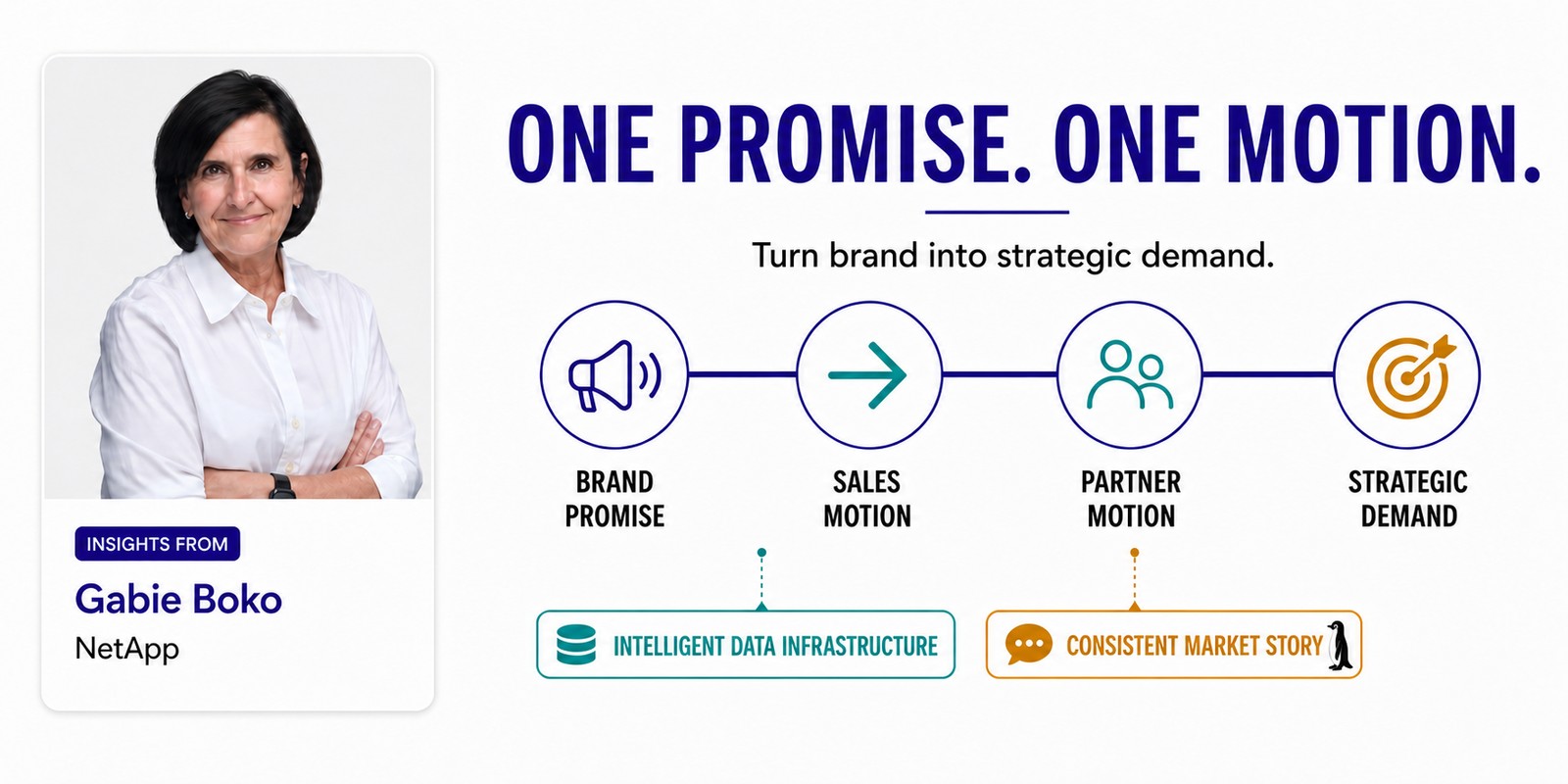
NetApp strengthened strategic demand by replacing a “brand of commas” with one durable promise: Intelligent Data Infrastructure. Former NetApp CMO Gabie Boko explains how a customer-tested narrative, company-wide demand ownership, selective NFL activation, and shared measures helped connect brand with growth while avoiding AI-washing, unnecessary category creation, and disconnected product stories across the wider business.
B2B brands often accumulate messages faster than they retire them.
Each product, acquisition, audience, and internal stakeholder adds another phrase. The result is what former NetApp CMO Gabie Boko called a “brand of commas,” a story trying to contain too many ideas at once.
At NetApp, the alternative was focus. The company rallied around one durable narrative, Intelligent Data Infrastructure, and connected that promise to a broader strategic-demand motion shared across marketing, sales, and partners.
The work shows how brand can become an operating idea rather than a creative layer.
NetApp needed a narrative broad enough to support its future without simply attaching AI to its existing storage story.
The company arrived at Intelligent Data Infrastructure. “Intelligent” acknowledged the role of AI without resorting to AI-washing. “Data infrastructure” remained connected to NetApp’s established capabilities.
Gabie described the outcome as a simpler story about removing friction between data and innovation.
The language was not selected by internal preference alone. NetApp tested alternatives with customers, prospects, partners, and the market. That evidence helped leadership move beyond competing opinions.
“The most important thing to be able to facilitate demand was to change the narrative.”
The brand refresh followed the strategic story. New fonts and colors supported the change, but they were not positioned as the change itself.
A durable company narrative becomes harder to build when every product or capability receives its own category.
“Every time you take your brand vision and try to turn it into a product, then you negate the ability for us to build a brand.”
This does not mean products lose their individual value. It means they contribute to a larger promise instead of competing with it.
For NetApp, that gave teams a consistent way to explain why different offerings belonged together. It also reduced the burden placed on customers, who otherwise have to interpret a growing collection of product-level stories.
Gabie’s concept of strategic demand changes the ownership conversation.
“Strategic demand is absolutely 100% connected to the entire company. Marketing now just becomes a contributor to demand, not the owner of demand.”
Marketing contributes narrative, audience understanding, activation, and measurement. Sales contributes account knowledge and commercial execution. Partners extend reach and relevance. Leadership creates alignment around the growth objective.
This shared motion reduces the familiar argument over who generated or influenced a specific opportunity. The more useful question becomes whether the combined system is increasing consideration, improving progression, and supporting growth.
NetApp’s NFL partnership offered reach, but the activation remained selective.
Rather than relying on a large broadcast-ad purchase, NetApp concentrated on moments connected to its audience:
The approach linked sponsorship activity to target audiences and existing customer credibility.
The lesson is not that every B2B brand needs a sports partnership. It is that reach becomes more defensible when the activation connects the brand promise, audience, and business relationship.
NetApp evaluated more than a single awareness number.
The conversation included measures such as:
Gabie noted that NetApp already had strong consideration among buyers who knew the company. The growth opportunity was expanding the number of relevant buyers who reached that consideration stage.
This connects brand measurement with a commercial question: Is a stronger narrative helping more of the right buyers recognize NetApp as a relevant choice?
A unified narrative depends on internal trust.
Gabie described returning to C-suite peers during the harder middle stage of transformation and asking for help making necessary adjustments. That collaboration helped the original strategy evolve without becoming a completely different strategy.
The external campaign may be the visible output, but the harder brand work often happens inside the company:
One promise becomes powerful when the organization can move behind it together.
Strategic demand is a company-wide growth motion that connects brand, marketing, sales, partners, and leadership rather than treating demand generation as marketing’s responsibility alone.
It describes a brand narrative overloaded with products, capabilities, categories, and claims. The volume of ideas makes the company’s central promise harder to understand.
NetApp used “Intelligent Data Infrastructure” to acknowledge AI while preserving a customer-tested connection to its established data and infrastructure capabilities.
Brand measures such as awareness, consideration, and sentiment can be evaluated alongside pipeline progression, time to close, and revenue growth to understand how perception supports commercial movement.
Listen to the full conversation with Gabie Boko about NetApp’s strategic-demand transformation.
CMO Huddles helps B2B marketing leaders win by bringing together peers, fresh perspectives, and opportunities to build stronger personal brands. Want to join the huddle? Learn more about CMO Huddles and apply to join the community.