
Back to Blogs
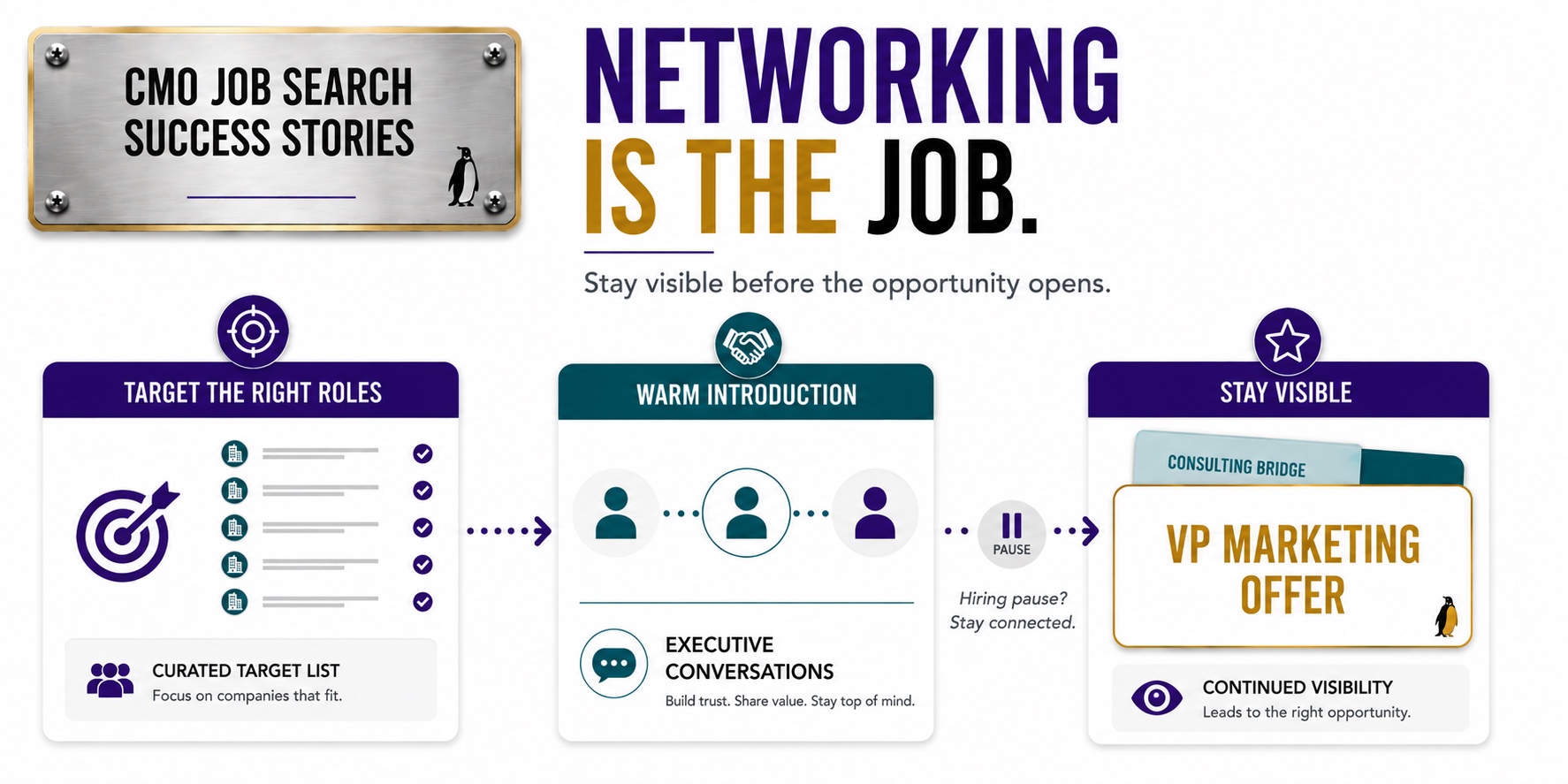
An eight-month search led one marketing executive to a VP role through disciplined targeting, persistent networking, and a relationship built years earlier. After a hiring freeze interrupted the expected offer, a structured consulting engagement preserved momentum. Strong preparation, peer support, and an AI-powered Co-CMO helped the Huddler demonstrate value and convert quickly to full-time leadership.
After eight months of searching, one Huddler landed a VP of Marketing role at a large manufacturing company. The first recruiter screen began a two-month evaluation process that eventually produced a verbal offer. The next day, external circumstances forced the company to freeze full-time hiring.
That disruption could have ended the opportunity. Instead, the company and the Huddler maintained the relationship through a carefully structured consulting engagement. After only two and a half weeks of working together, the company converted the Huddler into its full-time VP of Marketing.
The anonymized account comes from CMO Job Search Success Story #24.
The Huddler developed a clear search thesis around B2B manufacturing companies that sold through distribution. That focus reflected the markets, go-to-market models, and organizational structures where the executive’s experience could create the greatest impact.
The thesis shaped which roles deserved serious attention. Instead of pursuing a wide range of positions across unrelated sectors, the Huddler went deeper on opportunities aligned with that experience.
The narrower focus also gave contacts a useful way to help. Rather than hearing that the executive was open to any senior marketing position, people in the network could understand the type of company, role, and go-to-market environment that represented a strong match.
The Huddler summarized that clarity in the source account: “I knew exactly the type of company, GTM model, and market structure I could impact most.”
That confidence became especially important when frustration created pressure to pursue more junior or poorly aligned positions. The search thesis gave the Huddler a standard for evaluating opportunities even when the timeline became discouraging.
The eventual opportunity came through a second-degree contact the Huddler had met years earlier. That person encountered a role and believed the executive was better suited for it than the candidates already under consideration.
The Huddler was not included on the retained recruiter’s original list. Networking created access to the process.
“Networking is the job. It’s a long game, but those investments pay off.”
The outcome illustrates the difference between collecting contacts and building professional relationships. A connection can make a relevant introduction when they understand an executive’s experience, operating strengths, and preferred environment.
Seniority was not the deciding factor in who opened the door. A junior recruiter at the retained search firm recognized the unexpected fit and escalated the candidate to a partner.
That experience reinforced the value of treating every relationship with care. The person who notices the match may not be the person with final authority, but they can still change the course of the search.
The first recruiter arrived late to the initial call, leaving approximately 20 minutes for the conversation. The shortened window made clarity especially valuable.
The Huddler communicated the relevance of the experience quickly enough that the recruiter scheduled a 45-minute follow-up. From there, the process expanded to include the CEO, cross-functional peers, private equity representatives, and on-site visits in two cities.
Each audience brought a different perspective. The CEO could evaluate executive partnership and leadership judgment. Cross-functional peers could assess how the candidate might operate across the business. Private equity representatives could focus on value creation, growth, and the company’s broader investment thesis.
The Huddler prepared for those differences instead of treating every interview as the same conversation.
The Huddler built a custom GPT with guidance from SmarterX.ai and used it as a “Co-CMO” throughout the search. The system supported research, value frameworks, interview preparation, stakeholder-specific deliverables, and analysis of relevant podcast content.
The technology helped the executive prepare faster and approach each stakeholder with more context. It could organize information, challenge assumptions, and support the development of hypotheses.
Judgment remained with the Huddler. The tool could accelerate research and production, but it could not replace the experience required to determine what mattered, which conclusions were credible, or how to communicate with each person in the process.
This combination became a differentiator. The Huddler could move quickly while still bringing a senior marketing perspective to the material.
Executive candidates are often asked to demonstrate how they would approach the business before receiving complete access to employees, customers, data, or company history. That creates a delicate balance between showing value and presenting an overdeveloped strategy built on incomplete assumptions.
The Huddler learned that useful deliverables depend on relevant stakeholder input. A strategic deck created without conversations with sales, finance, the board, or other important leaders may miss essential context.
The source captures the boundary clearly: “You want to impress, not become an undervalued asset.”
A set of strategic hypotheses can demonstrate how a candidate thinks while making room for what remains unknown. It can identify the questions that would shape the eventual strategy without giving away a complete body of unpaid consulting work.
Access also benefits the hiring company. The more context a candidate receives, the more accurately the organization can evaluate the executive’s judgment.
The company extended a verbal offer, but external circumstances forced a full-time hiring freeze the following day. The timing interrupted the anticipated outcome without eliminating the underlying interest on either side.
The company proposed a consulting agreement as a bridge. The terms included:
The structure distinguished the arrangement from an open-ended audition. Defined compensation, duration, and scope signaled that both sides were treating the engagement seriously.
For the Huddler, the agreement created an opportunity to demonstrate value while preserving appropriate boundaries. For the company, it provided a way to continue the relationship during the hiring pause.
The consulting period gave the company direct evidence of how the Huddler worked. Leadership could observe the executive’s pace, strategic judgment, communication style, and ability to turn incomplete information into useful action.
The Huddler gained evidence as well. Working with the CEO and team offered a closer view of the company’s decision-making, expectations, culture, and capacity to support the marketing agenda.
After two and a half weeks, the company offered the full-time VP of Marketing position. The package included an increased base salary and a generous bonus plan.
Written severance was the one missing element. The Huddler accepted that tradeoff based on the perceived long-term upside and the strength of the working relationship with the CEO.
The conversion did not require posturing. The pace, structure, and clarity of the consulting engagement created leverage through demonstrated fit.
An eight-month executive search includes periods when progress is difficult to see. Opportunities may stall, recruiters may disappear, and seemingly promising conversations may end without an explanation.
The Huddler participated actively in peer transition groups throughout the process.
“The job search is a team sport. You cannot do this alone.”
The community contributed perspective, accountability, and shared learning. Peers helped the Huddler refine tactics, evaluate opportunities, and remain focused when frustration made less suitable roles appear more attractive.
That support also helped separate the length of the search from the executive’s value. A long search can reflect market conditions, role availability, fit, timing, and organizational decisions that have little to do with the candidate’s capability.
The Huddler used “One day closer” as a daily reminder during the search. The phrase reframed progress when the final outcome remained invisible.
The mindset did not imply that every day would produce an interview or lead. It encouraged the Huddler to continue the work that made an eventual opportunity more likely: Maintaining relationships, researching aligned companies, preparing carefully, contributing to peer groups, and staying curious.
Treating the search like a strategic process also made it easier to learn from each interaction. Interviews became opportunities to demonstrate value and improve the next conversation, not merely tests to survive.
Several lessons emerge from the Huddler’s experience:
The opportunity came through networking, but the offer required more than an introduction. The Huddler’s focus, preparation, judgment, and resilience turned access into a full-time leadership role.
The Huddler searched for eight months. The period from the first recruiter screen to the consulting offer lasted approximately two months.
A second-degree network connection established years earlier shared a role that closely matched the Huddler’s experience.
The company offered a two-month consulting agreement with a monthly retainer and four defined deliverables.
The company converted the Huddler to a full-time VP of Marketing role after two and a half weeks.
A custom GPT supported research, stakeholder preparation, value frameworks, content analysis, and strategic deliverables.
CMO Huddles has a dedicated Transition Team for experienced B2B marketing executives navigating what comes next.