
Back to Blogs
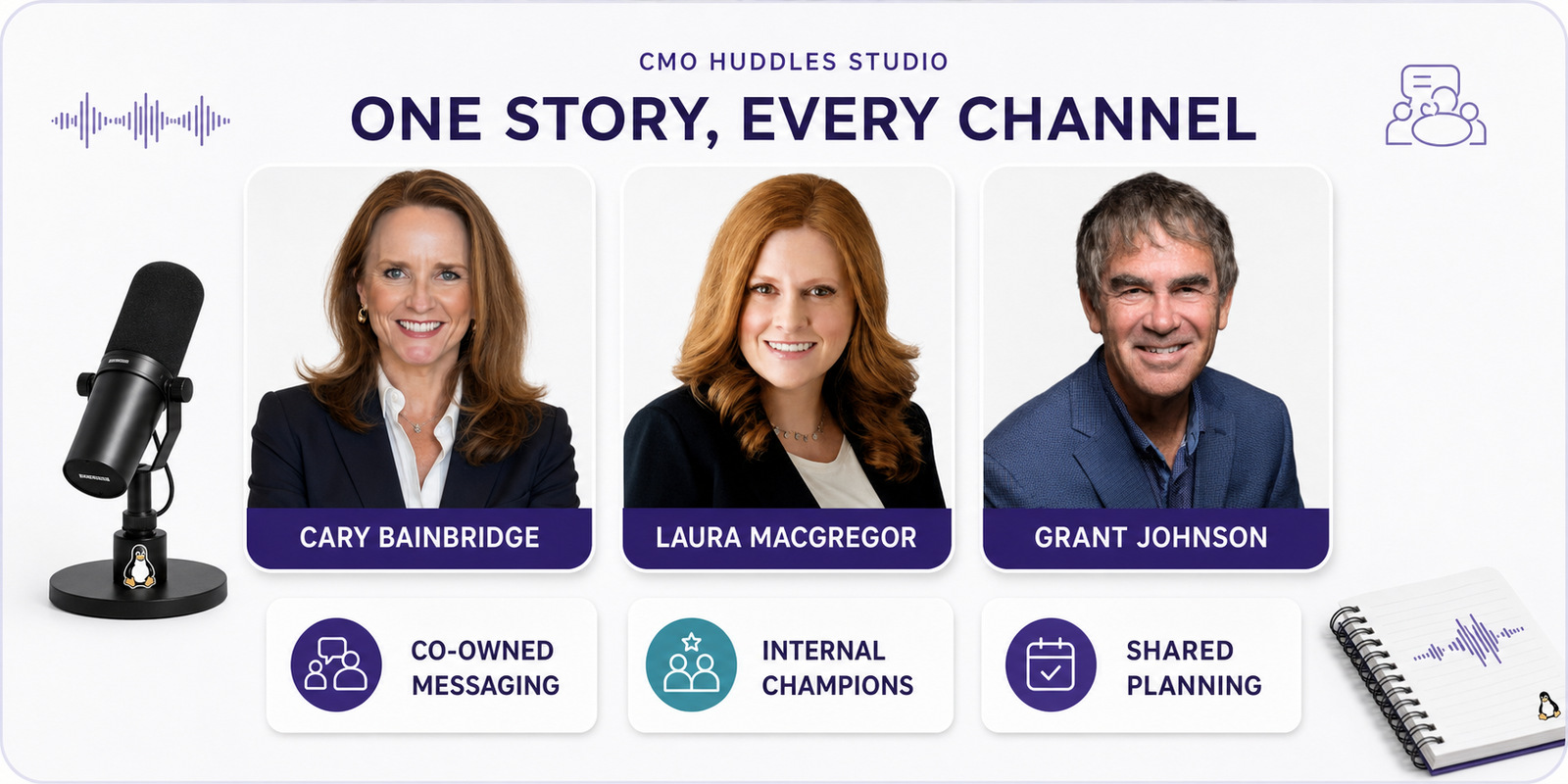
Marketing and communications become more effective when they share a story, operating cadence, and view of business priorities. Cary Bainbridge, Laura MacGregor, and Grant Johnson show how co-owned messaging, joint planning, internal brand champions, crisis preparation, meaningful measurement, and thoughtful AI use can help both functions move together while preserving their distinct expertise and responsibilities.
Marketing and communications may own different channels, audiences, and responsibilities, but buyers, employees, investors, and journalists still encounter one organization. Misalignment becomes visible when teams release conflicting messages, duplicate work, or respond differently to the same event.
In a CMO Huddles Studio conversation about marketing and communications alignment, Cary Bainbridge of ABM Industries, Laura MacGregor of the Center for Internet Security, and Grant Johnson of Chief Outsiders shared how their teams create consistency without erasing specialized expertise. Their experiences point to an operating model built on trust, shared messages, internal activation, connected measurement, and preparation before an urgent situation demands it.
At ABM Industries, Cary owns brand, marketing strategy and operations, and product marketing. Her communications partner oversees external public relations, media, investor relations, crisis communication, culture, and internal communications. Paid media sits with marketing, earned media sits with communications, and owned media is shared.
That arrangement creates overlap by design. Cary described what makes it workable.
“Collaboration is really the foundation of how we operate. You have to be collaborative, and in that way, it comes with mutual trust, respect, transparency.”
Trust allows the lead to change as the work changes. Product marketing may lead the early market framing for a launch. Communications may lead media strategy or crisis response. Marketing may lead paid activation while both teams shape owned channels.
Cary compared the relationship to people traveling in the same car. Everyone is headed to the same destination, even though the driver may change along the route.
Clear ownership prevents the change in leadership from becoming a territorial dispute. Shared visibility prevents one team from learning about the work only after key decisions have already been made.
Laura described how her combined organization approaches a new product or service initiative.
“Every time we have a new product or service, we start with key messages. They’re the foundation for how we would build the campaign.”
Those key messages can then inform campaign assets, media outreach, executive communication, employee materials, sales enablement, social content, and digital experiences.
The language may change across channels because each audience needs different context. The central narrative remains recognizable.
Co-development also gives the teams a chance to resolve disagreements before the message reaches the market. Product marketers can contribute customer, product, and competitive knowledge. Communications specialists can sharpen the broader narrative and anticipate questions from journalists, employees, and external stakeholders. The process produces a story that can travel without becoming several conflicting stories.
Internal communication plays a particularly important role at ABM Industries, which has approximately 100,000 employees, including around 10,000 staff and management employees.
Cary returned to the way the two functions work together.
“We work closely together on the enablement of our own teams, and then how we tailor that message for our external audiences. So it all starts inside.”
Employees need more than early access to an announcement. They need to understand what the story means, how it connects to their work, and how they can express it credibly.
ABM used a cross-functional brand council and internal champions to support a large-scale brand activation. Town halls, tools, field stories, surveys, and feedback loops allowed the message to move through the organization while giving employees a way to respond.
The external promise becomes easier to believe when employees can recognize it in the company’s behavior.
Communications teams need enough access to understand the decisions, risks, and priorities shaping the company. Without that context, they may receive information too late to influence the message or prepare for stakeholder questions.
Direct relationships with senior leaders can help communications anticipate what may become important externally. Marketing can contribute customer, market, and campaign context, while communications can identify reputational implications and areas requiring preparation.
This exchange is especially valuable when a product decision, organizational change, or external event affects several audiences at once. Employees, customers, partners, media, and investors may require different versions of the message, but those versions still need to reflect the same facts and company position.
A crisis exposes operating weaknesses quickly. If teams lack established decision rights, they may issue inconsistent responses, wait too long for approval, or create confusion across internal and external channels.
A shared playbook can identify:
The playbook cannot predict every event. Its value comes from establishing relationships and responsibilities before time pressure makes coordination more difficult.
Marketing may not lead the response, but its customer knowledge, channel access, and messaging discipline can still contribute. Communications may lead the situation while relying on marketing to keep ongoing customer communication accurate and consistent.
Marketing and communications do not need identical dashboards. They do need a shared view of what the company is trying to accomplish and how their respective measures contribute.
Grant has used cross-functional scorecards to connect activity with business priorities. Depending on the initiative, the combined view may include:
A product launch, for example, may combine media quality, campaign engagement, website behavior, sales use, and pipeline movement. Each function retains its specialist measures while contributing to a broader business story.
This connected view can also expose gaps. Strong coverage with limited message pull-through suggests one problem. High engagement with weak sales adoption suggests another. The teams can investigate the system instead of defending isolated metrics.
Grant approaches prompting as a form of structured delegation.
“The way I think about prompting is like giving instructions to a very smart intern. If I can give them instructions that include the expertise that I have, then the output they produce is a lot better.”
AI can support drafting, localization, research synthesis, analysis, workflow coordination, and content adaptation. Its usefulness depends on the quality of the instructions, source material, and review.
A shared messaging foundation gives AI-supported workflows more reliable inputs. Teams can provide approved language, audience context, examples, constraints, and channel requirements. Without that foundation, the technology may reproduce the inconsistencies the organization is trying to eliminate.
Human review remains responsible for factual accuracy, tone, judgment, and risk. Speed is useful only when the resulting message still reflects the company’s position.
The operating model described by Cary, Laura, and Grant relies on repeatable practices:
The result is not one blended function. Marketing and communications retain their distinct expertise while working from the same narrative and business priorities.
When the relationship exists before the work becomes urgent, the company can move faster without fragmenting the story.
No. Shared priorities, clear ownership, trust, and a regular operating cadence can support alignment across different reporting structures.
Marketing and communications can co-own the core narrative while adapting it for their respective audiences and channels.
Relevant measures may include message adoption, targeted reach, traffic, engagement, employee understanding, customer advocacy, and crisis readiness.
AI can assist with drafting, localization, research, coordination, and analysis when teams provide sufficient context and retain human review.
Listen to the full Marketing and Communications conversation.
CMO Huddles helps B2B marketing leaders win by bringing together peers, fresh perspectives, and opportunities to build stronger personal brands. Want to join the huddle? Learn more about CMO Huddles and join CMO Huddles Starter.