
Back to Blogs
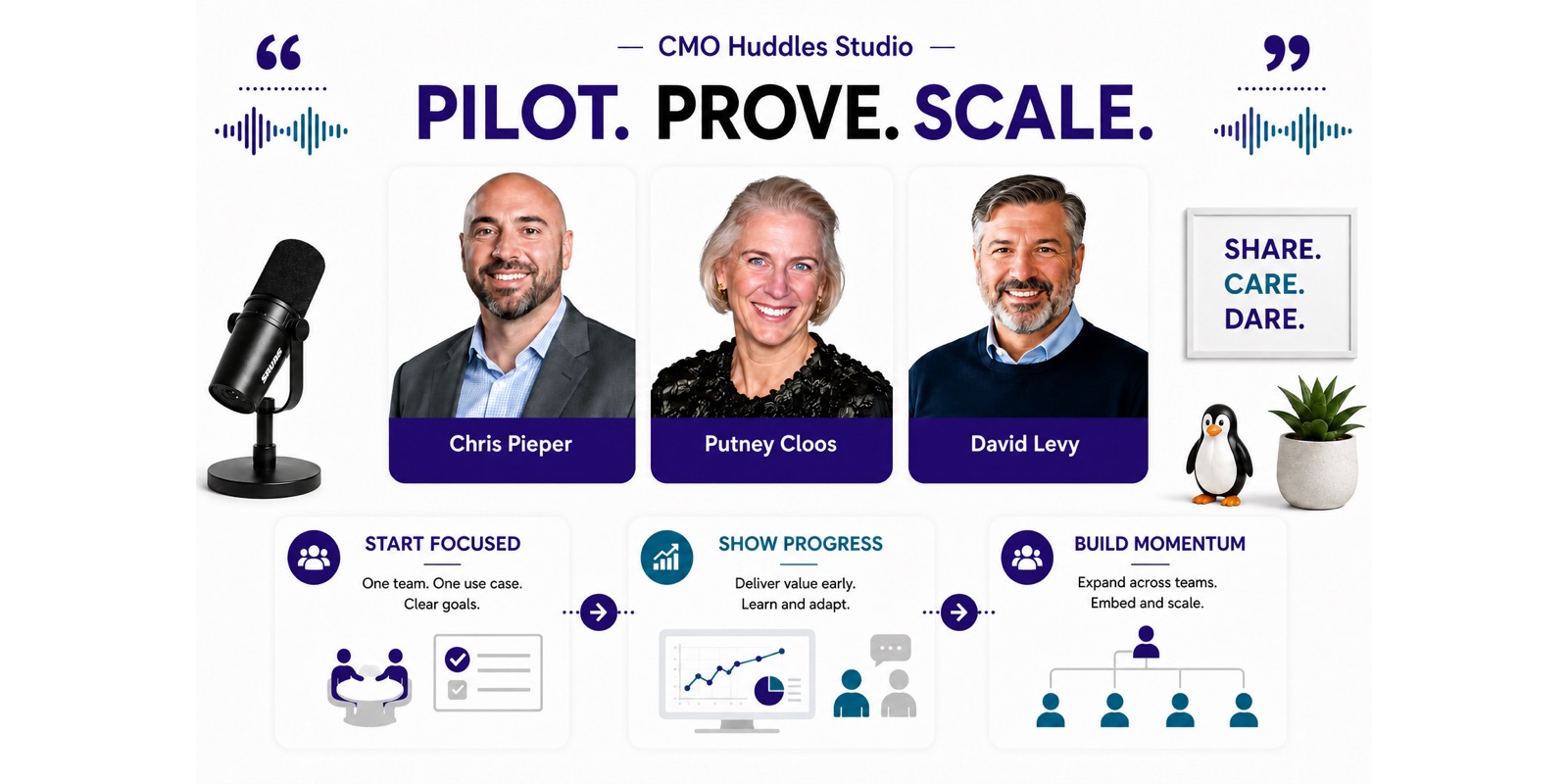
Transformation gains credibility through visible progress, honest expectations, and evidence that a new approach can work. Chris Pieper, Putney Cloos, and David Levy explain how pilots, champions, milestones, parallel operating lanes, and selective scaling help organizations move through uncertainty. Transformation succeeds as an act of leadership that changes organizational operating systems, expectations, behavior, and mindsets.
Transformation is easy to announce and difficult to absorb. The destination may be compelling, but employees still need to understand how daily work, priorities, and expectations will change.
A CMO Huddles Studio conversation about leading transformation brought together Chris Pieper, Putney Cloos, and David Levy.
“Transformation isn’t just about changing approaches. It’s really about shifting mindsets as a key factor of success.”
Chris’s distinction places behavior and belief inside the transformation. The shift becomes visible when teams begin making decisions differently, not when new language first appears in a presentation. A strategy may define the intended destination. The organization still needs to develop the confidence, capability, and operating discipline required to move toward it.
A pilot gives the organization a bounded way to test a new approach. The scope needs to be meaningful enough to produce evidence and small enough to limit risk.
Chris described using “small-scale pilots” with sales champions who had “the appetite for this,” then sharing the early wins to build credibility with their peers. Participation from respected sales partners helped the emerging motion gain support beyond marketing before ADP expanded it across the market.
The measure needs to connect with the case for change. If the transformation intends to improve pipeline, the pilot can examine account progression, opportunity quality, conversion, or another relevant commercial signal. A small win does not prove the entire model. It creates a stronger basis for the next decision and exposes what broader adoption might require.
“Scrappy to industrial strength. We’re in the scrappy mode. So it means we’re piloting it, we’re doing it in sort of a dirty way, but we’re not letting perfect get in the way of good enough.”
Putney’s description treats scrappy work as a stage rather than a permanent operating standard. The team can test the central idea before investing in automation, integration, governance, and scale. A pilot also reveals what industrial strength will require. Manual steps expose missing data. Close collaboration uncovers unclear ownership. Quality problems identify where review or training belongs.
Scaling too early can harden a weak process. Waiting for perfection can prevent the organization from learning anything. A pilot becomes useful when the team records what happened, which assumptions proved correct, where the process failed, and what another iteration would change.
Transformation often loses support in the period after initial excitement and before large results appear. A simple roadmap can make the intermediate work visible. Milestones might include completing a pilot, establishing a workflow, training a team, integrating data, expanding participation, or demonstrating the first commercial result.
The roadmap helps leaders distinguish slow progress from no progress. It also creates moments when the organization can decide whether to continue, adapt, or stop.
Visibility matters because employees and executives experience transformation from different distances. The people building the system may see daily movement while everyone else sees only the absence of a final result. Progress updates can show what the organization learned, which barrier was removed, and what evidence will determine the next step.
David described parallel lanes that allow the organization to protect the current business while building a future model. This ambidextrous approach recognizes that existing customers, campaigns, and revenue commitments cannot simply stop. At the same time, assigning every resource to current performance leaves no capacity for change.
Separate lanes can clarify measures and expectations. The existing system may be evaluated on reliability and performance. The emerging system may be judged on learning, feasibility, and movement toward strategic milestones.
The two lanes eventually need to reconnect. A pilot isolated indefinitely from the core business may become an innovation showcase without changing how the company operates. Evidence provides the bridge. Once the emerging model demonstrates value, leadership can decide which parts belong in the core and what the organization needs to stop or redesign.
Employees may resist transformation because they do not understand it, do not trust it, or have seen previous programs disappear. Visible evidence reduces some of that skepticism. Internal champions add another source of credibility because colleagues can hear from people who tested the approach directly.
Communication also needs honesty about what is known, what remains uncertain, and how roles may change. Overpromising creates cynicism when reality becomes messier than the launch story.
Belief grows when employees can connect the transformation with a real problem and see that leadership remains engaged after the announcement. Participation can deepen that belief. People who help test, improve, and explain the new model are more likely to understand why it exists and what successful adoption requires.
Transformation requires capacity. Adding new responsibilities on top of every existing commitment creates exhaustion instead of change.
Leaders can identify activities, reports, meetings, campaigns, and processes that no longer justify the resources they consume. Stopping low-value work makes the priority credible because the organization can see what the new direction replaces.
The tradeoff also prevents transformation from depending on heroics. Employees gain time to learn and build without treating the new model as work performed after their real jobs are finished.
These decisions may be difficult because older work often has owners, history, and political support. Clear evidence and explicit priorities make the conversation more manageable.
“Transformation is not a campaign, it’s not a value proposition, it’s not a brand promise. It’s an act of leadership.”
Marketing can explain the change and make progress visible, but communications cannot substitute for decisions about resources, roles, systems, and accountability. Leadership remains responsible through the messy middle, when the old model still operates and the new one has not yet proven itself. That responsibility includes determining what the organization will protect, where it will experiment, which evidence matters, and when a pilot is ready to influence the core.
A focused pilot produces evidence, exposes operating requirements, and limits risk before broader scaling.
It describes moving from a manual test to a repeatable system with the integrations, standards, and governance required for scale.
Parallel operating lanes can preserve current performance while a separate team tests and develops the future model.
They often lose support when progress is invisible, expectations are unrealistic, ownership is unclear, or no capacity is released from existing work.
Listen to the full conversation with Chris Pieper, Putney Cloos, and David Levy.
CMO Huddles helps B2B marketing leaders win by bringing together peers, fresh perspectives, and opportunities to build stronger personal brands. Want to join the huddle? Learn more about CMO Huddles and join CMO Huddles Starter.