
Back to Blogs
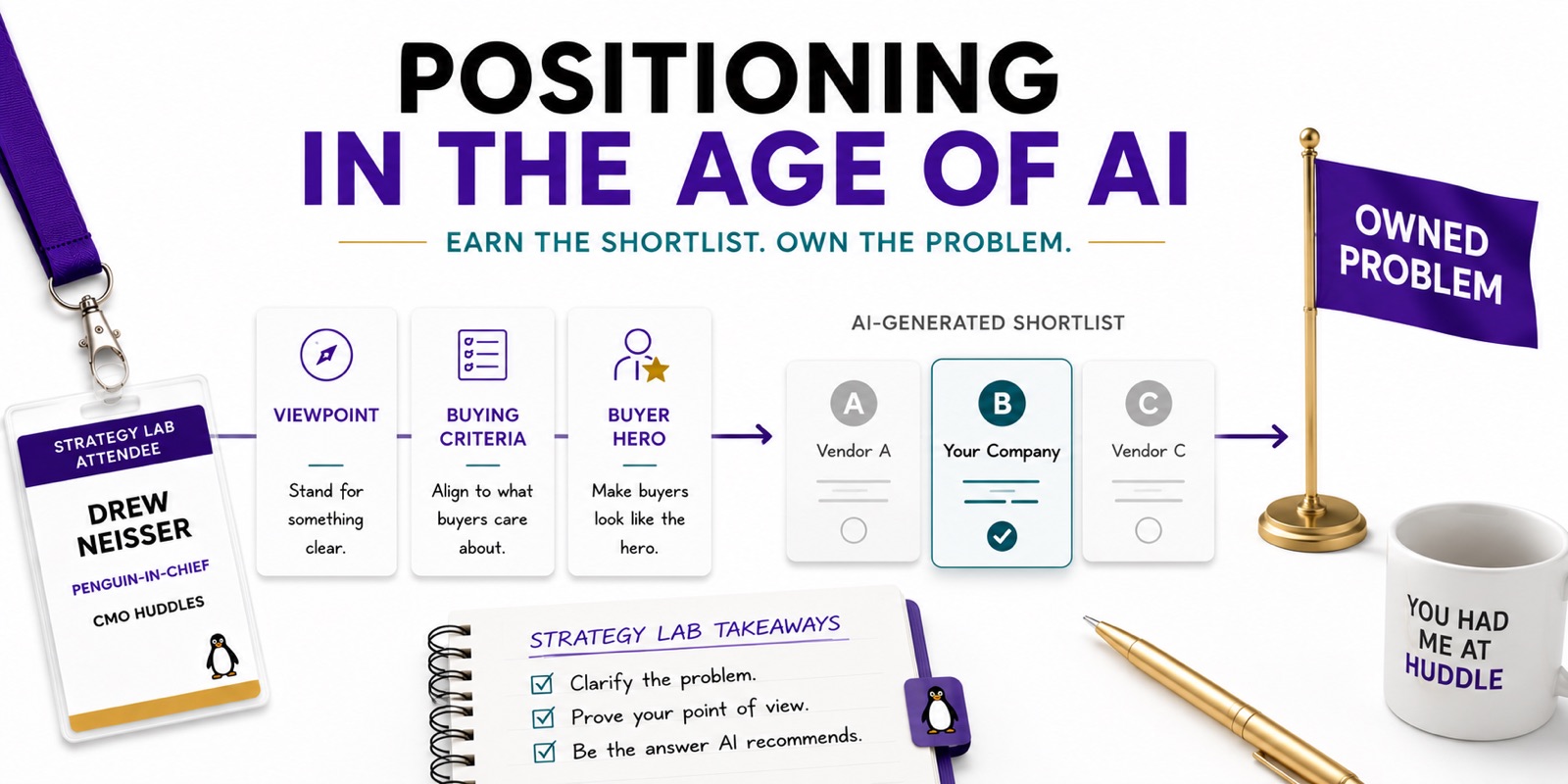
In AI-assisted buying journeys, positioning begins shaping the shortlist before sales enters the conversation. Bob Wright and Ellie Victor offer a practical system: Hold a market viewpoint, name the buyer's problem, define favorable buying criteria, claim a credible hill, align executives, and repeat the position consistently enough for buyers and AI to understand it clearly.
A buyer once depended on websites, sales conversations, analysts, peers, and product demonstrations to understand a vendor.
Those sources still matter. AI-assisted research has changed when the market begins forming an opinion.
A buyer can now ask an AI system to compare approaches, identify vendors, explain differences, and suggest evaluation criteria before contacting a salesperson. The response reflects whatever signals the system can find.
At the 2026 CMO Huddles Strategy Labs, Bob Wright of Firebrick and Ellie Victor of ZOOM Marketing explored what this shift means for B2B positioning.
Their frameworks converge on one idea: A company needs a clear position before a buyer or an AI system begins describing it.
Bob's five-pillar framework begins with a point of view.
A viewpoint is not a product opinion or a collection of features. It is a market stance about what has changed, what is broken, or why an old approach no longer fits the buyer’s environment.
“Have a viewpoint. Own a problem. Take a corner of the room.”
A distinctive viewpoint gives the company a recognizable role in the market conversation.
Without one, content may be accurate but generic. AI systems then have little distinctive language to associate with the company.
Product-led positioning often explains how technology works before establishing why the buyer needs it.
Bob favors the opposite sequence:
Buyers buy from pain and problems. Name the problem, not the category, not the product.”
Naming the problem gives buyers language for something they already experience. It can also help the company build authority around a focused subject.
This becomes especially relevant in crowded AI categories. ‚AI-powered‚ describes a broad technology choice, not a differentiated position. Specific problems, proprietary data, and purpose-built capabilities create stronger signals.
Once the problem is named, the company can define what solving it requires.
Bob calls these requirements success principles. They describe the capabilities, practices, or conditions a buyer needs to address the problem effectively.
The strongest success principles also correspond with the company's genuine differentiators.
This changes the competitive conversation. Instead of accepting a generic feature checklist, the company gives buyers a more useful framework for evaluating possible approaches.
The objective is not to manipulate the buyer. It is to make a well-supported case for which criteria matter and why.
Ellie describes positioning through a two-part metaphor:
The hill is the market space the company can credibly claim. The second part defines what buyers need to value within that space.
“Be very clear about the space you want to own in the next two years.”
The time horizon matters. A position needs to reflect what the company can support with its product, roadmap, customer evidence, and market credibility now.
A position that tries to claim an entire mountain range may become too broad to mean anything.
Ellie's animal diagnostic helps reveal the current state of a company’s positioning:
Hamster: The company produces activity but has not established a clear strategic direction.
Pigeon: The company has broad visibility but blends into the category.
Lion: The company has claimed recognizable territory around a specific buyer and problem.
Most companies come to me as hamsters or pigeons. The work is to figure out which lion they could be.”
The value of the exercise is not the label itself. It is whether executives share the same understanding of the company’s current position and intended territory.
If the CEO, CRO, CMO, and product leader provide different answers, the inconsistency extends into campaigns, sales conversations, partner content, and AI-generated descriptions.
Positioning reaches beyond marketing when it defines the problem the company owns, the buyer it prioritizes, and the opportunities it leaves outside that position. Bob and Ellie both connected successful positioning to alignment among the CEO, CRO, product leader, and CMO.
Saying no gives the position definition. Excluding buyer segments, use cases, or claims the company cannot credibly own makes the chosen territory easier for buyers, employees, and AI systems to recognize.
A product demonstration can persuade a practitioner while still failing to create executive urgency.
Bob’s framework connects the named problem to its financial, operational, or strategic consequences. That gives an internal champion a story capable of traveling upward.
The buyer remains the central character. The positioning describes the problem they face, the criteria they can use, and the future they could create.
The product supports that journey rather than becoming the opening subject.
Positioning loses value when it changes after every lost deal, product update, or competitor announcement.
Bob described the discipline required after the position is selected:
“Positioning is not code. Don’t iterate it. Stick with it.”
Feedback still matters. Win rates, sales-cycle length, executive access, analyst language, customer response, and internal consistency can reveal whether the position is gaining traction.
The distinction is between improving activation and repeatedly replacing the underlying position.
Consistent language across the website, executive communications, employee profiles, partner content, and earned media also gives AI systems a more coherent body of evidence.
Bob’s five pillars provide the architecture: Viewpoint, named problem, buying criteria, executive relevance, and buyer success.
Ellie’s framework tests whether the company has selected a credible hill and committed to it.
Together, they show why positioning in the AI era is more than a messaging exercise. It shapes how buyers and machines understand the company before a salesperson has an opportunity to clarify the story.
AI can shape vendor comparisons and shortlists before direct sales contact, making clear and consistent market signals more important.
It means giving a recognizable name to the buyer pain a company is uniquely equipped to address.
It distinguishes between activity without direction, broad but generic visibility, and ownership of specific market territory.
Bob’s framework allows approximately 12 to 18 months before reconsidering the position, with activation feedback gathered along the way.
Explore the complete Strategy Lab synthesis in 7 B2B Positioning Lessons for the Age of AI, The 5 Positioning Pillars Every B2B Category Leader Gets Right, and What Is B2B Positioning? A Framework for Owning Your Hill.
CMO Huddles helps B2B marketing leaders win by bringing together peers, fresh perspectives, and opportunities to build stronger personal brands. Want to join the huddle? Learn more about CMO Huddles and apply to join the community.