
Back to Blogs
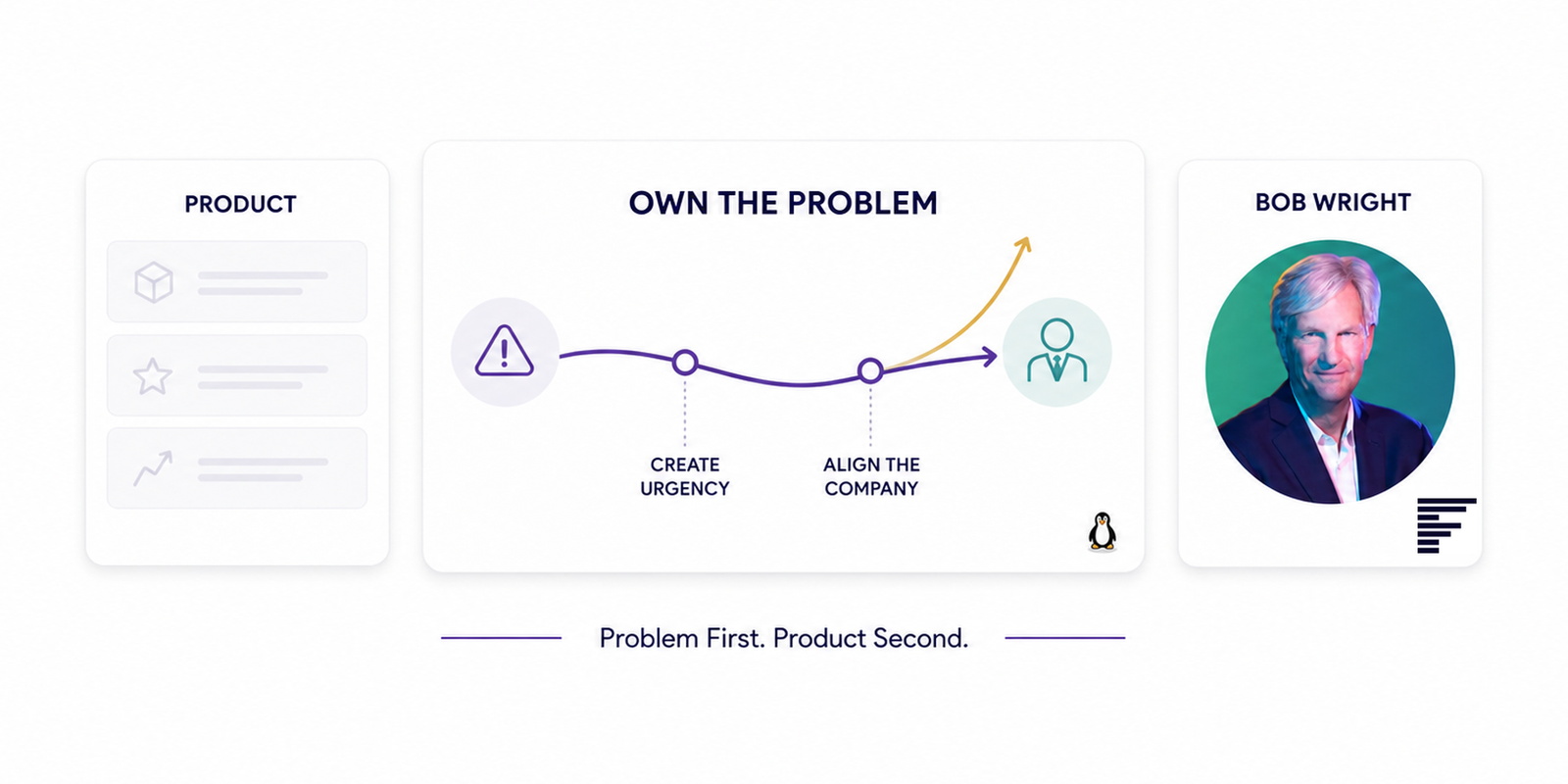
Product-first messaging is one of the fastest ways for a B2B company to sound like everyone else. In a CMO Huddles Expert Huddle, Bob Wright, founder of Firebrick, explained why positioning should be treated as a growth lever: It helps companies own a market problem, create urgency, align the executive team, and give sales a sharper story.
The lesson for CMOs is simple but not easy: Stop leading with what the product does. Start with the problem your buyer urgently needs to solve.
Feature-and-function decks feel safe because they are concrete. They show what the product does, how it works, and why the team is proud of it.
But buyers rarely wake up wanting another product. They wake up with a business problem, a stalled initiative, a risk they cannot ignore, or a number they need to move.
That’s why Bob Wright’s positioning advice lands so cleanly for B2B CMOs: “Executive buyers don’t care about how your product works, and they don’t want more technology. Sell the problem, not the product.”
That shift changes the whole conversation. Instead of asking prospects to care about another platform, CMOs can frame the product inside a business issue the buyer already feels. The product still matters, of course. But it becomes the proof, not the opening argument.
“What’s important to wake the market up and distance yourself from all the other noise in the marketplace is to have a viewpoint and own a problem.” — Bob Wright, Firebrick
Bob named three mistakes that show up again and again in B2B positioning work:
That last point matters especially now. Many buying committees are cautious, budgets are scrutinized, and buyers can often delay decisions without immediate consequences. Positioning has to make the cost of inaction visible.
The best positioning doesn’t invent pain out of thin air. It names something buyers are already experiencing but may not have language for yet.
Bob compared this to the classic idea of creating a category-defining problem. In B2B tech, that could mean naming an “AI Acceleration Gap,” a “Margin Erosion Zone,” or another business issue that makes buyers say, “Yes, that is exactly what we are dealing with.”
That’s the sweet spot. The buyer recognizes the problem. The company gives it sharper language. Then the solution becomes easier to understand, evaluate, and prioritize.
“What’s really working today is: Have a viewpoint, own a problem in the marketplace, set the buying criteria necessary to solve that problem, and show companies the promised land.” — Bob Wright, Firebrick
CMOs may run the positioning process, but Bob was clear that positioning cannot live inside marketing alone:
If the CEO isn’t in the room, Bob’s advice is blunt: Don’t move forward.
That may sound dramatic, but it’s practical. Positioning shapes how the company competes, what sales says, how the category is framed, which buyer problem gets elevated, and why the company deserves budget now. That’s executive-team territory.
“Positioning is not a marketing initiative. Certainly it will fuel your marketing investments, but if you do positioning right, it’s going to make a huge impact on sales cycles.” — Bob Wright, Firebrick
One of the most useful parts of the conversation was Bob’s distinction between branding and positioning.
Branding is the corporate identity, tone, experience, and emotional wrapper around the company. It should last. Positioning is more closely tied to revenue growth, category strategy, sales conversations, competitive pressure, and market timing.
That means a CMO walking into a new role should be careful before defaulting to a rebrand. If the company looks dated, maybe brand is the issue. But if sales cycles are long, reps are using different decks, competitors sound too similar, or the website looks interchangeable with everyone else’s, the deeper issue may be positioning.
Bob put it simply: In B2B, it’s “big positioning, small branding.”
AI has made positioning both more urgent and more difficult.
Buyers want to know a company’s AI story. Boards and investors want AI in the narrative. But if every company says “AI-powered,” “AI-enabled,” or “AI-driven,” the phrase quickly becomes wallpaper.
Bob called this “the great AI washing.” His advice: Don’t bolt AI onto the message. Decide what role AI should play in the positioning.
For some companies, AI belongs front and center. For others, it should support a larger problem-led story. The stronger move is to name what makes the AI specialized, name the data advantage if one exists, and connect both back to a business problem buyers actually care about.
That’s the difference between sounding current and sounding credible.
“Please, just don’t put ‘AI-powered this’—that’s just wallpaper now. It looks like your AI is just a bolt-on conversation.” — Bob Wright, Firebrick
Positioning shouldn’t be treated as a once-a-decade exercise. Markets move. Competitors change. Buyers shift. Companies acquire products, move upmarket, expand into enterprise, or face new category dynamics.
Bob named several red flags that suggest positioning needs a refresh:
For CMOs, the point isn’t to rewrite the company story every quarter. It’s to keep checking whether the current story still helps buyers understand why the company matters now.
One of Bob’s most memorable metaphors was about owning a corner of the room.
If buyers walk into a category and every vendor is standing in the middle saying roughly the same thing, the safest decision is often no decision or the biggest brand name. That’s a dangerous place for most companies to compete.
The better move is to claim a distinct corner: The problem you solve best, the buyer you serve best, the urgency you can prove, and the differentiation competitors cannot easily copy.
“What’s the corner of the room you can own? What’s the respective corners your competition’s trying to own? Can you box them into smaller corners of the room and own a very clear, distinct corner of the room in the minds of your buyers?” — Bob Wright, Firebrick
Positioning isn’t wordsmithing. It’s not a tagline. It’s not a prettier homepage headline. Done well, it’s a growth lever.
It helps CMOs answer the questions that matter most to executive buyers: Why this problem? Why now? Why this company? Why should the buyer believe change is worth it?
The strongest positioning starts with a market problem, builds urgency around that problem, defines the criteria for solving it, and then connects the company’s differentiation to that path forward.
That’s how CMOs move beyond product talk and into business relevance.
B2B positioning is the strategic work of defining the market problem a company owns, why that problem matters now, and why the company is uniquely suited to solve it. It’s not just a tagline or a homepage headline. Strong positioning gives buyers a clear reason to care and gives sales a clearer way to create urgency.
Branding shapes the company’s identity, tone, and experience. Positioning is more directly tied to revenue growth, category strategy, competitive differentiation, and sales conversations. In B2B, positioning often needs to evolve faster than brand because markets, competitors, buyers, and product portfolios keep changing.
A CMO should consider refreshing positioning when sales cycles are getting longer, too many deals end in no decision, reps are using different decks, competitors sound too similar, win/loss trends are slipping, AI has made the category noisier, or an acquisition has made the company story harder to explain.
“AI-powered” is weak positioning because it rarely explains why the company matters, what problem it solves, or why buyers should act now. As more companies add AI language to their messaging, generic AI claims become noise. Strong AI positioning connects specialized AI, data advantage, or technical capability to a business problem buyers already care about.
Want to hear more? You can listen to the full conversation on Renegade Marketers Unite: Positioning as a Growth Lever.
CMO Huddles helps B2B marketing leaders win by bringing together peers, fresh perspectives, and opportunities to build stronger personal brands. Want to join the huddle? Learn more about CMO Huddles and apply to join the community.