
Back to Blogs
Drew Neisser is the founder of CMO Huddles and a globally recognized authority on B2B marketing. He’s an AdAge columnist, LinkedIn TopVoice, leading CMO coach, podcast host & friend of penguins everywhere.
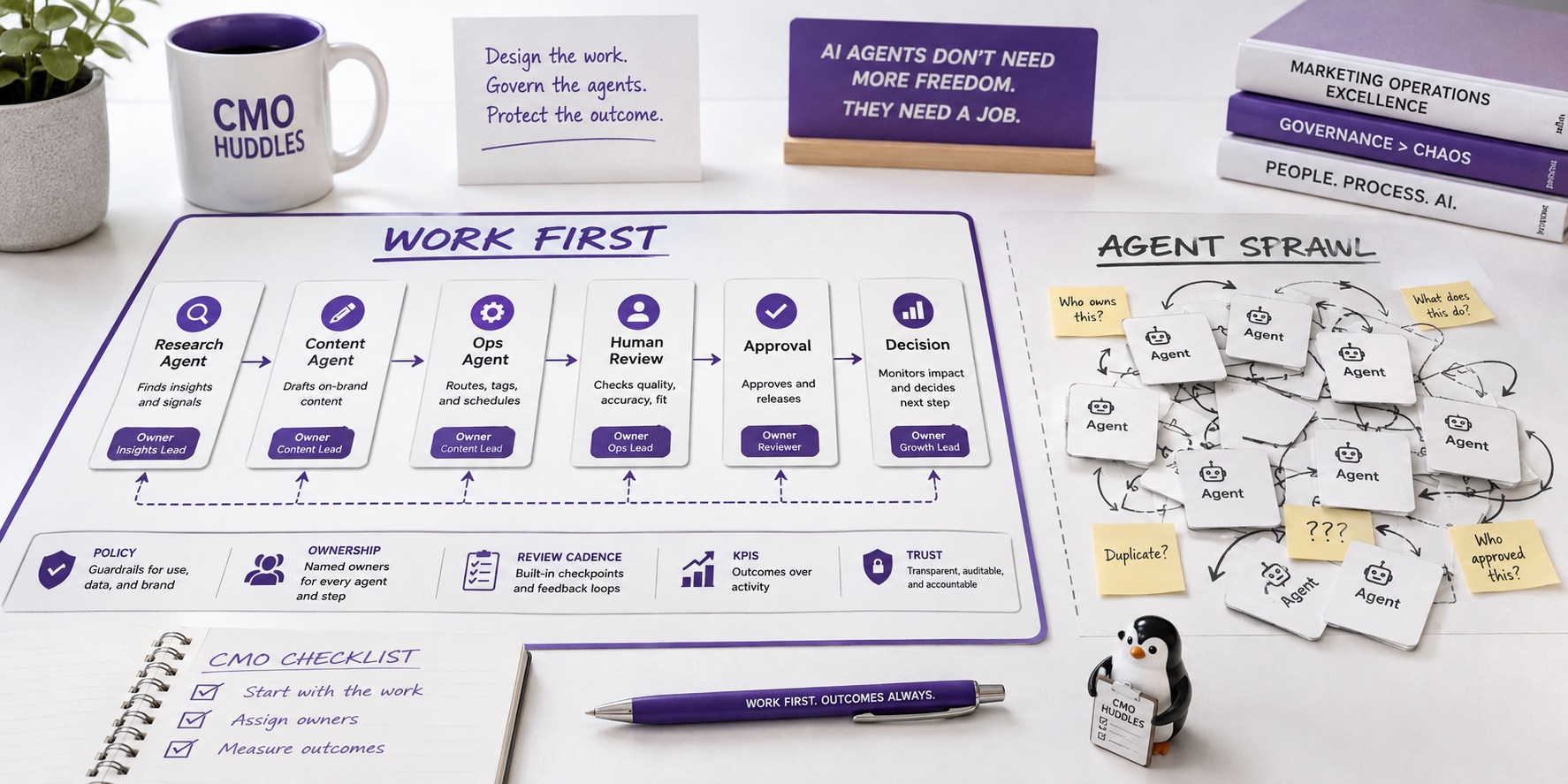
AI agents are getting easier to build, but agent sprawl is already knocking at marketing’s door. Drew Neisser argues that CMOs need to move beyond hackathon enthusiasm and redesign the marketing operating model around work, ownership, governance, maintenance, and business value before agents become the next expensive, ungoverned martech pileup.
91% of marketers say they’re already using AI. And somehow, I think the hard part is just beginning.
Building an agent is getting ridiculously easy. At one recent Huddle, a CMO told me her team built 18 agents in a single-day hackathon. Impressive? Absolutely. But then come the less glamorous questions: Who maintains them? Who makes sure the data feeding them stays accurate? Who watches the costs? And what happens when the person who built Agent #14 leaves?
Welcome to the age of agent sprawl.
Don’t get me wrong. I’m cautiously optimistic because I love what this technology makes possible. AI lets non-coders like me build things we couldn’t touch two years ago, which is both exhilarating and mildly dangerous, like handing a teenager the keys to a sports car and saying, “Just keep it under 90.”
But I also know how easy it is to build something that quietly burns tokens, money, and patience because we don’t yet know what good architecture looks like. An agent can start as a clever helper and quickly become another mysterious thing in the stack that no one wants to unplug because someone, somewhere, might still need it.
The numbers capture the tension. Jasper reports that 91% of marketers are using AI in 2026, up from 63% last year. Gartner predicts more than 40% of agentic AI projects will be canceled by the end of 2027 because of escalating costs, unclear business value, or inadequate risk controls. Deloitte says only 21% of enterprises report having mature governance in place for agentic AI.
In other words, the experiment is over, but the operating model is still wearing pajamas.
Marketers should recognize this movie because we have seen it before. First came the martech gold rush, where every problem apparently required another platform, dashboard, enrichment layer, workflow, attribution model, or “single source of truth” that somehow created five more sources of truth by Thursday.
Now we are doing it again, only faster. Agents are easier to build than platforms, easier to duplicate than workflows, and easier to forget than meetings you declined with “tentative.” That speed is thrilling until the first real audit turns into a scavenger hunt.
Mariia Romanova, an automation specialist focused on CRM administration and business systems, nailed this in a LinkedIn comment. “Agent sprawl is the right name for it,” she wrote. “The same thing happened with no-code workflows a few years ago: everyone could build one, nobody owned the two hundred that piled up, and the first real audit turns into archaeology.”
Her prescription was wonderfully boring, which is exactly why it matters: one named owner per workflow, a two-line note on what it does and why it exists, and a monthly review of anything that has not run in sixty days. As she put it, “The teams that skip that part do not have a system, they have a pile of things that used to work.”
A pile of things that used to work. Put that on the next AI governance slide and watch the room get quiet.
The challenge has changed. The hard part of agentic marketing is no longer building agents. It is redesigning the marketing system around them without creating a costly, ungoverned mess.
That redesign is already happening at companies like Culture Amp, GoTu, and BuildOps. Paige O’Neill’s team at Culture Amp broke marketing into roughly 5,000 units of work and 36 scenarios to figure out what belongs with humans, what can be automated, and how those pieces fit together. She is also clear-eyed about the change management required: “Don’t underestimate the journey that the team has to go on.”
That “5,000 units” detail is the kind of thing that separates serious transformation from executive Mad Libs. Ben Dixon, founder of dixon.ai and an expert in LLM evaluation and AI quality control, called it “the sharpest bit” in the post because most agentic transformation conversations skip that level of granularity. He asked the right follow-up: what counted as one unit: task, output, level, or something else entirely?
That question matters because CMOs cannot redesign marketing around vibes. You have to map the work. Not just the org chart, not just the tools, not just the handoffs, but the actual work: decisions, approvals, inputs, outputs, dependencies, judgment calls, quality checks, and moments where human context still matters.
Agents don’t eliminate the need to understand the work. They punish you faster when you don’t.
At GoTu, Thalía Diedrick has moved from simple AI-assisted workflows to a bespoke agentic project manager called Sprint. The interesting part is not just what Sprint does. Her team treats it like a teammate, giving it context, explaining blockers, and relying on it to keep work moving.
That is where this gets fascinating. We are moving beyond individual productivity tricks toward new operating models for marketing. But the winners will not be the teams with the most agents. They will be the ones that connect those agents into smart workflows, govern them, maintain them, and ultimately prove that all this activity creates business value.
Daniel Gilbert, CEO of Brainlabs, raised another critical point in the comments: “the ‘what happens when the person who built Agent #14 leaves’ question is the one nobody asks in the hackathon.” His team’s answer was to make every agent a shared build that the whole organization iterates. “Community ownership is the fix for sprawl,” he wrote.
I like that. Not because every agent needs a committee, heaven help us, but because the lone-wolf builder model does not scale. If an agent touches meaningful work, then the organization needs to know what it does, where it gets information, what decisions it influences, who maintains it, and when it should be retired.
Otherwise Agent #14 becomes the new spreadsheet from 2017 that everyone fears and no one understands.
Here is where I think some CMOs are underestimating the moment. This is not just a tooling issue. It is an org design issue.
To truly capitalize on AI, marketing organizations will need to evolve their structures. Some roles will become more strategic. Some workflows will disappear. Some functions will merge. Some specialists will become orchestrators. Some leaders will need to manage human teams and agent-enabled systems at the same time.
That does not mean putting every bot on the org chart and giving it a jaunty title like “Assistant Vice President of Webinar Repurposing.” Please don’t. But it does mean CMOs need to understand how work is changing before they make structural changes.
Start with the work. Then redesign the operating model. Then rethink the org.
Today, I’m moderating a conversation with Paige O’Neill of Culture Amp, Thalía Diedrick of GoTu, Colin Piper of BuildOps, and Neil Tewari of Conversion about what it actually takes to redesign marketing around agents without creating a mess. That timing is useful, but this conversation is bigger than one webinar. If you can't join us at 2pm ET, you can watch the replay here.
We will continue it at the CMO Super Huddle on October 22-23 in Palo Alto, where the Future of Marketing Org Design is very much on the table. Because if AI agents are going to change how marketing work gets done, CMOs cannot delegate the operating model to whoever got most excited during the hackathon.
Agent sprawl is not inevitable, but it is highly acheivable. It starts innocently: one agent to summarize calls, another to write briefs, another to check content, another to build lists, another to monitor competitors, another to prepare QBRs, and suddenly you have a digital junk drawer with API access.
CMOs need to get ahead of this now. Map the work. Decide what should stay human, what should be automated, what should be augmented, and what should be eliminated. Assign ownership. Design for maintenance. Build shared practices. Track costs. Measure outcomes. Retire what no longer creates value.
The future of marketing will not belong to the teams with the most agents. It will belong to the teams that redesign the work around the right agents.
Otherwise, congratulations. You didn’t solve martech sprawl. You gave it a chatbot.
Agent sprawl happens when teams build or adopt many AI agents without clear ownership, governance, documentation, maintenance, cost control, or business impact. It is the agentic AI version of martech sprawl.
Agent sprawl can create hidden costs, inconsistent outputs, poor data quality, security risks, duplicated work, and operational confusion. It also makes it harder to prove that AI activity is improving business outcomes.
CMOs should map the work first, define which tasks belong with humans or agents, assign named owners, document each agent’s purpose, monitor costs and usage, and review agents regularly for quality and relevance.
AI agents change how work gets done, which means they eventually affect roles, workflows, approvals, skills, and team structures. CMOs who only add agents to old processes may get more speed without meaningful transformation.
Not automatically. Teams should start with real workflow pain, clear business outcomes, reliable data, and a maintenance plan. Building an agent is easy. Building one that remains useful, trusted, and aligned with business value is harder.