
Back to Blogs
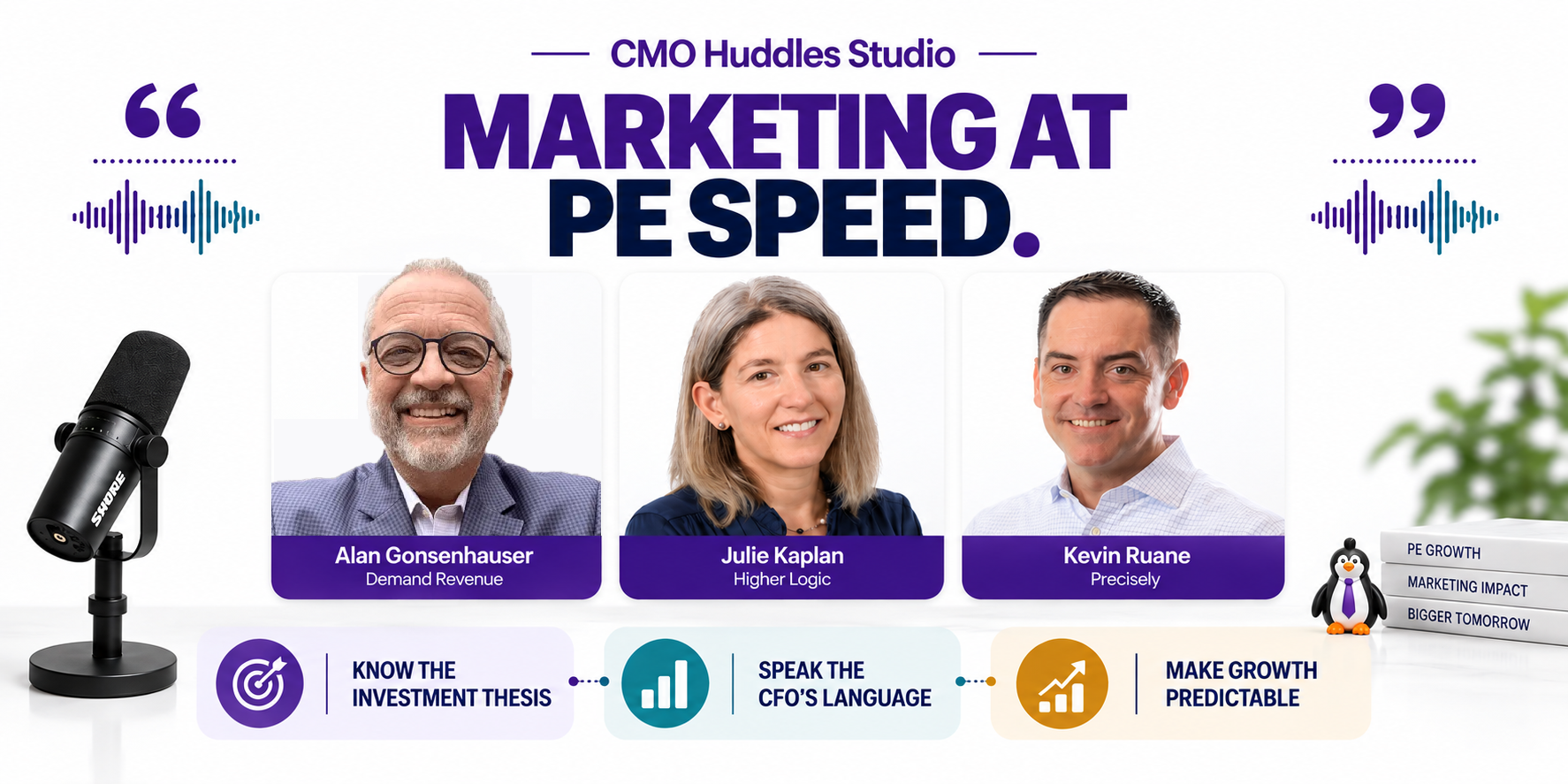
PE-backed CMOs operate under a different level of speed, scrutiny, and financial accountability. Kevin Ruane, Julie Kaplan, and Alan Gonsenhauser share how marketing leaders can understand the investment thesis, earn CFO and board trust, own pipeline outcomes, and make growth more predictable and explainable.
A CMO entering a private equity-backed company quickly discovers that the marketing conversation changes.
The PE sponsor has an investment thesis. The company has specific growth expectations. The CFO is watching the economics. The board wants to understand what is working, what is changing, and where additional investment can create value. Marketing leaders are expected to develop a point of view quickly and explain how their decisions support that larger business story.
In a CMO Huddles Studio conversation, Kevin Ruane of Precisely, Julie Kaplan of Higher Logic, and Alan Gonsenhauser of Demand Revenue explored what it takes to lead marketing successfully in that environment.
Their advice converges around a central idea: Marketing becomes more credible when the CMO understands the economics of the business as deeply as the marketing plan and can connect investment to outcomes that matter to the sponsor, board, CEO, and CFO.
For Kaplan, one of the first jobs of a PE-backed CMO is understanding what the sponsor is trying to accomplish.
“It's important to understand what your PE firm is trying to accomplish with their portfolio,” Kaplan said. “What story are they trying to tell with their portfolio? What does an exit look like for them?”
Those questions provide essential context for marketing strategy. A sponsor pursuing aggressive organic growth may have different priorities from one focused on acquisitions, market expansion, operational efficiency, or preparing the business for an eventual exit.
The CMO needs to understand that destination before deciding which marketing capabilities and investments deserve priority.
That understanding also extends to the executive team. Kaplan recommends learning what each leader is accountable for and where marketing can help advance those goals. When the CMO understands the CEO's growth expectations, the CFO's financial requirements, the sales leader's pipeline needs, and the sponsor's investment thesis, marketing decisions can be framed around shared business priorities.
This makes the marketing plan part of the value-creation plan rather than a parallel functional agenda.
Private equity ownership can create pressure to move quickly, but speed becomes expensive when a company scales an ineffective marketing engine.
Before adding budget, headcount, channels, or technology, CMOs need to understand where the current system works and where it breaks. That can mean examining positioning, demand generation, conversion, sales handoffs, customer economics, technology, measurement, and team capabilities.
The distinction matters because additional investment can amplify both strengths and weaknesses.
Kaplan's perspective is particularly relevant when a PE-backed company expects rapid growth. The CMO may inherit an ambitious target and feel pressure to immediately increase activity. A better first step is determining whether the existing growth system can support that ambition.
If conversion is weak, adding more leads may simply create more waste. If positioning is unclear, increasing media spend can amplify a message that does not resonate. If sales and marketing disagree about the target market, scaling demand generation can deepen the disconnect.
The fastest route to growth may begin with fixing the constraints that prevent current investments from performing.
Gonsenhauser argues that successful PE-backed CMOs behave more like P&L leaders. That requires ownership of the outcomes marketing is expected to influence, particularly pipeline and growth.
In his view, CMOs need to understand the investment thesis, know the company's growth targets, and align marketing with what the business is trying to accomplish.
That changes the questions marketing brings into executive conversations. Instead of leading with campaign volume, engagement, or lead counts, the CMO can explain how marketing contributes to pipeline, where growth is coming from, which assumptions are changing, and what additional investment is expected to produce.
This level of accountability also strengthens the CMO's ability to advocate for marketing. A leader who understands the company's economics can have a much more productive conversation about why a particular investment matters and what the business should expect in return.
Marketing metrics still have a role, but they become evidence inside a broader business argument rather than the argument itself.
“The best CMOs I've worked with at PE portfolio companies have made growth more predictable and more explainable,” Gonsenhauser said, “and they take the mystery out of marketing for the PE sponsors to see what the value is of marketing.”
Predictability does not require promising that every marketing dollar will produce a perfectly attributable return. It requires giving leadership a clearer view of how the growth engine works.
A CMO should be able to explain which segments matter, how demand is created, where pipeline comes from, how opportunities progress, what conversion assumptions underpin the plan, and where investment could change the outcome.
When performance differs from the plan, the explanation matters just as much. CMOs gain credibility when they can identify what changed, what they learned, and what they will do next.
That discipline turns marketing from a collection of activities into an operating model the board can understand.
Financial fluency becomes especially important in a PE environment, and the CFO can be one of the CMO's most valuable partners.
The CFO understands how the board and sponsor evaluate performance, which financial assumptions matter most, and how competing investments are compared. A strong relationship gives the CMO a better understanding of how marketing decisions will be interpreted before those decisions reach the boardroom.
It also creates an opportunity to establish shared definitions. Marketing and finance can align on pipeline assumptions, customer acquisition economics, investment horizons, attribution limitations, and the evidence required to justify additional spending.
That preparation helps prevent board discussions from becoming debates over basic numbers or definitions.
For CMOs accustomed to explaining marketing primarily to marketing audiences, the shift requires a different vocabulary. Revenue, margin, growth rates, efficiency, investment requirements, risk, and expected business impact need to sit alongside marketing performance measures.
The objective is clarity. When the CFO understands how marketing creates value, that understanding can travel into conversations with the CEO, board, and PE sponsor.
Ruane highlights another reality of private equity leadership: The CMO is expected to develop an opinion about the business quickly.
That expectation extends well beyond campaigns and brand. The CMO may be asked for a perspective on the market, customers, competitors, growth opportunities, company direction, and where investment should go next.
For a first-time PE-backed CMO, the speed of that expectation can be surprising.
The implication is that onboarding needs to extend across the business. Customer conversations, sales calls, financial reviews, product discussions, market research, and conversations with the CEO, CFO, and sponsor can all help the CMO develop a useful point of view.
Marketing leaders bring a particularly valuable perspective because they sit at the intersection of market opportunity and company capability. The more quickly they understand both, the more useful they can become in strategic discussions.
Brand investment can receive additional scrutiny in a PE-backed environment because its impact is often less immediate than a demand program.
That does not make brand irrelevant. It raises the standard for explaining why the investment matters.
A CMO can connect brand work to the larger value-creation story by showing how positioning supports priority markets, how reputation affects customer consideration, how brand strength supports sales, or how a clearer market narrative can improve the company's strategic position.
Demand investment needs the same discipline. Pipeline targets should connect to the company's growth assumptions, and marketing should understand how pipeline quality and progression affect the eventual revenue outcome.
When brand and demand are both connected to the same business narrative, the discussion becomes more useful than debating which side of marketing deserves the budget.
Customer evidence also plays an important role in making the marketing story credible.
Customer success stories can demonstrate that the company's value proposition works in the real world. They can strengthen positioning, support sales conversations, create proof for demand programs, and give boards and sponsors tangible evidence of market traction.
Customer signals can also help CMOs identify where growth may be strongest. Patterns in adoption, retention, expansion, satisfaction, and advocacy can reveal which segments or use cases deserve greater attention.
For PE-backed companies working against a defined value-creation timeline, those signals can help marketing distinguish between a growth hypothesis and a repeatable opportunity.
The strongest customer evidence becomes both a marketing asset and an input into business strategy.
Board scrutiny can be uncomfortable, but it can also force useful clarity.
Preparing for a board discussion requires the CMO to decide which information actually matters. That discipline can expose where the marketing story is too complicated, where measurement is weak, or where the connection between an investment and the growth plan is unclear.
A useful board narrative should help leadership understand where the company is trying to grow, how marketing contributes, what the team is learning, where risks are emerging, and which decisions need to be made.
The same narrative can sharpen priorities inside the marketing organization. If an activity cannot be connected to a customer, pipeline, growth, or strategic objective, the CMO has reason to question why the team is investing in it.
The private equity environment rewards CMOs who can move between marketing expertise and business leadership.
A practical operating review might ask:
The standard is demanding because PE-backed CMOs are operating against explicit expectations for value creation and time.
That environment also gives marketing an opportunity. A CMO who can translate customer and market insight into predictable growth can become central to the investment story rather than simply responsible for the marketing chapter.
Start with the private equity firm's investment thesis, the company's growth targets, and the expected value-creation or exit story. Those factors provide the context needed to determine which marketing priorities and capabilities matter most.
The CFO understands the financial framework used by the CEO, board, and PE sponsor. Strong CMO-CFO alignment can help marketing establish credible investment assumptions, communicate results in financial terms, and make a stronger case for future spending.
Marketing measurement should connect activity to business outcomes such as pipeline, growth, customer economics, and revenue. The CMO should also be able to explain the assumptions behind the model and why performance is changing.
Make the growth engine understandable. Connect marketing investments to the investment thesis, explain how pipeline and revenue are expected to develop, use customer evidence, and communicate what the team is learning when actual performance differs from the plan.
PE-backed CMOs can face greater speed, financial scrutiny, and expectations for business-wide leadership. They need to develop a point of view on the company quickly, understand the sponsor's objectives, and translate marketing into the language of growth and value creation.
Listen to the full conversation on leading marketing in a private equity-backed company.