
Back to Blogs
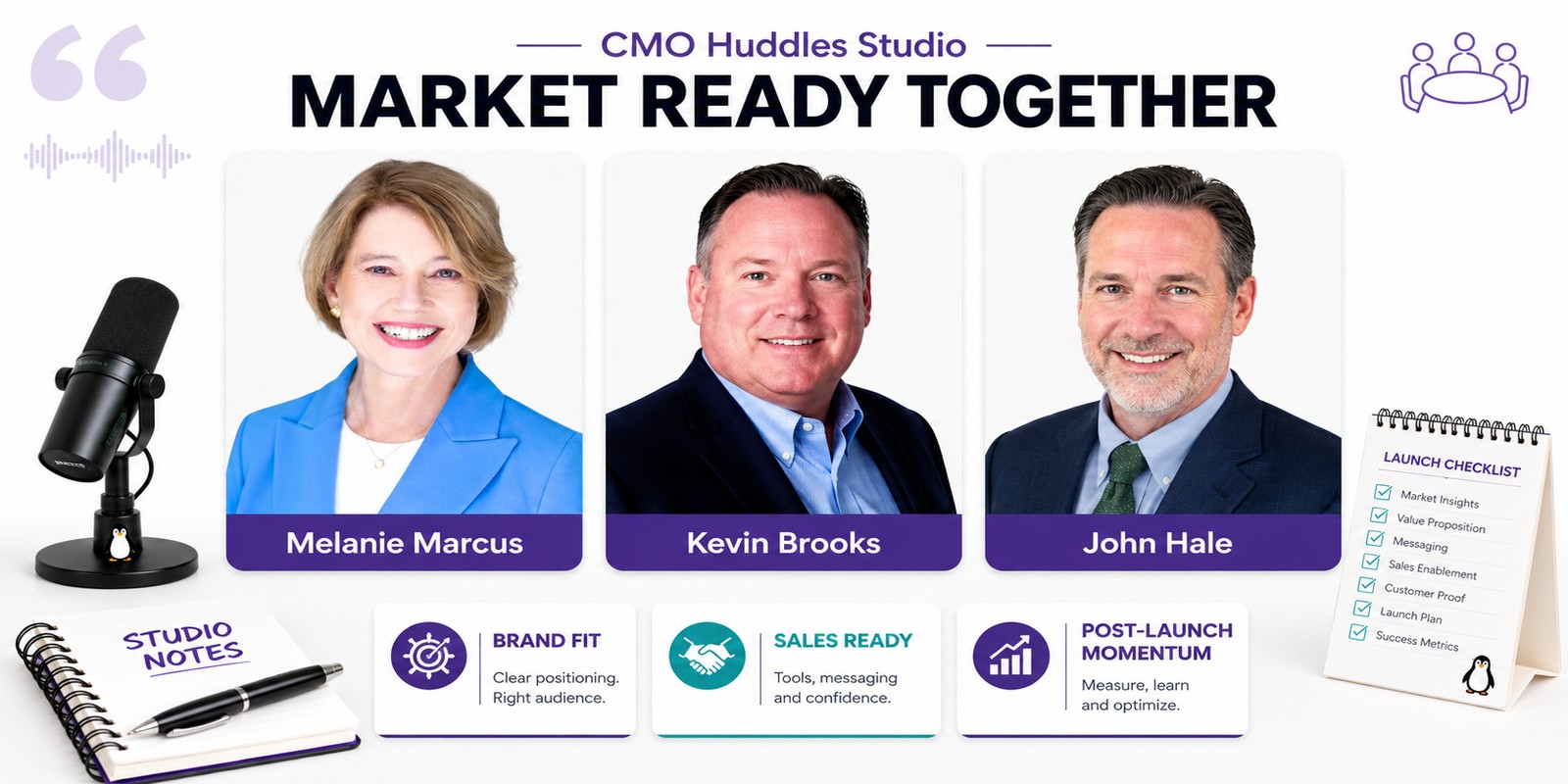
Successful product launches depend on company readiness, not marketing activity alone. Insights from Melanie Marcus, Kevin Brooks, John Hale, Guy Yalif, Chris Pieper, and Ali McCarthy show how clear positioning, launch tiering, customer pain, sales enablement, and cross-functional ownership turn a launch from a one-day announcement into a path toward adoption, pipeline, and lasting growth.
Marketing may coordinate a launch, but it cannot create market readiness alone.
Two CMO Huddles product-launch conversations explored the work required before and after launch day. The second discussion featured Melanie Marcus and Kevin Brooks of Surescripts and John Hale of Consilio.
Their collective message was clear: the product, brand, story, sellers, customer-facing teams, and measurement plan need to work together.
A launch can stretch a brand into a new market or solution. The question is whether that stretch remains credible.
Melanie offered a useful starting point:
“Does our brand support the solution we’re launching? If it does, great. If it doesn’t, what do we need to do to align this new product with our brand or our brand with this new product?”
That question can surface positioning work, missing evidence, category confusion, or a mismatch between what the product promises and what the company is known for delivering.
Not every launch warrants the same level of investment.
Launch tiering can help determine:
Kevin identified an early source of launch clarity:
“One of the most critical and often underdeveloped aspects of product launches is really narrowing down that ideal customer profile.”
A sharper ICP makes the story, channels, enablement, and success measures more specific.
The earlier product-launch discussion reinforced the value of simplicity. Customer pain and product essence are more useful than a feature inventory.
That can mean choosing one primary problem, one memorable promise, and one proof point that customer-facing teams can explain consistently.
The launch story also benefits from pressure testing with sales, customers, and other teams before it reaches the market. Confusion inside the company rarely becomes clarity outside it.
John reframed how ownership can work across the company:
“A secret weapon for more impact in these things is deeply believing that launches aren’t marketing. This is not mine; this is ours. This is a large group of people building something really cool.”
Shared ownership can include:
Marketing can orchestrate the motion without carrying every responsibility.
The announcement creates visibility. The work that follows creates adoption.
Post-launch activity can include seller coaching, message refinement, customer feedback, proof development, pipeline review, adoption analysis, and decisions about where to increase or reduce investment.
A successful launch is not simply delivered on time. It creates a credible path from awareness to customer value.
Ownership is shared. Marketing may coordinate the motion, while product, sales, customer success, operations, and leadership contribute to readiness and results.
Launch tiering matches resources, enablement, channels, and measurement to the importance and complexity of the launch.
Early involvement can help test buyer relevance, identify objections, and ensure sellers understand how to carry the story.
No. Adoption, enablement, feedback, pipeline development, and story refinement continue after the announcement.
Listen to The B2B Product Launch Blueprint and Go for Launch.
CMO Huddles helps B2B marketing leaders win by bringing together peers, fresh perspectives, and opportunities to build stronger personal brands. Want to join the huddle? Learn more about CMO Huddles and apply to join the community.