
Back to Blogs
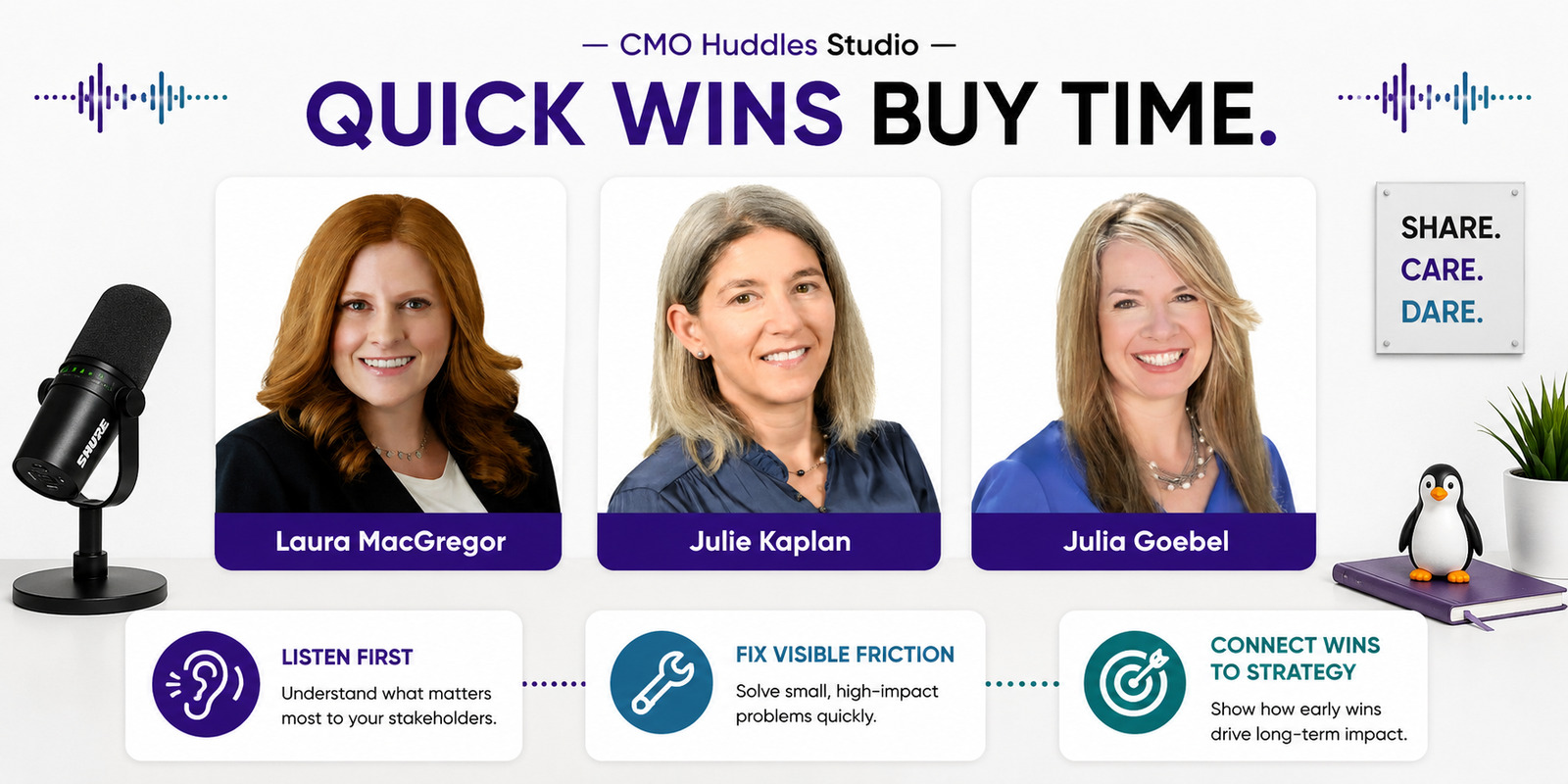
Quick wins give a new CMO credibility and time when they address a visible business problem, involve partners, and support the longer strategy. Laura MacGregor, Julie Kaplan, and Julia Goebel show how early listening, simplification, sales collaboration, and execution can create momentum without trapping marketing in a cycle of disconnected short-term fixes or premature promises.
A new CMO inherits two clocks. The business expects visible progress almost immediately, while the work that produces durable growth may require months of research, alignment, and infrastructure. The answer is not to abandon the long-term strategy or fill the first 90 days with activity. It is to select a small number of early wins that solve real problems and point toward the larger plan.
The search for those wins can begin with conversations across the organization. Laura MacGregor, then CMO and Principal of Savvy Marketing Works, described her starting point:
“Take the time to meet people, understand what's going on with them, what's working and what's not, and try to distill that information down into some common things that really align with the business objectives.”
The listening tour becomes valuable when it reveals repeated friction tied to an established business priority. A broken handoff, outdated segment, neglected nurture program, or unclear message may be easier to correct than a larger transformation. When that correction helps a peer meet an urgent goal, it also begins building the relationships the CMO will need later.
Laura saw this dynamic after reviewing an existing lead-nurture program. Adjustments to its content and scoring model produced stronger lead and conversion results without requiring a complete rebuild. Because pipeline was already a concern, the work also strengthened marketing’s relationship with sales.
A quick win earns more credibility when colleagues can see why it was chosen.
The interview process often contains an early map of organizational frustration. Executives describe work that has never been completed, processes that need attention, and outcomes they hope the new marketing leader can deliver. Those comments are not commitments, but they can become hypotheses to investigate after joining.
Julie Kaplan, then CMO of Higher Logic, noted:
“A lot of the listening can begin before day one. In the interview process, there are an awful lot of hints that are given as to processes that need to be updated or an activity that's never been done.”
The people involved in the interview process may also become the new CMO’s first internal champions. Acting on something they raised demonstrates that the conversation was heard. The opportunity still needs to fit the business objectives and the emerging 90-day plan, rather than becoming a collection of favors for individual stakeholders.
Julie encountered this situation while building a marketing department from scratch. During the interview process, the CFO mentioned that the company had never emailed customers about its products. The organization lacked the systems required for sophisticated marketing, but one early email demonstrated movement while the foundational work continued.
The email was not presented as a transformation or a revenue breakthrough. It was a visible milestone connected to the infrastructure the company would eventually need. Over the following year, Julie reported a tenfold increase in blog visits, a 68% increase in website sessions, and a fivefold increase in form submissions.
As she explained, the first action served a larger purpose: “It bought me the time to do the work that needed to be done that was going to produce real results.”
An easy task is not automatically a useful quick win. A strong candidate usually meets several conditions:
This filter helps separate momentum from motion. A cosmetic project may attract attention while consuming resources needed elsewhere. A technically modest improvement to conversion, segmentation, or customer communication may matter more because it advances a business objective.
Julie recommended using the relative freedom of the opening months to examine neglected work:
“Take that time to take a look at some of the things that you wouldn't ordinarily have the luxury to look at, and you just need to find one or two that are consistent with your plan and your strategy, and demonstrate progress.”
That final requirement matters. A quick win can show that the CMO listens, makes decisions, and follows through. It can also provide an early test of how the organization responds to change before a larger initiative begins.
A new marketing leader brings experience, but the more valuable advantage may be a fresh view of the evidence. Familiar statements such as “events do not work here” or “email is not effective for our audience” can harden into organizational facts without anyone examining the execution behind them.
Julia Goebel, then CMO of Komodo Health, begins with a point of view and then calibrates it against company data. She looks at conversion rates, opportunity sources, stalled stages, customer retention, and channels producing unexpected results. When a result differs sharply from experience or industry norms, it becomes a reason to investigate rather than an invitation to impose a familiar playbook.
Her customer research adds another layer:
“I want to call 10 most recent wins, 10 most recent losses and 10 lapsed customers. So right away you've got 30 data points that can bring your perspective.”
Those conversations can reveal why a channel is underperforming, where buyers encounter friction, and which value messages survive outside the company. They also give the CMO direct customer evidence to bring into executive discussions.
Julia conducts the calls herself. That choice turns customer research into executive learning rather than a report delivered after the interpretation has already been completed. It also surfaces whether account teams make customer access difficult, which may reveal another operating issue worth addressing.
Early activity creates confidence only when leaders can see where it leads. A CMO can use the first 90 days to communicate both tracks: the immediate improvements underway and the deeper work required to build sustained growth.
Laura emphasized the importance of showing the larger plan even while it is developing. Without that visibility, other leaders may interpret careful diagnosis as indecision. Sharing milestones, timing, and what the team is learning demonstrates that the foundational work is moving.
The plan also establishes realistic expectations. Repositioning a company, modernizing its systems, rebuilding customer trust, or changing the relationship with sales will not happen through a handful of tactical wins. The early improvements create evidence that marketing can deliver while the larger decisions take shape.
Julia described the first 90 days as a period for testing and refining a point of view. Conversion data, sales conversations, and customer interviews help determine which early opportunities deserve attention. The resulting plan can then move from assumptions toward informed priorities.
The connection between the quick win and the strategic destination is what keeps early success from becoming a trap. When executives understand that a nurture improvement, customer interview program, or messaging correction is one step in a larger sequence, the CMO is less likely to be judged solely on the next short-term result.
A quick win addresses a recognized business problem, can be completed with available resources, produces visible evidence of progress, and supports the longer marketing strategy. It does not need to generate immediate revenue, but its relevance to the business needs to be clear.
One or two meaningful wins are often more credible than a long list of disconnected activities. The remaining time can support customer research, team assessment, executive alignment, and development of the longer plan.
Yes. Simplifying an inefficient workflow can improve speed, reduce frustration, and demonstrate that marketing understands how work gets done. Its value increases when the improvement supports a larger objective rather than merely making one task faster.
The immediate work can be presented alongside the broader roadmap, including milestones, dependencies, and expected timing. This helps executives distinguish early proof of progress from the full business outcome the strategy is designed to produce.
Listen to the full conversation with Laura MacGregor, Julie Kaplan, and Julia Goebel.
CMO Huddles helps B2B marketing leaders win by bringing together peers, fresh perspectives, and opportunities to build stronger personal brands. Want to join the huddle? Learn more about CMO Huddles and join CMO Huddles Starter.