
Back to Blogs
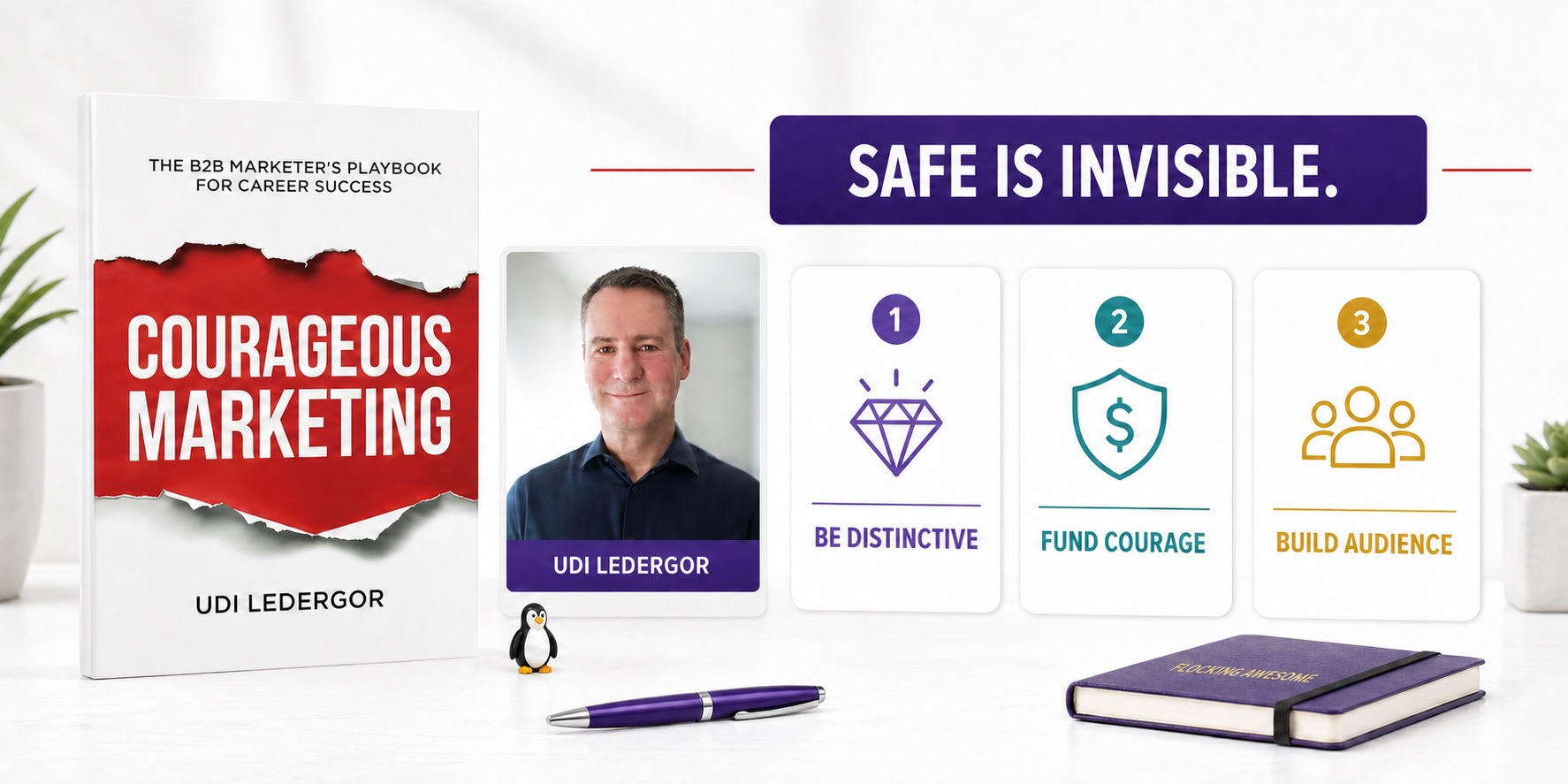
Safe B2B marketing disappears into a category of similar claims and tactics. In Courageous Marketing, Udi Ledergor connects distinctiveness with disciplined experimentation, executive support, audience-building, and evidence. His Gong examples show that courageous marketing is not creativity without accountability. It is a willingness to challenge conventions while remaining clear about the audience and business outcome.
The safest B2B marketing often resembles everything around it.
The message is agreeable. The campaign follows familiar conventions. The team adopts the same language, visual styles, and channels as its competitors.
Nothing is obviously wrong, but little is memorable.
In Courageous B2B Marketing, Udi Ledergor, former CMO and current Chief Evangelist at Gong, discussed ideas from his book, Courageous Marketing.
Udi identified three common traps:
Each seems safe, but each can also make a company less distinctive, less aligned, or less capable of learning.
Udi questioned content so agreeable that no one feels compelled to respond.
“If you say something so agreeable, so trivial, nobody has anything else to say about it, why would anybody share it or tag someone or comment on it?”
Provocation for its own sake is not the answer. A useful point of view reflects a real belief about the customer, market, or category and gives the audience something worth considering.
That may involve challenging a familiar practice, choosing an unexpected creative treatment, or expressing a company’s position more clearly than competitors.
The risk of safe marketing is not simply lower engagement. It is invisibility at the moment the business needs to be remembered.
Udi’s regional Super Bowl example shows how courage and constraint can work together.
Gong wanted the attention associated with a Super Bowl appearance but did not have the budget for a national placement. The team discovered that regional inventory could reach much of its audience for a fraction of the assumed cost.
“I did a Super Bowl commercial for less than 5% of what people assume it would cost because instead of getting the national spot, I got a regional spot where my actual audience was.”
The execution appeared larger than the spend because the team understood the media structure, geographic concentration of its buyers, and cultural value of appearing during the event.
Punching above one’s weight is not pretending to be larger. It is designing a credible way to create disproportionate attention.
Udi also challenged the idea that marketing alone owns the brand.
Marketing can shape positioning, campaigns, creative standards, and customer insight. The lived brand still depends on product decisions, sales behavior, customer experience, recruiting, executive communication, and company culture.
If the executive team treats brand as a marketing project, the story can fracture as soon as it leaves a campaign.
Executive participation also affects the organization’s tolerance for distinctive work. An unconventional campaign is easier to evaluate when leadership understands its audience, logic, evidence, and acceptable level of risk.
Courageous marketing becomes an organizational capability rather than one creative team’s personality.
The 95-5 discussion focused on the large share of a market that is not actively buying at a given moment.
Product-heavy promotion has little value for that audience. Useful, entertaining, or educational content can create a reason to follow and remember the company before a buying process begins.
“That 95%, if we want to engage them and nurture them and have them subscribe and follow our content, we need to provide something valuable that doesn’t involve selling our product.”
This does not remove commercial intent. It changes the sequence. Content earns attention first, building familiarity that may become valuable later.
Audience programs can also compound through subscribers, recurring formats, recognizable voices, and a growing understanding of what the market values.
Bold marketing does not require the entire budget to become experimental.
A portfolio approach can protect proven programs while creating defined space for new messages, channels, formats, or creative ideas.
A useful experiment clarifies:
That structure makes courage more repeatable and gives other executives a clearer way to evaluate the idea.
Udi’s third trap concerns hiring only for previous experience.
Experience remains valuable when work requires category knowledge or technical depth. It can also lead teams to repeat familiar approaches in a market that has already changed.
At Gong, Udi hired people from backgrounds including sales, journalism, food service, and music merchandising. Their audience understanding and fresh perspectives helped shape content, social media, and events.
Curiosity, learning speed, judgment, and potential provide another view of how someone may respond to an unfamiliar challenge.
That becomes increasingly relevant as AI changes workflows and role boundaries.
Safe marketing can feel responsible because it avoids visible failure. It may also avoid attention, conversation, and memory.
Udi’s argument is not that every idea belongs in the Super Bowl. It is that B2B marketing becomes stronger when teams question conventions, create value before selling, and make room for ideas competitors would not automatically choose.
The courageous choice is not always the loudest. It is distinctive enough to matter and disciplined enough to defend.
It is distinctive marketing grounded in audience insight, business purpose, executive support, and a clear understanding of risk.
No. Gong’s regional Super Bowl placement shows how audience concentration and media design can create disproportionate attention.
Familiar claims and tactics can make a brand harder to notice, remember, or distinguish.
A defined hypothesis, bounded investment, relevant evidence, and expansion criteria make an experiment easier to evaluate.
Want to hear more? Listen to the full conversation with Udi Ledergor.
CMO Huddles helps B2B marketing leaders win by bringing together peers, fresh perspectives, and opportunities to build stronger personal brands. Want to join the huddle? Learn more about CMO Huddles and apply to join the community.