
Back to Blogs
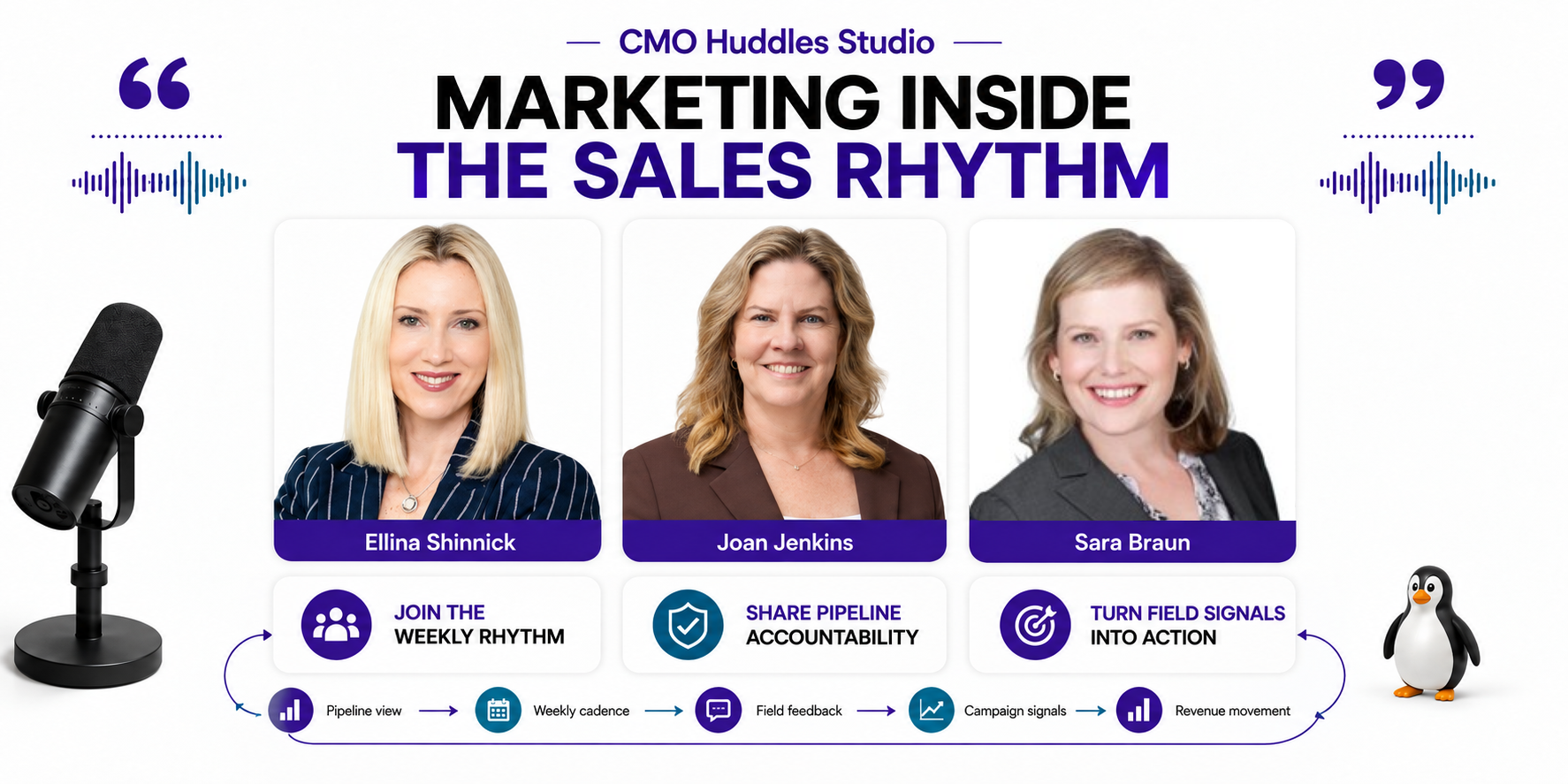
Sales trust is built in the rhythm of the work. CMOs from HUB, Fastly, and FORTA share how weekly sales meetings, shared pipeline accountability, field feedback, and faster marketing pivots can turn alignment from an aspiration into an operating system for growth.
Sales and marketing alignment often gets discussed as a relationship issue, but the operating cadence between the teams can matter just as much. If marketing joins the conversation after priorities have shifted, deals have stalled, or sales needs an asset tomorrow, even strong relationships can produce mediocre results.
Marketing needs to be close enough to the sales motion to hear what is changing and respond while there is still time to make a difference. That was the common thread in a CMO Huddles Studio conversation with Ellina Shinnick, CMO of HUB; Joan Jenkins, CMO of Fastly; and Sara Braun, CMO of FORTA.
Their approaches differ, but each leader has built marketing closer to the daily and weekly work of revenue. The result is greater pipeline accountability, faster feedback, and more trust between the teams.
At HUB, Shinnick saw the limits of the traditional model firsthand. Marketing would create an annual plan, execute campaigns, and periodically report back to sales. Meanwhile, sales priorities changed, opportunities emerged, and leads arrived without enough context. The teams could be aligned strategically while still operating on different timelines.
HUB changed the model in one region by embedding a marketer directly into the regional sales leadership team. Instead of appearing quarterly to report on marketing activity, that marketer participates in weekly sales leadership meetings, quarterly offsites, and annual planning.
“In order for this to work, we need to create an actual partnership, not some sort of flyby relationship that happens once a quarter. That isn't sticky,” Shinnick said.
That weekly cadence gave marketing a much clearer view of what the field was experiencing. The team could respond to emerging segments, regulatory developments, cross-sell opportunities, and other market signals faster, while sales gained better visibility into why marketing was making particular investments.
HUB also incorporated marketing leads into the sales pipeline dashboard rather than maintaining a separate marketing view. Sales leadership could review marketing-generated opportunities alongside the rest of the pipeline, and the region using the model saw a 3x improvement in conversion.
The lesson goes beyond simply meeting with sales more often. The real advantage comes from shortening the distance between a field signal and a marketing response. When marketing hears about an opportunity this week instead of at the end of the quarter, the team still has time to influence it.
Embedding marketing also changed how HUB approached planning. Shinnick's team maintains broader priorities while allowing regional activity to move with current sales opportunities instead of treating the annual marketing plan as a fixed commitment.
That flexibility matters because assumptions made during annual planning may no longer reflect what the field is seeing a few months later. A segment may suddenly become more attractive, a regulatory development may create a reason for customers to act, or cross-sell opportunities may become more valuable than the acquisition campaign originally planned.
Working inside the sales rhythm gives marketing enough context to make those adjustments with purpose. Sales helps shape current priorities, marketing responds faster, reps understand why the work was created, and both teams get better information about what converts.
Over time, that repeated cycle builds trust because sales can see that marketing is listening, responding, and contributing to the opportunities already in motion.
At Fastly, Jenkins carries the same operating principle into pipeline accountability. Marketing's responsibility continues after a lead crosses into the sales process because pipeline creation alone does not determine whether the business wins.
“No longer can you have marketing just kind of handing off leads and hoping for the best,” Jenkins said during the conversation.
Fastly focuses on shared responsibility for pipeline creation, pipeline quality, progression, and ultimately revenue. That approach changes the conversation between the functions because marketing and sales are evaluating the growth outcome together.
As Jenkins put it, “There's no world in which, if sales isn't hitting their target, marketing looks good. That world doesn't exist. You don't want to be the marketer that shows up to the board meeting with everything in green.”
Shared accountability does not mean every marketing contribution will fit neatly into an attribution model. Account journeys contain many touches and imperfect data, so Fastly combines measurement with regular communication about what is actually happening inside accounts.
Weekly and monthly touch points, Slack, and quick video updates help keep information moving between the teams. Sales brings objections and deal friction, while marketing contributes engagement signals, messaging performance, and account insight. Those signals become more useful when the teams examine them together.
The operating rhythm also starts with marketing leadership. Jenkins believes CMOs need firsthand exposure to customer and sales conversations if they expect their teams to behave like one revenue organization.
She regularly participates in customer conversations and deals where marketing can contribute. The purpose is to understand how the business wins and to bring useful customer insight, messaging, content, account intelligence, or deal support when those inputs can improve the opportunity.
Jenkins described the ideal as being a marketing leader who can “major in marketing, minor in sales.”
That mindset can be particularly valuable when sales leaders are skeptical of marketing's contribution. A presentation explaining marketing's value may have limited impact, while useful participation in real opportunities gives sales direct evidence of what the function can add.
Braun took a field-first approach when she joined FORTA. Before jumping into campaigns, she spent time with sales leaders, experienced reps, new reps, and customers. She also went into the field to see FORTA's products being used at a job site.
The objective was to understand the actual selling environment before deciding what marketing should produce. That work helped FORTA get more specific about target companies, job titles, priority verticals, regional differences, and the types of support reps needed.
Marketing then began developing playbooks around those real selling situations. When reps across different states face different challenges and large national accounts create their own demands, the team cannot respond equally to every request.
Braun's team surveys reps, works with sales leadership to prioritize opportunities, tests approaches in specific markets, and identifies playbooks that can be replicated. This gives the field a meaningful voice without turning marketing into an on-demand creative services function.
The goal is to find the intersection between what sales needs now and what marketing can build in a way that scales.
FORTA also brings performance data back to sales so the field can see what is working and help interpret what the numbers mean.
“We regularly meet with sales and bring back the data to show them what's getting engagement, what's falling flat, where we should double down,” Braun said. “It's made marketing feel, to them, a lot more valuable. Now they're bringing us in earlier and coming to us instead of us going to them.”
That change in timing is a useful signal of trust. When sales brings marketing into the opportunity while account strategy, messaging, or the next move is still taking shape, marketing has more room to contribute.
Braun also described a vertical campaign that generated encouraging engagement, strong event conversations, and a list of promising prospects but had not yet produced a closed deal. Rather than stopping at engagement metrics, marketing went back to sales to understand what was happening and whether the message or approach needed to change.
That feedback loop keeps marketing performance connected to the actual revenue outcome instead of allowing promising activity metrics to stand on their own.
Across HUB, Fastly, and FORTA, proximity creates the shared advantage. Marketing stays close to sales priorities, account movement, customer conversations, and field feedback, while sales gains greater visibility into marketing decisions and performance. Both teams can change course faster because information moves continuously instead of waiting for quarterly presentations and formal handoffs.
For CMOs looking to strengthen the relationship, a useful starting question is: Where are we operating on different clocks?
A practical audit might include:
These questions help reveal where the operating model is creating distance between the teams. Closing those gaps can make alignment more tangible because the relationship becomes part of how the work gets done every week.
Start by integrating marketing into the recurring operating cadence of sales. Weekly leadership meetings, shared pipeline reviews, field feedback, and joint outcome measures give marketing more opportunity to respond while deals and priorities are still active.
Marketing should share accountability for growth outcomes rather than stopping at lead generation. Fastly, for example, looks at pipeline creation, quality, progression, and revenue as shared outcomes between marketing and sales. Marketing may not control every stage, but it can stay engaged throughout the deal cycle.
Use sales input to identify repeatable needs rather than responding equally to every request. FORTA surveys reps, prioritizes needs with sales leadership, tests support in specific markets, and develops playbooks that can be replicated across similar accounts or regions.
One strong signal is when sales brings marketing into opportunities earlier. Early involvement suggests sales sees marketing as a contributor to account strategy and growth rather than a team brought in only to produce materials.
Frequent interaction shortens the time between a field signal and a marketing response. It allows marketing to hear changing priorities, customer objections, and stalled opportunities early enough to adjust campaigns, content, messaging, or enablement.