
Back to Blogs
Drew Neisser is the founder of CMO Huddles and a globally recognized authority on B2B marketing. He’s an AdAge columnist, LinkedIn TopVoice, leading CMO coach, podcast host & friend of penguins everywhere.
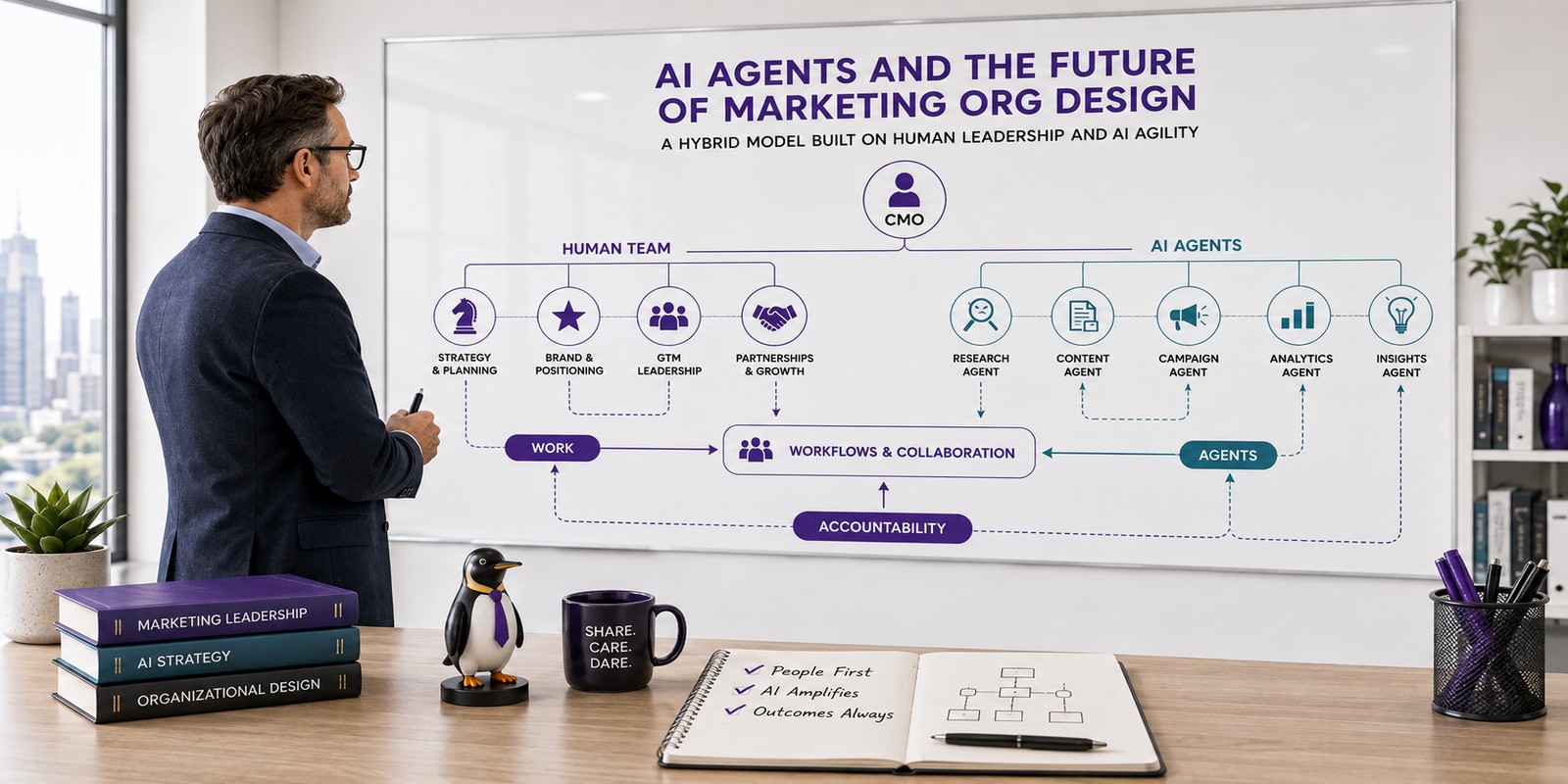
As AI agents move from novelty to real work, CMOs face a thorny org design question: Should bots show up on the marketing org chart? The better starting point is not titles for agents. It is mapping the work, redesigning the operating model, and making human accountability painfully clear.
“Bots are just workflows, so they don’t belong on org charts,” exclaimed a CMO from a $225 million SaaS company.
It was a pin-drop moment as the other CMOs considered the thought.
I’m not so sure.
Not because I’m ready to give bots titles, managers, and performance reviews. That feels like org chart theater, perhaps even a way to signal to investors, “See, look how tech-forward we are!”
But if AI agents are doing real work, influencing real outcomes, and changing how humans spend their time, don’t they need to show up somewhere?
This question has been haunting our FOMO Task Force, short for Future of Marketing Org Design, and it came up again this week in two of our Leader Huddles. The issue is no longer theoretical. CMOs are already testing agents across content, campaign operations, research, reporting, sales enablement, customer marketing, and analytics.
The org chart may not be ready. The work already moved.
One CMO said, “Before you make any org changes, you need to reimagine the work.”
That feels like the right starting point.
Liza Adams, AI advisor and GTM strategist, made a similar point in her excellent piece on the future of GTM roles and org design: “Before we rethink the roles/org design, we need to rethink the work itself. Otherwise, it’s like hiring an actor without a script yet.”
Exactly. The first question is not whether the agent gets a box. The first question is: What is happening to the work?
If AI simply makes old work faster, you may get efficiency, but not necessarily growth. The bigger opportunity is to rethink the work itself: What can be automated, what can be augmented, what can be eliminated, and most importantly, what can now be done that was previously impossible?
Liza put it well in her LinkedIn comment: “Work automation gets us efficiency, work innovation gets us growth.”
That distinction should be printed out, laminated, and quietly placed near every AI steering committee snack tray.
Related reading: Liza Adams on new GTM roles and org design.
Wendy White, a B2B SaaS CMO and GTM architect, offered a clean counterpoint in the LinkedIn comments: “I am team no agents on org charts. Agents are critical tools not people. Keep an agent chart or a well designed manus board.”
That is a smart distinction.
Agents are not employees. They do not need career paths, compensation bands, succession plans, or an awkward year-end review in which someone says, “Your Q3 outputs were strong, but your collaboration energy could improve.”
But if agents are critical tools doing critical work, they need visibility. If a campaign agent drafts nurture streams, a research agent identifies buying signals, and an analytics agent recommends budget shifts, the CMO needs to know where those agents sit in the workflow.
Maybe that is not the human org chart. Maybe it is an agent map. Maybe it is a workflow map. Maybe it is a responsibility matrix that shows humans, agents, systems, approvals, data sources, and outcomes.
But “not on the org chart” cannot become “not documented.”
That is how invisible labor becomes invisible risk.
One leading-edge CMO told us, “A lot of marketing leaders deploy these agents, but the org structure stays the same.”
Same collaboration model. Same approval model. Same measurement model. Same meeting load. Same handoffs. Same bottlenecks, now wearing a tiny AI hat.
That is how you end up with AI-powered bureaucracy.
Faster handoffs are still handoffs. Faster content drafts are still waste if the review process takes three weeks. Faster reporting is still underwhelming if no one changes the decisions that follow.
The operating model has to change with the tools.
That means CMOs need to look beyond individual use cases and ask harder questions: Who owns the workflow? Who approves the output? Who trains the agent? Who monitors quality? Who decides when human judgment is required? Who measures business impact? Who shuts the thing down if it starts producing confident nonsense?
AI agents can accelerate work. They can also accelerate confusion.
Whether bots appear on the org chart or not, someone needs to own the outcome.
Someone needs to own the guardrails. Someone needs to own quality, judgment, cost, governance, and business impact.
One CMO described the future as “a lead with a cloud of agents wrapped around them.” I like that image because it keeps humans accountable while acknowledging that the work is no longer being done by humans alone.
That may be the most practical model for now. Not agents as employees. Not agents as invisible tools. Agents as an explicit layer around human leaders, teams, and workflows.
The CMO does not need to know every prompt. But the CMO does need to know which workflows are agent-enabled, which humans are accountable, which risks are being managed, and which outcomes are improving.
Because the big org design mistake would be treating AI as a software rollout when it is really a work redesign challenge.
Start by mapping the work. Look at major marketing workflows from strategy to execution to measurement. Identify what can be automated, augmented, eliminated, or newly created because AI changes the economics of the task.
Do not begin with boxes and titles. Begin with work, outcomes, and decision rights.
If you deploy agents into the same operating model, expect disappointment with better formatting.
CMOs should revisit approval paths, handoffs, collaboration rhythms, data access, measurement, and governance. The goal is not to sprinkle AI on yesterday’s workflows. The goal is to redesign the workflows so teams can move faster without losing judgment.
Whether you create an agent map, workflow chart, AI responsibility matrix, or “cloud of agents” model, make the agent layer visible.
Each AI-enabled workflow should have a human owner. Each agent should have a defined purpose, approved data boundaries, quality expectations, and measurable business impact. The point is not to make the org chart cute. The point is to make the operating model clear.
What am I certain about?
Marketing orgs will look very different a year from now. The savviest CMOs are already preparing for that transition, not by blowing everything up, but by mapping workflows, testing new operating models, training their teams, adding AI ops experts, and deciding where human judgment matters most.
At CMO Huddles, our FOMO Task Force is digging into this exact question: What should the future of marketing org design look like as AI changes the work, the roles, and the operating model?
We’ll be sharing the FOMO Task Force’s findings and guidance at the CMO Super Huddle on October 22-23.
If you’re wrestling with where agents belong, how marketing roles should evolve, and how to keep humans accountable in an increasingly agentic marketing function, join us there.
This is not about drawing cuter org charts.
It is about making sure the humans, bots, and business outcomes all know where they stand.
Probably not on the human org chart, at least not yet. Agents are tools, not employees. But they should appear somewhere visible, such as an agent map, workflow map, or accountability matrix that shows how work gets done.
Start by reimagining the work. Map key workflows and identify what can be automated, augmented, eliminated, or newly created. Once the work is clear, roles and structure can follow with far less guessing.
You may simply make broken workflows move faster. Without changes to approvals, ownership, measurement, and collaboration, AI can create faster handoffs, more content, and more complexity without improving business outcomes.
A human should own every AI-enabled workflow. That person should be accountable for quality, guardrails, cost, governance, and business impact. Agents can do work, but humans still need to own the judgment.
Track workflow impact, not just AI usage. Useful measures include cycle time, conversion lift, cost reduction, content quality, pipeline impact, customer experience improvements, and reduced manual work in high-friction processes.
CMO Huddles helps B2B marketing leaders win by bringing together peers, fresh perspectives, and opportunities to build stronger personal brands. Want to join the huddle? Learn more about CMO Huddles and apply to join the community.