
Back to Blogs
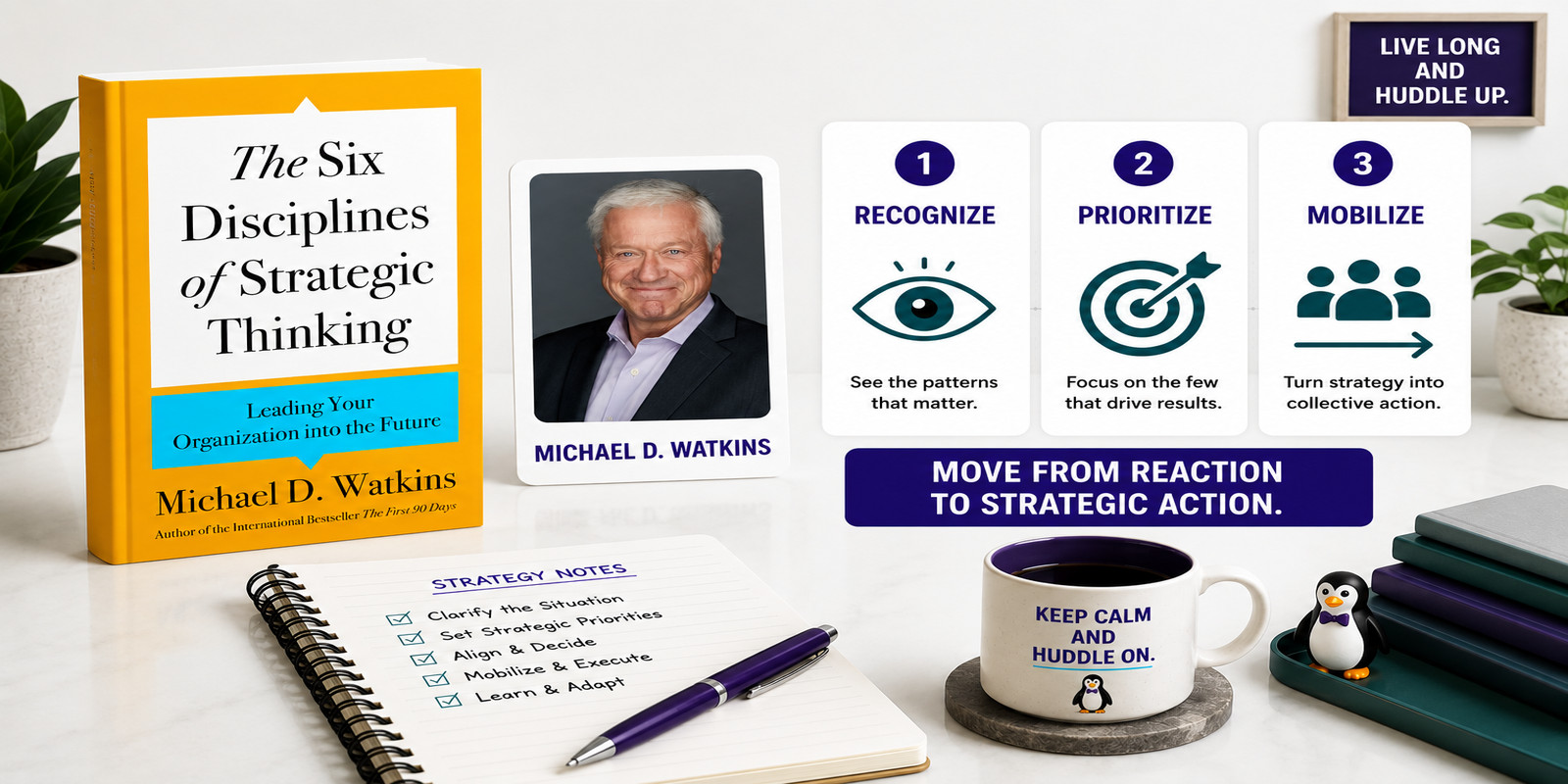
Strategic thinking allows CMOs to recognize emerging threats and opportunities, establish priorities, and mobilize the organization before market change becomes a crisis. Drawing from Michael D. Watkins’ six disciplines, this article explores how marketing leaders can shift perspective, identify patterns, test hypotheses, make tradeoffs, align executive teams, and build strategic capacity beyond the CMO’s office.
Marketing leaders possess customer data, market intelligence, competitive signals, and visibility across the buying journey. Those inputs can give the CMO a meaningful role in shaping enterprise strategy, but access to information alone does not create strategic influence.
Michael D. Watkins, professor at IMD Business School and author of The Six Disciplines of Strategic Thinking, frames the shift as a move into enterprise leadership. The CMO represents marketing at the executive table while also taking responsibility for what is best for the business as a whole.
That second responsibility can require tradeoffs. A decision that benefits the enterprise may not maximize marketing’s budget, headcount, or preferred priorities. Participating credibly in those decisions helps the CMO move beyond the role of functional advocate.
Watkins offered a direct invitation: “Step into the strategy sphere.” The opportunity is not limited to presenting a marketing plan. It involves helping the leadership team interpret change, choose priorities, and coordinate action across the company.
Watkins defines strategic thinking as “the process of recognizing emerging threats and opportunities, establishing the right priorities and mobilizing your organization to do something about it.”
That definition produces a practical cycle: Recognize, Prioritize, Mobilize, or RPM. Its value lies partly in speed. An organization that moves through the cycle effectively can adapt before a change becomes obvious to every competitor.
For marketing, recognition begins with a deliberate sensory system. Customer interviews, win-loss analysis, advisory boards, search behavior, sales conversations, social listening, product usage, market research, analyst perspectives, and competitive activity can provide different views of what is changing.
The challenge is not simply collecting more information. Teams need a recurring process for comparing signals, identifying patterns, and distinguishing structural change from temporary noise. A monthly market review, quarterly assumption check, or standing customer-insight discussion can bring that work into the operating rhythm.
Customer evidence becomes more strategically useful when it connects to other parts of the enterprise. Watkins cautioned against stopping at the marketing implication:
“We need to look at this problem not just from a customer perspective. And here's some customer data that helps us think about that. But what are the implications for the supply chain? What are implications for investment?”
Connecting those dots turns market intelligence into enterprise intelligence. A change in buyer expectations may affect product priorities, service capacity, pricing, technology investment, or the skills the company needs next.
Strategic discussions often become solution debates too early. Teams argue about campaigns, systems, hiring, or product moves before establishing which problem deserves attention.
The prioritization discipline asks leaders to frame the issue carefully, examine competing explanations, and decide what matters most. That process may reveal that a pipeline problem is actually a positioning problem, a retention issue, a product-fit issue, or a consequence of unclear ownership.
Watkins distinguished strategic thinking from strategy itself:
“Strategic thinking is the set of mental disciplines that you're engaged in, a set of dialog processes that you're embarking on that lead eventually to strategy, but often, more importantly, lead to changes in strategy.”
This makes strategic thinking continuous rather than an annual planning exercise. Plans still matter, but leaders revisit assumptions as conditions change. Shorter planning cycles create room to learn without turning the organization into a collection of reactions.
Tradeoffs make prioritization real. If everything remains important, the organization has produced a list rather than a strategy. The CMO can help clarify which audience, category opportunity, customer problem, or growth constraint deserves concentrated attention and which work will receive less investment as a result.
Marketing teams can become attached to the first plausible explanation in the data. Strategic thinking creates room for several possibilities and defines what evidence would distinguish among them.
Watkins described this habit:
“One of the hallmarks of strategic thinkers is that they're hypothesis generators and testers.”
A decline in conversion might reflect weaker traffic, a changing buying group, unclear positioning, pricing concerns, sales follow-up, or a product gap. Each explanation leads to a different response. Treating the first one as fact can send the organization toward an expensive solution to the wrong problem.
Hypothesis testing does not require months of research. Customer interviews, message tests, funnel analysis, seller observations, controlled pilots, and cohort comparisons can narrow the possibilities. The key is to state the assumptions clearly enough that the team knows what it is trying to learn.
This discipline also improves executive communication. Instead of arriving with a predetermined answer, the CMO can present the evidence, the plausible interpretations, the risks attached to each, and the next test.
A strong strategy has limited value if the organization cannot act on it. Mobilization connects the decision to ownership, resources, sequencing, and learning.
It also expands strategic capability beyond one executive. Watkins warned against treating the CMO as the marketing team’s only strategic thinker:
“Move from thinking about yourself as needing to exert central control to embracing shared leadership.”
Shared leadership does not remove accountability. It gives more people the context and authority needed to identify changes, propose priorities, and act within clear boundaries. Product marketing may recognize a category shift, field marketing may see regional buying changes, and customer marketing may identify a retention risk before it appears in aggregate reporting.
Team meetings can reinforce this capability by spending less time reciting activity and more time examining assumptions. Questions such as “What changed?”, “What evidence would change our decision?”, and “If we do this, what happens next?” move discussion from status reporting toward strategic dialogue.
Strategic influence is visible in how a leader frames questions and connects consequences. The CMO does not need to claim ownership of corporate strategy to demonstrate enterprise thinking.
Watkins suggested questions such as: “If we do this, what happens next?” That inquiry moves the conversation beyond the immediate decision and into second-order effects. Other useful questions explore how a choice fits the customer perspective, product development, investment priorities, and the organization’s ability to execute.
The objective is not to make every conversation abstract. It is to connect tactical decisions to the system around them. A campaign choice can raise questions about positioning. A technology investment can expose data or process problems. A customer request can reveal a product or operating-model decision.
Watkins summarized the desired posture:
“The goal is to be the one that is shaping what's happening and not the one that's responding to what's happening.”
That is the practical difference between strategic participation and functional reaction. The CMO brings market evidence into the room, helps the team interpret it, clarifies choices, and supports coordinated action.
Strategic planning produces priorities, choices, and coordinated actions. Strategic thinking is the ongoing process used to recognize change, interpret evidence, test assumptions, and revise those choices when conditions shift.
RPM stands for Recognize, Prioritize, and Mobilize. It describes a recurring cycle in which leaders identify emerging threats and opportunities, decide what matters most, and organize the business to act.
They can connect customer and market evidence to implications for product, investment, operations, sales, talent, and company strategy. They can also frame competing hypotheses and examine the consequences of proposed decisions.
The operating rhythm can include market-signal reviews, hypothesis testing, scenario discussions, assumption checks, and decision-oriented questions. Team members also need enough context and authority to act on what they learn.
Listen to Drew Neisser’s conversation with Michael D. Watkins.
CMO Huddles helps B2B marketing leaders win by bringing together peers, fresh perspectives, and opportunities to build stronger personal brands. Want to join the huddle? Learn more about CMO Huddles and join CMO Huddles Starter.