
Back to Blogs
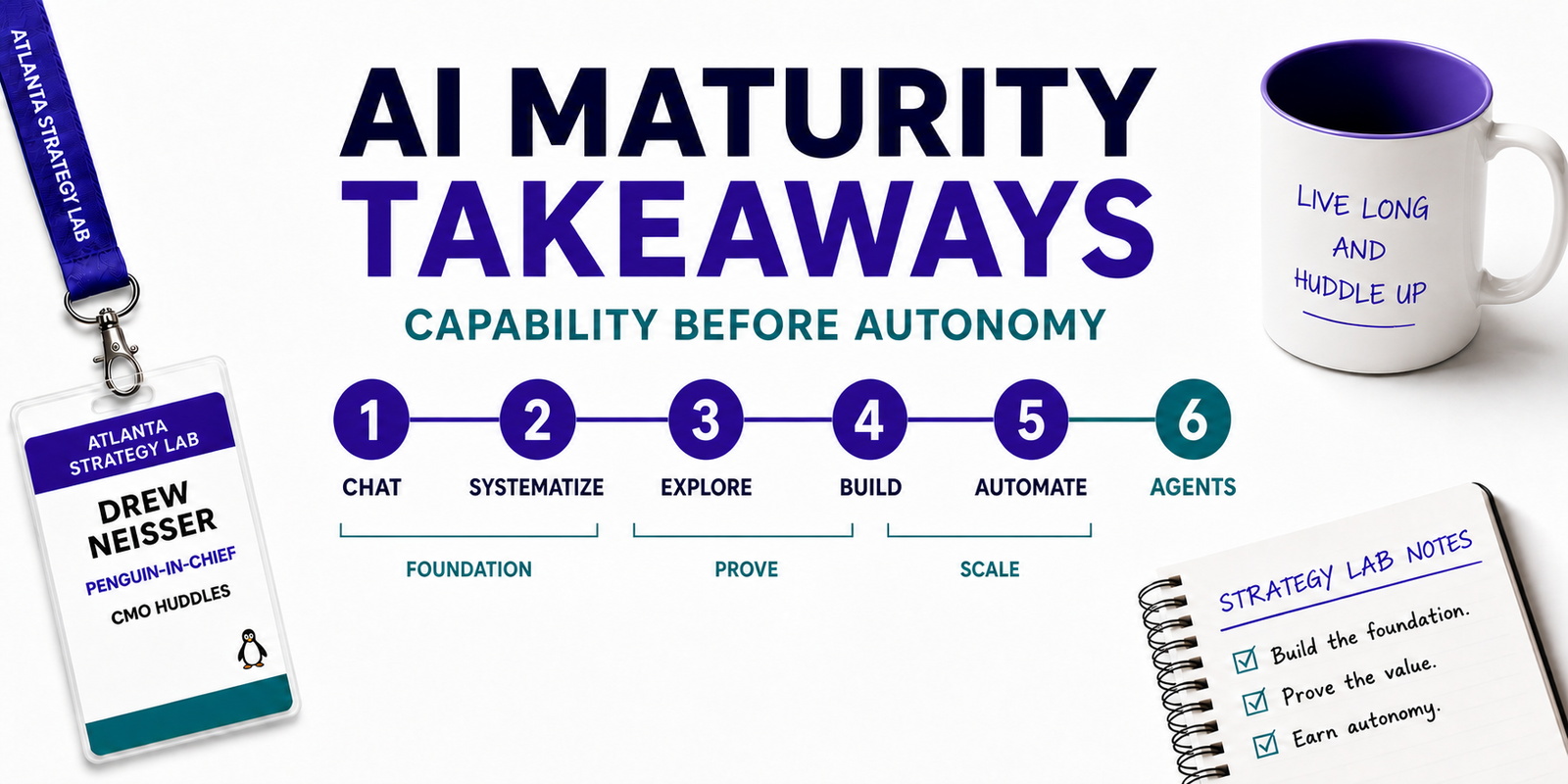
Marketing AI maturity progresses from individual chat experimentation to repeatable prompts, shared tools, controlled automations, and eventually autonomous agents. Most organizations are earlier in that journey than they think. CMOs should honestly assess their current stage, strengthen training and documentation, and advance through valuable workflows before pursuing agentic AI.
Most marketing teams are using AI. That does not mean they are AI-ready.
At a CMO Huddles Strategy Lab in Atlanta, AI trainer and consultant Nicole Leffer described the wide distance between casual experimentation and real operational capability.
At one end are marketers using AI as a conversational search engine. At the other are teams running systems that research, decide, act, and report with limited supervision. Both groups may say they use AI, but their ability to repeat, govern, and improve the work is not comparable.
Leffer’s six-stage model gives CMOs a more useful question than “Are we using AI?” The better question is “What can our team reliably do with it?”
Leffer’s warning: “You can’t go from zero to 10,000 in an hour.” This isn’t an argument for moving slowly. It’s an argument for building the literacy, reusable instructions, clean inputs, and controls that make later automation dependable.
The first stage is conversational use. A marketer asks for an answer, reviews the output, and continues prompting until it looks acceptable.
Chat is a useful learning environment. It teaches people what models do well, where they fail, and how clearly instructions need to be expressed.
The limitation is repeatability. An improvised conversation is difficult to share, test, or run consistently.
CMO check: Are valuable outputs trapped inside individual chat histories?
At Stage 2, the marketer stops negotiating with each output and improves the original instruction.
The prompt becomes an asset. It is documented, tested, reusable, and shareable. Another teammate can run the process and compare the result. As Nicole observed, "When people start editing instead of chatting to change the output, they get better results."
This is where improvement begins to compound. The organization is no longer depending entirely on individual prompting instincts.
CMO check: Can another qualified teammate follow the same instructions and produce a comparable result?
Teams at Stage 3 understand the broader capabilities inside their chosen platforms, including research, data analysis, image generation, projects, memory, connectors, and task-specific features.
The goal is not to sample everything. It is to match the right capability to the right workflow.
A team can use AI every day and remain immature if it treats an advanced platform as a slightly more talkative search box.
CMO check: Does the team know which available capabilities apply to its highest-value work?
The fourth stage turns successful instructions and reference material into shared resources.
An analyst-relations project might contain prior briefings, analyst research, presentation standards, and internal notes. A competitive-intelligence tool might synthesize earnings reports and market changes each week.
Two anonymous Strategy Lab examples made the stage concrete:
Neither example relied on autonomous agents. Both created value by organizing instructions and context around recurring marketing work.
The value is consistency. Institutional knowledge begins moving out of private prompts and into governed team systems.
CMO check: Are proven workflows available to the team, or do they still depend on one enthusiastic user?
At Stage 5, an event initiates the workflow. A competitor publishes earnings, a lead reaches a threshold, or new content goes live. Connected tools trigger the process and route the result for review.
For many marketing teams, controlled automation is the most useful near-term destination. It can deliver meaningful efficiency while preserving visibility and human accountability.
CMO check: Which repeatable, low-risk workflows could run automatically with human review at the end?
True agentic AI receives a goal rather than a narrowly defined task. It creates a plan, takes actions, makes intermediate decisions, and adapts with limited oversight.
That autonomy creates new possibilities and new failure modes. Marketing language around AI agents often creates confusion. A saved prompt may be marketed as an agent even when it has little meaningful autonomy.
CMOs should evaluate what the system can access, decide, and change. The label is less important than the decision rights.
CMO check: Can the team explain the system’s data access, escalation rules, monitoring, and accountable human owner?
Survey actual behavior instead of asking whether employees use AI. Determine which workflows are repeatable, documented, shared, measured, and governed.
A team may occupy several stages at once. That is normal. The goal is visibility, not a flattering score.
Generic awareness training rarely changes operating behavior. Product marketers, demand-generation leaders, content teams, and marketing operations need examples grounded in their actual work.
AI systems inherit the weaknesses of their inputs. Outdated personas, conflicting product narratives, undocumented processes, and scattered brand guidance will produce inconsistent results at greater speed.
Documentation is not administrative cleanup. It is AI infrastructure.
Recognize employees who document useful workflows, teach colleagues, measure results, and expose limitations. The emerging AI leader may be the person most committed to making learning reusable, not the person who tries the most tools.
An AI-ready marketing team does more than generate outputs faster. It can repeat successful workflows, share them across the organization, connect them safely to other systems, and measure their effect on business outcomes.
The goal is not to reach Stage 6 first. It is to build the level of capability the business actually needs.
AI maturity is the progression from individual conversational use to repeatable instructions, shared AI resources, governed automations, and potentially autonomous workflows.
Many teams remain between chat-based experimentation and early systematization. Daily use can feel advanced while still depending on individual prompting and undocumented processes.
No. Controlled automation may deliver most of the available value with less risk. Agentic workflows should solve a specific problem that requires autonomy.
Train the team, document the workflow, clean the underlying knowledge, define decision rights, establish human accountability, and prove the process through lower-risk automation first.
CMO Huddles helps B2B marketing leaders win by bringing together peers, fresh perspectives, and opportunities to build stronger personal brands. Want to join the huddle? Learn more about CMO Huddles and apply to join the community.