
Back to Blogs
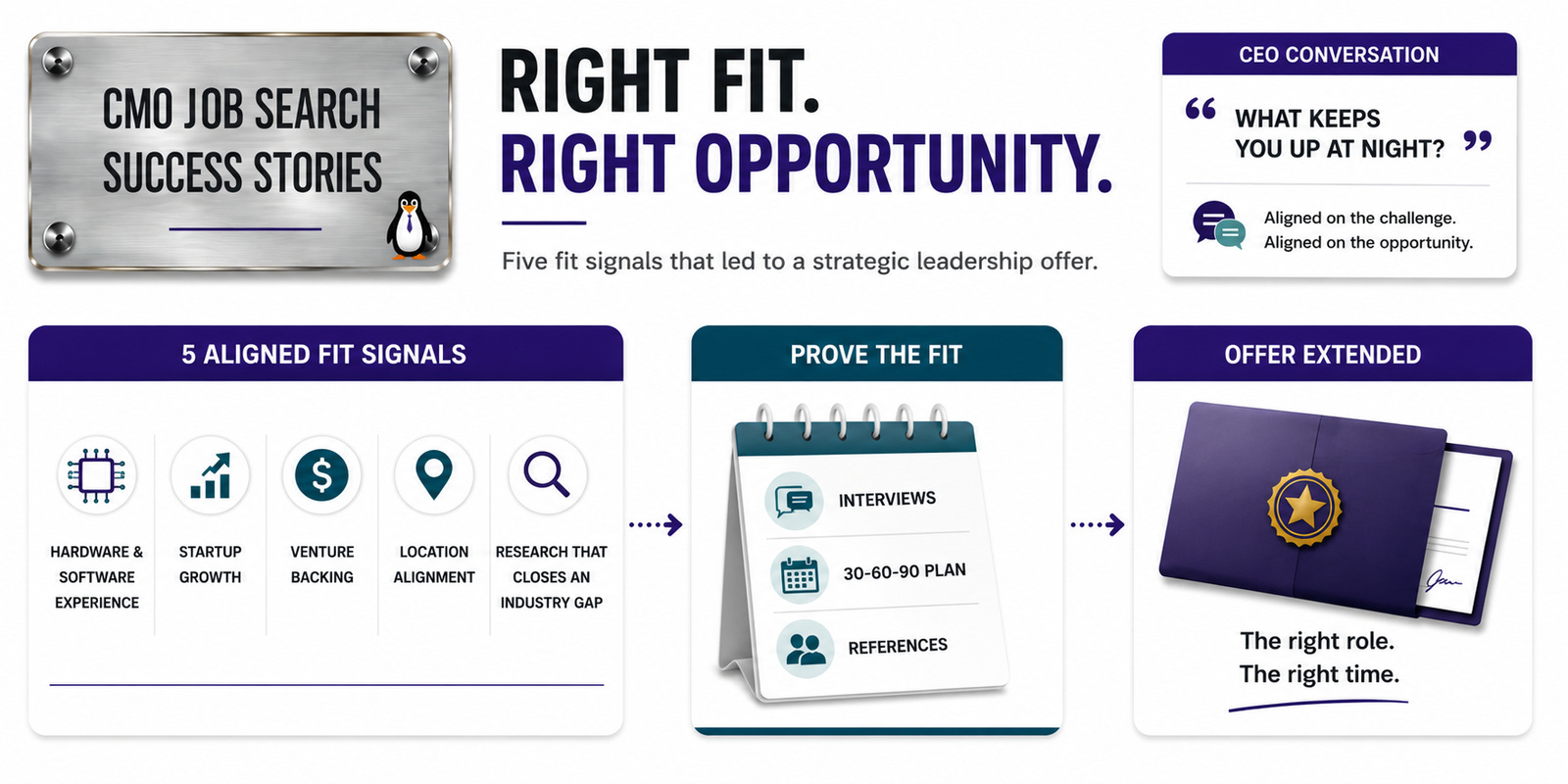
One Huddler turned a recruiter inquiry into a CMO role after extensive research, eight interviews, and a revealing CEO conversation. Experience across hardware, software, startups, venture-backed companies, and customer success strengthened the fit. The search shows how targeted preparation, networking, CMO+ capabilities, and thoughtful questions can help executives close experience gaps and evaluate an opportunity from both sides.
One Huddler knew in May that a previous CMO role would end after a six-month transition period. Rather than wait until the October departure, the executive began the search and updated LinkedIn.
In September, a recruiter reached out after finding the Huddler on the platform.
What caught the recruiter's attention was a relatively unusual combination of experience: marketing both hardware and software.
That background aligned with a CMO opportunity at a small software company. Eight interviews followed over four weeks, including lunch with the CEO.
The Huddler entered the process with several points of alignment and one notable experience gap. Extensive research and a broader CMO+ capability helped strengthen the case.
Search Snapshot
The Huddler described the market as one where recruiters were looking for close matches.
For this opportunity, four areas aligned particularly well.
The candidate had experience with both hardware and software products, had helped grow a startup, had worked with venture-backed companies, and was geographically close to the company's Boulder headquarters.
The fifth area, industry experience, was different.
The company targeted the construction industry, a vertical where the Huddler did not have the same depth of experience. Rather than treating that gap as disqualifying, the candidate invested heavily in preparation.
That made the search a useful example of “round peg, round hole” without requiring every part of the résumé to match perfectly. The strongest experience created credibility while research helped address the area where the fit was less obvious.
The Huddler spent hours researching the company, its competitors, and the portfolio companies of its lead venture investor.
That work allowed the candidate to develop hypotheses about the company's challenges and opportunities before the interviews.
The research also generated questions that could fill information gaps and test whether the role itself was a good fit.
Reviewing the investor's portfolio added another perspective. The Huddler looked at the most successful portfolio companies and considered the role marketing had played in their growth. That preparation became particularly useful when speaking with the investor.
The goal was not to walk into the process claiming to know the company better than its leadership. The research gave the candidate a more informed starting point for the conversations that followed.
The Huddler wanted to understand whether the company could clearly articulate its challenges and whether its expectations for marketing were reasonable.
One question to the CEO became especially revealing:
“What keeps you up at night when you think about go-to-market?”
The CEO answered:
“Having a predictable, repeatable sales model.”
That response gave the Huddler a clearer view of what mattered most to the CEO.
The candidate had already researched the company, industry, and likely challenges. With the CEO's answer as context, the Huddler could use that preparation to discuss a potential roadmap and demonstrate how prior experience might apply to the company's situation.
The exchange also helped the candidate evaluate the opportunity. The interview was not only about convincing the company to make an offer. It was a chance to determine whether the leadership team understood the business challenge and had realistic expectations for marketing.
The Huddler also created visual aids to explain a marketing approach to the CEO.
The source does not describe those materials in detail, so there is no basis for prescribing a specific presentation format. What matters is how they were used.
The visuals helped turn the candidate's thinking into something the CEO could react to during the interview process.
Combined with the research and questions, they gave the Huddler another way to demonstrate how marketing might approach the company's challenges without relying only on descriptions of previous accomplishments.
The position offered another point of alignment beyond traditional marketing experience.
The Huddler's predecessor had led both marketing and customer success. The candidate had previously managed customer success as well.
That experience meant the Huddler could credibly take responsibility for both functions.
For the company, that meant one fewer executive hire. For the candidate, it created an additional reason the background fit the opportunity.
The success story framed this as a CMO+ capability: experience beyond the core marketing remit that can become relevant to a particular company's needs.
For executives in transition, the useful question is not how many additional functions they can claim. It is which responsibilities they have genuinely led before that could strengthen the case for a specific role.
The recruiter may have surfaced the eventual role, but networking remained an important part of the broader search.
The Huddler reached out to former associates and friends, including people with whom contact had lapsed.
Many responded quickly and were willing to help. Local contacts met for breakfast or lunch. Some provided useful industry knowledge for the interview process, while others introduced additional people to speak with.
The ease of reconnecting also reflected work done before the transition. The Huddler had not completely neglected the network while employed.
The lesson from the experience was to dedicate at least a couple of hours each week to reengaging with former associates rather than waiting until a specific introduction is needed.
At the beginning of the search, the Huddler thought another startup was no longer desirable.
The search changed that view.
The candidate ultimately concluded that the company's current business phase mattered less if the culture itself was a strong fit.
That flexibility did not mean abandoning criteria. The Huddler was still actively testing the company, leadership, challenges, and expectations throughout the interview process.
Instead, the experience changed one assumption about what the next role had to look like.
The search also reinforced the importance of maintaining confidence during a transition. The Huddler made time for “feel good” breaks such as walks, hikes, and workouts while continuing to network and interview.
Several parts of the Huddler's background made the opportunity an unusually strong match: hardware and software experience, startup growth, venture-backed companies, geographic proximity, and previous customer success leadership.
The construction-industry gap remained.
Rather than trying to erase it, the Huddler compensated with research into the company, competitors, industry, and investor portfolio. Questions during the interview then tested those hypotheses and revealed where the CEO most needed help.
The result was not simply a candidate demonstrating qualifications. It was a two-way evaluation supported by preparation.
The recruiter found the Huddler because of a distinctive background. The interviews gave the candidate a chance to show how that background, plus the additional CMO+ capability, could address what the company actually needed.
This Huddler had strong alignment across product type, growth stage, investor experience, and location but less construction-industry experience. Extensive research into the company, competitors, industry, and investor portfolio helped address that gap.
It is relevant leadership experience beyond the traditional marketing remit. In this case, the Huddler had previously managed customer success and could therefore credibly lead both marketing and customer success in the new role.
The Huddler asked, “What keeps you up at night when you think about go-to-market?” The CEO's concern about creating a predictable, repeatable sales model gave the candidate a clearer problem to discuss.
Former associates provided industry knowledge, introductions, and in-person conversations. The Huddler found that even long-lapsed contacts were receptive and recommended dedicating regular time to reconnecting.
Read the original CMO Job Search success story.
CMO Huddles helps experienced B2B marketing executives navigate transitions with peer support and practical resources. Join the Transition Team.