
Back to Blogs
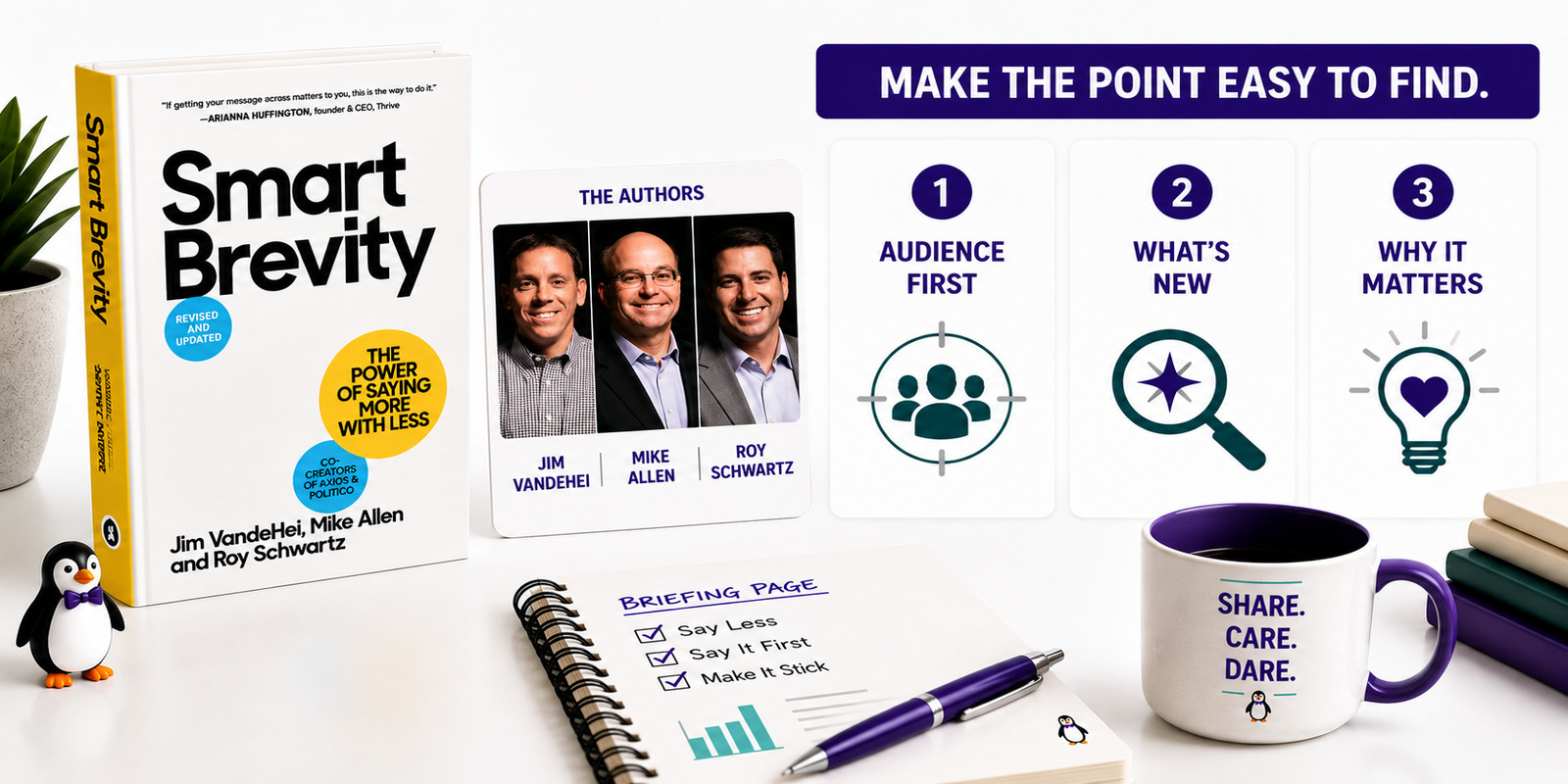
Busy executives do not need every detail at once. They need the most important information in an order they can absorb quickly. Smart Brevity co-author Roy Schwartz explains how audience focus, a clear opening, information hierarchy, conversational language, and disciplined editing can help CMO teams communicate with greater clarity without stripping away meaning or personality.
CMOs communicate with people who are deciding what deserves their attention every few seconds. An executive update competes with board materials, customer issues, sales forecasts, messages, meetings, and dozens of other demands.
Smart Brevity offers a system for helping readers understand the most important information quickly without reducing every message to a slogan. Co-authors Jim VandeHei, Mike Allen, and Roy Schwartz developed the approach through their work building Axios and Axios HQ.
Roy’s central distinction is that brevity is not the same as making every message as short as possible. The communication needs to be as long as required to convey the point, with the most valuable information receiving priority.
Corporate language often appears when the writer imagines an abstract audience. The message becomes formal, broad, and detached from the way people actually speak.
Roy recommends making the audience concrete.
“Focus on the audience first. Put up a picture or an image of the person you're trying to reach. It'll make all your communication better, because you'll be talking to a person as opposed to corporate speak.”
A CMO writing for the CEO may select different context and detail than a product marketer writing for a customer or a people leader addressing the full company. The underlying facts can remain the same while the hierarchy changes.
Writing for one person also makes editing easier. The writer can ask what that person already knows, what has changed, what decision is required, and which supporting detail will affect the response.
The communication no longer needs to explain everything marketing knows. It needs to help one reader understand and act.
Many business updates begin with history, process, and background before revealing why the message exists. Busy readers may leave before reaching the important point.
Smart Brevity reverses that order. The opening establishes what is new. The next layer explains why it matters. Supporting details follow for readers who need them.
“Keep your content focused on what they need to know: The ‘What's New’ and the ‘Why It Matters.’ The moment you do that, it will change the way you communicate for the better.”
For a CMO update, “what’s new” might be a shift in pipeline, a changed launch date, a competitor move, or a customer insight. “Why it matters” connects that change to revenue, strategy, risk, resources, or a required decision.
The approach does not remove context. It delays context until after the reader understands why the information deserves attention.
A strong message allows the reader to stop at different depths while still understanding the central point. The headline communicates the subject. The opening establishes the news. The next section explains the significance. Bullets and links provide evidence.
This structure serves several readers simultaneously:
When every piece of information receives equal visual weight, the reader must determine the hierarchy independently. That increases cognitive load and makes the message feel longer.
Headings, bullets, bold text, and spacing can make the logic visible. These elements work when they clarify the path, not when they decorate a message that still lacks a point.
Writers often use words and sentence structures they would never choose in conversation. The result sounds official but can become harder to understand.
Roy records himself talking through an idea and listens back to it. Hearing the message reveals where the language becomes unnatural, repetitive, or vague.
“When you listen to it, you'll know when you're rambling. You'd be like, ‘Oh my God, you've just said that point two, three, four times.’”
Speaking can expose filler that appears acceptable on the screen. It also preserves personality, which matters when brevity risks becoming sterile.
Conversational does not mean careless. The final version still needs accurate language, appropriate tone, and disciplined structure. The voice simply sounds like a capable person communicating with another person.
A concise message still needs a reason to continue. Smart Brevity uses a “muscular tease,” an opening that creates enough interest to move the reader into the next layer.
The tease does not need to exaggerate. It can identify a meaningful change, tension, consequence, or opportunity. Its job is to make the value of reading visible.
For example, “Website traffic fell 12 percent” reports a fact. “The traffic decline is concentrated in the pages that generate most enterprise demos” adds the consequence that makes the information more useful.
The next sentence can explain why the pattern matters and what the team is doing about it. The reader receives the business significance before the diagnostic detail.
BLUF stands for “Bottom Line Up Front.” The method originated in military communication, where the reader may need to understand the central conclusion immediately.
In a CMO context, the bottom line may be a decision, risk, recommendation, result, or change in plan. Placing it first prevents the reader from having to infer the purpose of the message.
A marketing budget request might begin with the amount and intended outcome rather than several paragraphs about market conditions. A launch update might open with the revised date and business effect before describing the dependencies. A board memo might state the conclusion before presenting the supporting analysis.
BLUF works best when the conclusion is specific. “Marketing is making progress” offers little direction. “Enterprise pipeline increased, but slower conversion puts the quarter at risk” gives the reader something to evaluate.
Some subjects cannot be reduced to a handful of bullets without losing important nuance. Smart Brevity does not eliminate long-form communication. It gives the reader a clearer entry point.
A board strategy memo, research report, or major organizational proposal can still contain substantial analysis. The beginning can summarize the conclusion, significance, and structure so readers know how to navigate it.
Roy explains that brevity means the message “should be as short as it needs to be in order to convey the point, not just short for short's sake.”
That standard protects against shallow communication. The writer removes repetition and low-value context while retaining the information necessary for a sound decision.
Clear communication becomes more valuable when it is consistent across the team. A shared structure can improve weekly updates, campaign briefs, executive emails, internal newsletters, meeting pre-reads, and decision documents.
Training can begin with a small number of habits:
Leaders also influence the system through what they reward. If every concise update receives requests for background already available in a linked document, the team will return to overloading the main message. If leaders use the hierarchy and follow links when needed, brevity becomes safer.
No. The message needs to be as short as it can be while preserving the meaning, evidence, and nuance required by the audience and decision.
The opening generally identifies what is new, why it matters, and any decision or action required. Supporting history and detail can follow.
It can if the writer removes voice along with unnecessary words. Conversational language and carefully chosen examples can preserve personality within a concise structure.
The team can apply a shared format to recurring updates, read drafts aloud, identify repeated points, and compare whether the first lines communicate the bottom line clearly.
Listen to the full conversation with Roy Schwartz.
CMO Huddles helps B2B marketing leaders win by bringing together peers, fresh perspectives, and opportunities to build stronger personal brands. Want to join the huddle? Learn more about CMO Huddles and join CMO Huddles Starter.