
Back to Blogs
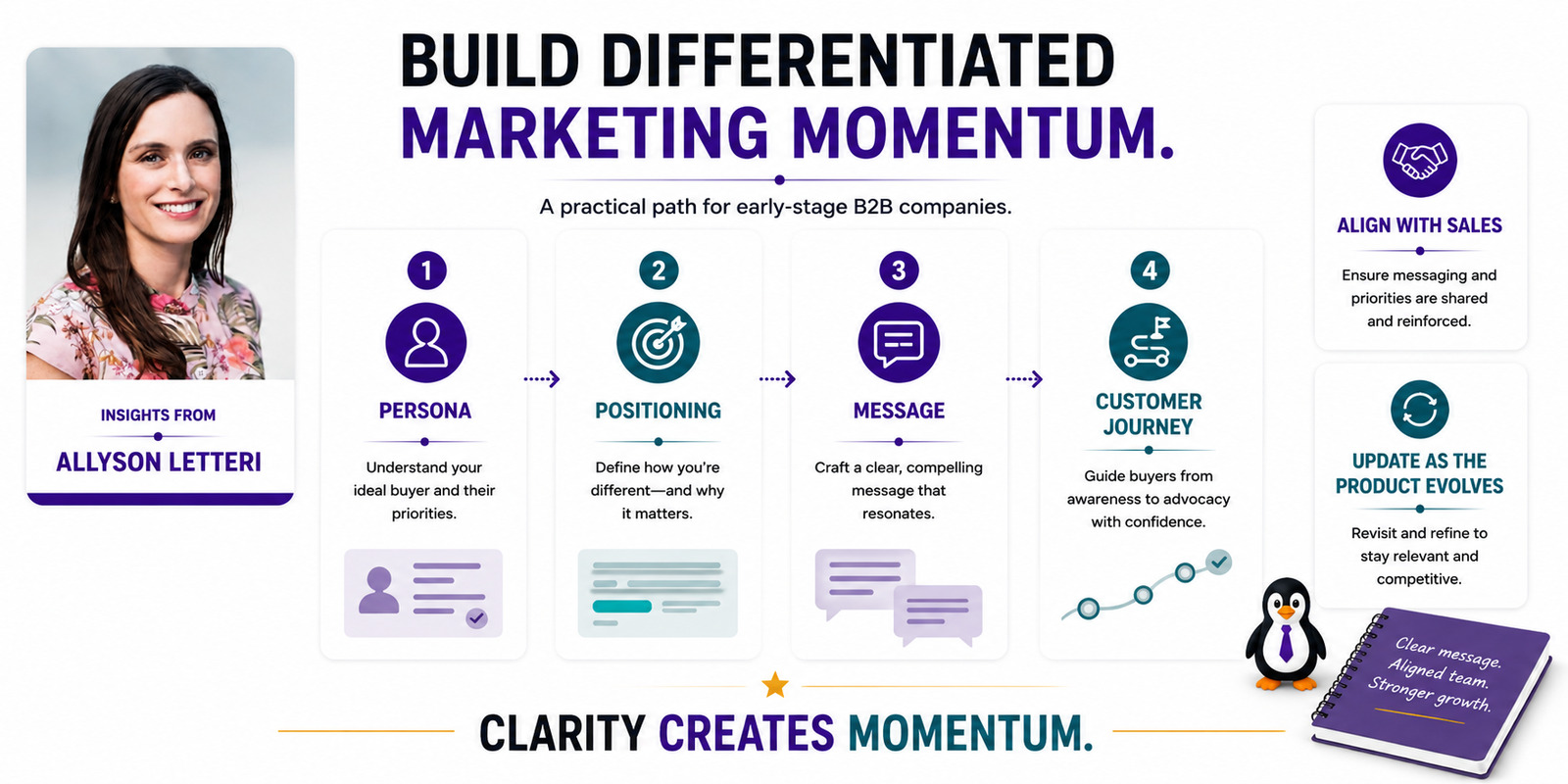
Standout startups connect positioning, messaging, content, and customer experience around a clear audience and measurable growth. Allyson Letteri explains how product marketing can unite product, sales, and marketing; why content should follow the customer journey; and how founders can avoid premature category creation while building a differentiated story customers understand and teams can use consistently.
Startups often generate their first wave of growth through founder relationships, investor introductions, direct sales, or a genuinely novel product. Those advantages can create momentum without proving that the company has a repeatable marketing system.
When the original network begins to run dry, the gaps become visible. The website reflects an earlier product. Sales tells a different story from the founder. Content accumulates without guiding buyers toward a decision. Product features ship faster than messaging can explain their value.
Allyson Letteri, author of Standout Startup, joined CMO Huddles to discuss how startups can replace that fragmentation with a clearer growth foundation. Her framework connects audience, positioning, messaging, and the customer journey rather than treating them as separate marketing projects.
Company-level messaging can retain continuity, but product messaging needs to evolve as customer needs, competitors, and capabilities change. The challenge is updating it without sending the organization into a constant identity crisis.
Allyson defines product messaging around why the product is valuable to an ideal customer and why it is better than the available alternatives. This moves the discussion beyond features. Each capability needs to connect to an outcome the buyer values and a reason the company can credibly claim an advantage.
Product marketing becomes the connective tissue across product, sales, and marketing. Product understands what is being built. Sales hears how prospects evaluate it. Marketing turns those inputs into a coherent market story.
A regular review cadence can keep those groups aligned. Quarterly or semiannual messaging reviews give product a place to explain new value, sales a chance to report what buyers are saying, and marketing a structured opportunity to update core assets.
That rhythm is more manageable when the company limits unnecessary content proliferation. Every new asset creates another place where old language can survive.
A startup cannot evaluate its message without knowing exactly whom it needs to influence. Allyson described the target audience as “the filter for all of your messaging decisions.”
That filter begins with the ideal customer profile and moves into the buying committee. Marketing and sales need agreement about which organizations are most likely to succeed with the product, who participates in the purchase, and which person serves as the primary buyer.
A useful persona should help the team understand more than a title or demographic profile. Allyson’s framework examines the buyer’s pains, desired gains, triggering shifts, blockers, and motivators.
Pains include functional problems as well as emotional and social consequences. Gains include the outcome buyers want and how achieving it changes their confidence, credibility, or relationships. Shifts explain why the buyer is open to change now. Blockers reveal what could prevent action. Motivators show which evidence is most likely to build confidence.
Those details improve more than copy. They can shape product priorities, sales discovery, customer proof, and the type of content marketing produces.
A positioning document handed to sales at the end of the process is unlikely to change what sellers say. Sales needs involvement while the message is being developed.
Frontline conversations reveal which problems buyers describe, which alternatives they consider, where deals slow down, and which claims create skepticism. Customer support and customer success contribute another view by showing what customers value after purchase and why they struggle or leave.
Allyson recommends listening directly to sales calls and customer conversations. Internal teams may already possess much of the insight needed to strengthen messaging, especially in companies where the founder remains active in selling.
The CMO can turn those scattered observations into a repeatable system: collect buyer language, test claims, document objections, update enablement, and monitor whether the new story improves conversations.
Sales alignment also requires tools that buyers can carry into their organizations. The primary buyer may believe the story and still need evidence to persuade finance, security, operations, or an executive sponsor.
Content volume is a poor substitute for journey coverage. Allyson uses the idea of a “happy path” to identify the essential information a prospect or customer needs at each stage.
That path begins with attracting the right audience and continues through nurture, conversion, onboarding, and long-term engagement. Each stage has a different job.
Early content helps buyers recognize a relevant problem. Nurture content demonstrates differentiation and proof. Conversion content addresses product, pricing, risk, and implementation details. Onboarding content accelerates time to value. Lifecycle content helps customers adopt new capabilities and remain engaged.
The model gives CMOs a way to audit content based on function rather than format. The question becomes whether buyers have what they need to keep moving, not whether the company published enough webinars, reports, or blog posts.
It also exposes duplication. If five assets make the same awareness argument while buyers lack implementation proof, producing another top-of-funnel article will not solve the journey problem.
Startups frequently run evergreen journey content, acquisition campaigns, and thought leadership at the same time. Those programs can fragment unless they share a planning rhythm.
Allyson recommends selecting timely themes and developing a smaller number of substantial core assets. One research report, customer study, or market point of view can support social content, sales outreach, public relations, search visibility, webinars, and nurture.
This is more than content repurposing. The shared source material creates message consistency across channels. Prospects encounter the same central idea in different forms rather than receiving disconnected claims from every campaign.
A quarterly planning cycle can help the organization choose one major market idea, identify the journey gaps it can address, and determine how each channel will distribute or deepen it.
An innovative startup may feel that existing category language fails to capture what it has built. Creating an entirely new category can therefore appear to be the boldest positioning move.
Allyson cautions companies against starting there. Buyers will still compare the product with something: a competitor, an internal process, a collection of tools, or doing nothing.
She recommends explaining “the problem they’re solving” and establishing why the product produces a better outcome than the alternatives buyers already recognize. That gives the market an understandable frame before introducing a more ambitious category claim.
A distinctive modifier within an established category can sometimes communicate novelty without forcing buyers to learn a new market definition. Category recognition may develop later as customers, analysts, and competitors adopt the language.
Founders often define marketing primarily as lead generation. Allyson offers a broader and more practical definition: the right combination of content and channels to acquire and retain customers while driving revenue growth.
That definition makes marketing accountable while acknowledging its contribution after acquisition. Marketing can help new customers reach value, support feature adoption, strengthen retention, and build advocacy.
“If founders aren’t using marketing” across those activities, Allyson said, they leave growth levers unused. The CMO can make those levers visible by connecting programs to acquisition, conversion, onboarding, engagement, retention, and expansion.
The result is a more durable explanation of marketing’s business role. It also keeps the startup from overinvesting in new leads while neglecting the customers whose experience will determine reputation and long-term growth.
Clarify the ideal customer, positioning, differentiated value, and essential buyer journey. These foundations make later channel and campaign decisions more coherent.
Fast-moving companies may benefit from quarterly reviews, with more substantial updates at least twice a year. Product launches, competitive changes, and shifts in customer needs may require additional revisions.
Identify the essential content for each journey stage, choose fewer core ideas, and plan how each major asset will support multiple channels and customer needs.
Only when the market evidence supports it. Begin by clarifying the recognized problem, existing alternatives, desired outcome, and credible differentiation. Category recognition usually requires adoption beyond the company making the claim.
Listen to the full conversation with Allyson Letteri.
CMO Huddles connects B2B marketing leaders with peers and experts who have faced similar growth challenges. Apply to join the community.