
Back to Blogs
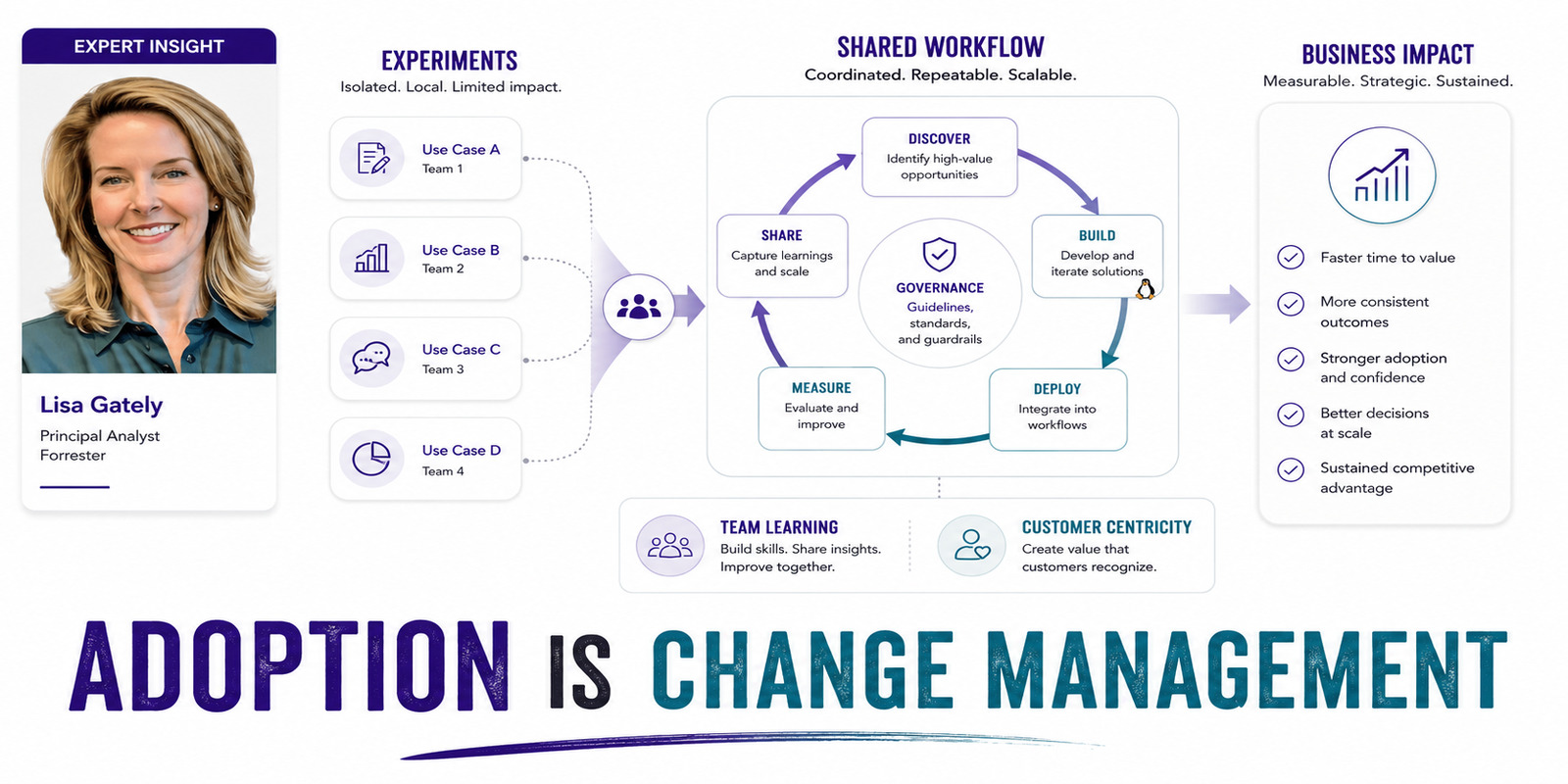
GenAI creates business impact when experimentation develops into an operating capability rather than remaining a collection of disconnected tools. Forrester analyst Lisa Gately explains why AI literacy, change management, workflow integration, cross-functional coordination, and outcome-based measurement matter. The opportunity extends beyond faster content production to better planning, precision, customer understanding, and organizational learning across marketing.
Early experimentation helped marketing teams understand what GenAI could do. The next stage involves turning isolated discoveries into dependable organizational capabilities tied to how the business plans, decides, and serves customers.
In a Renegade Marketers Unite conversation about realizing GenAI’s potential, Lisa Gately, principal analyst at Forrester, examined the leadership and operating-model work behind meaningful adoption. At the beginning of the discussion, Lisa considered the range of marketing work GenAI could affect. “People think of GenAI and stop at content generation,” Lisa said. “I look at this as: How does GenAI enable you with better planning, better precision, and more customer centricity?”
That wider lens gives experimentation a business purpose. A tool’s ability to produce a draft matters less than whether the surrounding system helps people plan more intelligently, understand customers more clearly, or make better decisions.
Lisa reflected on a recurring pattern in the organizations she studies. “I see a lot of organizations neglecting AI literacy and change management,” Lisa said. “It really underestimates how much cultural and skill gap there is.”
AI literacy includes prompt writing alongside a working understanding of what available systems can and cannot do. Teams also need clarity about how company and customer information may be used, where human review is required, and which outcomes the organization hopes to improve.
Literacy is role-specific. A content strategist, demand-generation leader, analyst, and marketing operations professional may use the same underlying technology differently. Shared principles create consistency, while role-based learning makes those principles useful in daily work.
Because tools and risks continue to evolve, one training session is unlikely to be enough. Office hours, internal demonstrations, use-case libraries, and peer learning give employees repeated opportunities to build confidence and examine real applications.
GenAI adoption affects routines, roles, quality controls, and professional identity. Employees may worry that experimentation will expose a lack of technical fluency or that efficiency will become a justification for reducing headcount.
Others may use AI privately without sharing what works because the organization has not established a safe way to learn in public. That behavior leaves useful discoveries hidden and prevents colleagues from benefiting from early mistakes. Lisa recalled advice from another marketer about the communication workload: “If you think about all the time communicating and handling change management, triple it.”
Repeated communication helps employees connect abstract AI ambitions with their actual responsibilities. It also gives leaders opportunities to clarify why the organization is investing, where experimentation is encouraged, and what boundaries apply.
Executive framing can reduce ambiguity. A team will approach adoption differently when the purpose is better customer understanding or new creative possibilities than when the only message is faster production.
A useful pilot examines the entire flow of work surrounding an AI-supported task. If a system produces campaign variations faster, the review team may receive more material. If research synthesis accelerates, strategists may need a new method for validating sources.
Personalization can create similar downstream demands. Expanded variation may increase the workload for legal, brand, marketing operations, and data teams unless the pilot accounts for review, approval, and distribution.
Greater speed can create challenges elsewhere.
A structured pilot can document the original process, the AI-supported process, required human review, observed quality, time saved, risks introduced, and resulting business outcome. That evidence helps the organization distinguish an impressive demonstration from a capability worth scaling.
The workflow view also reveals where human judgment has the greatest value. AI may accelerate production or synthesis while people remain responsible for strategy, factual accuracy, customer empathy, brand judgment, ethics, and final decisions.
Tool adoption and prompt volume demonstrate activity. They provide little evidence of whether the organization is making better decisions or producing stronger customer outcomes.
Lisa discussed the implications of AI beyond cost avoidance, describing them as “much bigger” and pointing toward outcomes such as revenue growth and customer retention. Those outcomes require marketing to work across functions instead of treating adoption as an isolated efficiency program.
Relevant measures depend on the workflow and may include:
“For this company’s AI literacy program, people were reporting time savings that equated to 14 FTEs for the year.”
The result shows how individual efficiency gains can accumulate across an organization. Its strategic value depends on what the company does with that additional capacity, such as increasing customer research, improving creative quality, accelerating testing, or addressing work that previously went untouched.
GenAI adoption often begins in pockets. A few motivated employees discover effective practices and develop informal standards while the rest of the organization remains uncertain about what is possible. Lisa cautioned against “treating AI like it’s a standalone initiative or a siloed project.” Her concern points to the organizational cost of leaving discoveries scattered across teams.
A center of excellence, internal council, or working group can help teams share patterns, establish safeguards, and reduce duplicated effort. Its value comes from turning individual discoveries into accessible organizational knowledge, without creating an approval process for every prompt.
A lightweight knowledge system might maintain approved tools, tested workflows, examples, review requirements, reusable prompts, and documented failures. Recording what did not work can prevent another team from repeating the same experiment without new information.
Internal champions can help translate broad guidance into functional practice. Their role may include demonstrating useful workflows, collecting feedback, identifying obstacles, and connecting teams that are solving similar problems independently.
Marketing rarely owns the full workflow affected by an AI initiative. Customer data, product information, sales activity, legal review, technical infrastructure, and agency work often cross organizational boundaries.
Lisa described the scope of that coordination as “a lot of cross-functional collaboration to do well across marketing, product, and sales,” along with agencies, vendors, and partners. Early participation from those groups can reveal data restrictions, integration challenges, quality risks, and approval requirements before a promising prototype becomes difficult to operationalize.
The approach also distributes responsibility appropriately. Marketing can lead an initiative while recognizing the dependencies and risks owned by other teams.
They often remain disconnected from regular workflows, shared standards, executive priorities, or measurable business outcomes.
It is a working understanding of available tools, appropriate uses, risks, review requirements, and the business problems AI may help address.
It can support planning, research synthesis, customer understanding, workflow coordination, analysis, personalization, and organizational learning.
Measures may include quality, cycle time, review effort, adoption, customer impact, revenue contribution, retention, or another outcome relevant to the workflow.
Listen to the full conversation with Lisa Gately. CMO Huddles helps B2B marketing leaders win by bringing together peers, fresh perspectives, and opportunities to build stronger personal brands. Want to join the huddle? Learn more about CMO Huddles and join CMO Huddles Starter.