
Back to Blogs
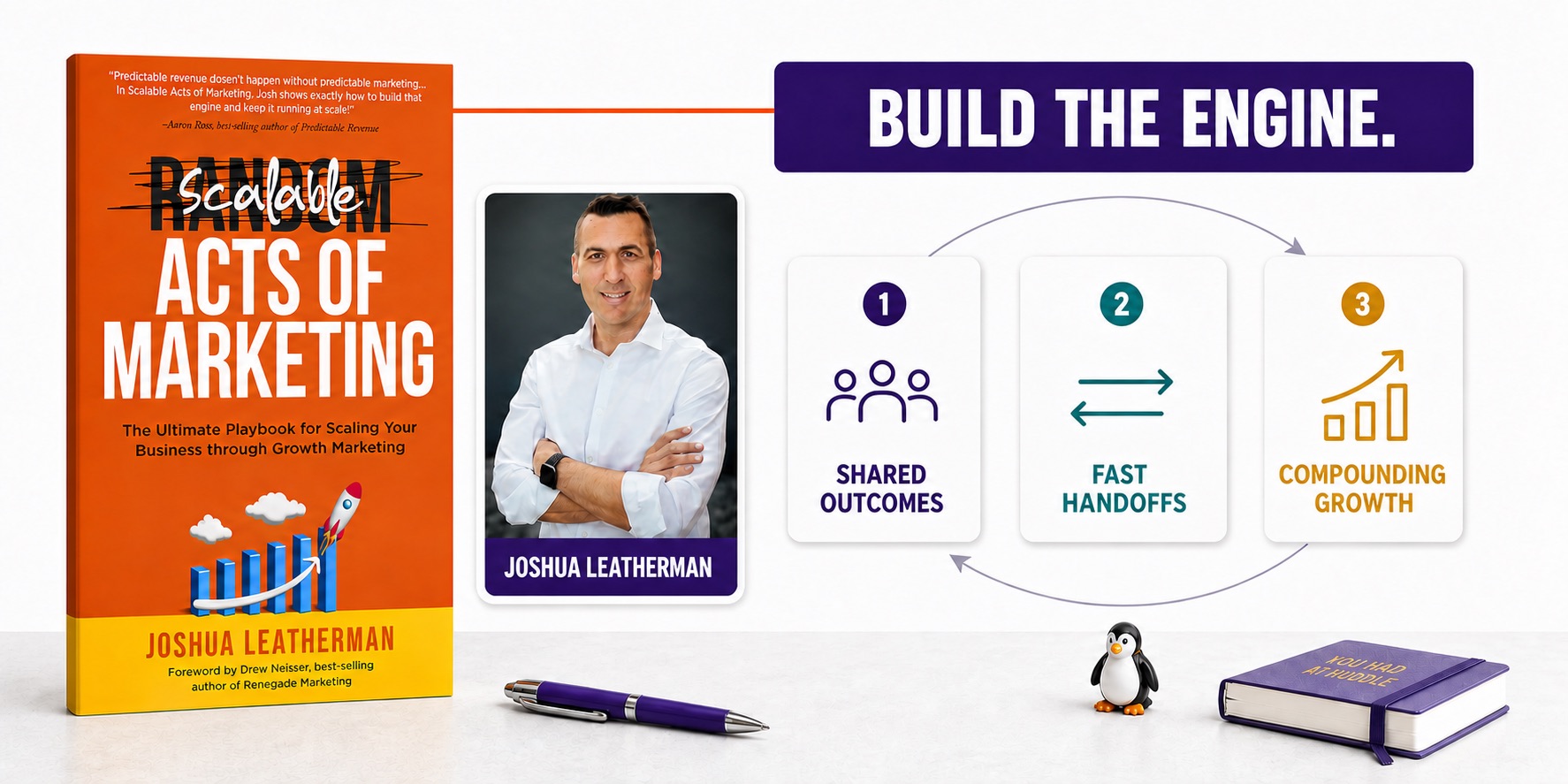
Scalable marketing is less about one breakthrough campaign and more about a system that turns insight into revenue progress. Joshua Leatherman connects durable growth with outcome-based language, shared revenue definitions, neutral operations, talent, fast follow-up, and peer learning. The result is a marketing engine whose processes and knowledge compound instead of resetting with every campaign.
A campaign launches. The team celebrates. The performance report arrives. Then everyone begins again with another idea, deadline, and collection of assets.
The work may be good. The problem is that little of it compounds.
In Scalable Acts of Marketing: Building a Repeatable Growth Engine, Joshua Leatherman of Cyderes discussed lessons from his book, Scalable Acts of Marketing.
The book draws on Joshua’s 13 years at Service Express, where the company grew from $30 million to $350 million in annual recurring revenue, according to the episode.
His central distinction is between disconnected activity and a growth system. A scalable system connects marketing with defined outcomes, shared data, executive partnership, consistent follow-up, and reusable learning.
Marketing teams often describe their contribution through campaigns, events, content, leads, and launches.
Those activities matter, but other executives may interpret them as costs rather than evidence of progress.
Joshua framed the shift clearly:
“It’s so important if you want to be a scalable marketer and one who produces value and is long-term for the organization to talk about outcomes, not activities.”
Outcomes might include qualified opportunities, pipeline, conversion, revenue, sales-cycle speed, or customer growth.
This language does not make marketing responsible for every variable. It creates a shared point of reference for the CMO, CFO, CRO, and CEO.
It also supports prioritization. When two programs compete for resources, the team can compare which outcome each supports and what evidence could reveal movement.
Joshua described close relationships with sales and finance as foundational to scale.
Shared definitions matter. When marketing and sales disagree about what constitutes a qualified opportunity, attribution and follow-up debates can consume more energy than improvement.
The handoff matters too. Marketing may create interest, but revenue is also influenced by response time, sales capacity, opportunity quality, and what happens after the first meeting.
A scalable model keeps marketing connected beyond lead creation through progression analysis, friction diagnosis, and relevant content across the buying process.
The goal is not departmental control. It is a more complete understanding of how demand becomes revenue.
Joshua described revenue operations as “Switzerland.”
The metaphor reflects a need for shared infrastructure across marketing and sales. A centralized RevOps function can maintain definitions, data quality, technology, routing, and reporting without becoming an extension of one department’s preferred narrative.
That neutrality becomes valuable when performance falls short. The conversation can focus on where the system is breaking instead of whose dashboard is correct.
RevOps does not create alignment automatically. It creates a structure in which shared evidence is easier to maintain.
Interest can decay quickly after a buyer signals intent.
A scalable system makes ownership, routing, and context visible so qualified demand does not wait unnecessarily.
Speed alone is not enough. A fast response still needs relevance and a useful next step.
This is where operations, automation, sales readiness, and content converge. The system can help the right person receive the right context while buyer interest remains active.
The important measure is not simply whether the lead moved. It is whether the buyer moved closer to a meaningful outcome.
Joshua identified talent and data as two pillars of scalable marketing.
Reliable data supports targeting, attribution, personalization, routing, and AI-assisted workflows. Strong people bring curiosity, learning velocity, accountability, and the ability to adjust as markets and tools change.
Joshua emphasized the importance of the people operating the system:
“One A player will run circles around four to five B players and one A player will outdo a hundred C players.”
A large campaign cannot repair a weak foundation. It may create a temporary spike, but the organization will still struggle to repeat or explain the result.
Joshua uses “R&D” to mean “rip off and duplicate.”
The phrase is intentionally provocative, but the underlying idea is practical. Marketing leaders can learn from peers who have already tested approaches, encountered common failures, and found useful questions.
“I attribute so much of my success to my ability to get in front of other CMOs who are ahead of me.”
The value is not copying a tactic without context. It is understanding the principle, adapting it to another organization, and measuring what happens.
That is another form of compounding. The team begins with accumulated learning rather than a blank page.
Big campaigns can create attention and growth. The risk appears when every result depends on another heroic launch.
Joshua’s scalable model focuses on what remains afterward: Shared definitions, cleaner data, stronger relationships, faster workflows, capable people, and reusable knowledge.
Those assets make the next result easier to produce. Over time, the marketing engine becomes more valuable than any individual moment it creates.
It is repeatable marketing work connected to an outcome, clear ownership, reliable data, and an improvable process.
A scalable act leaves behind a reusable workflow, stronger data, clearer learning, or another operating capability.
Shared definitions, evidence, and follow-up reveal how demand progresses and where momentum is being lost.
Documented workflows, reliable data, capable people, peer learning, and repeated improvement carry knowledge into future programs.
Want to hear more? Listen to the full conversation with Joshua Leatherman.
CMO Huddles helps B2B marketing leaders win by bringing together peers, fresh perspectives, and opportunities to build stronger personal brands. Want to join the huddle? Learn more about CMO Huddles and apply to join the community.