
Back to Blogs
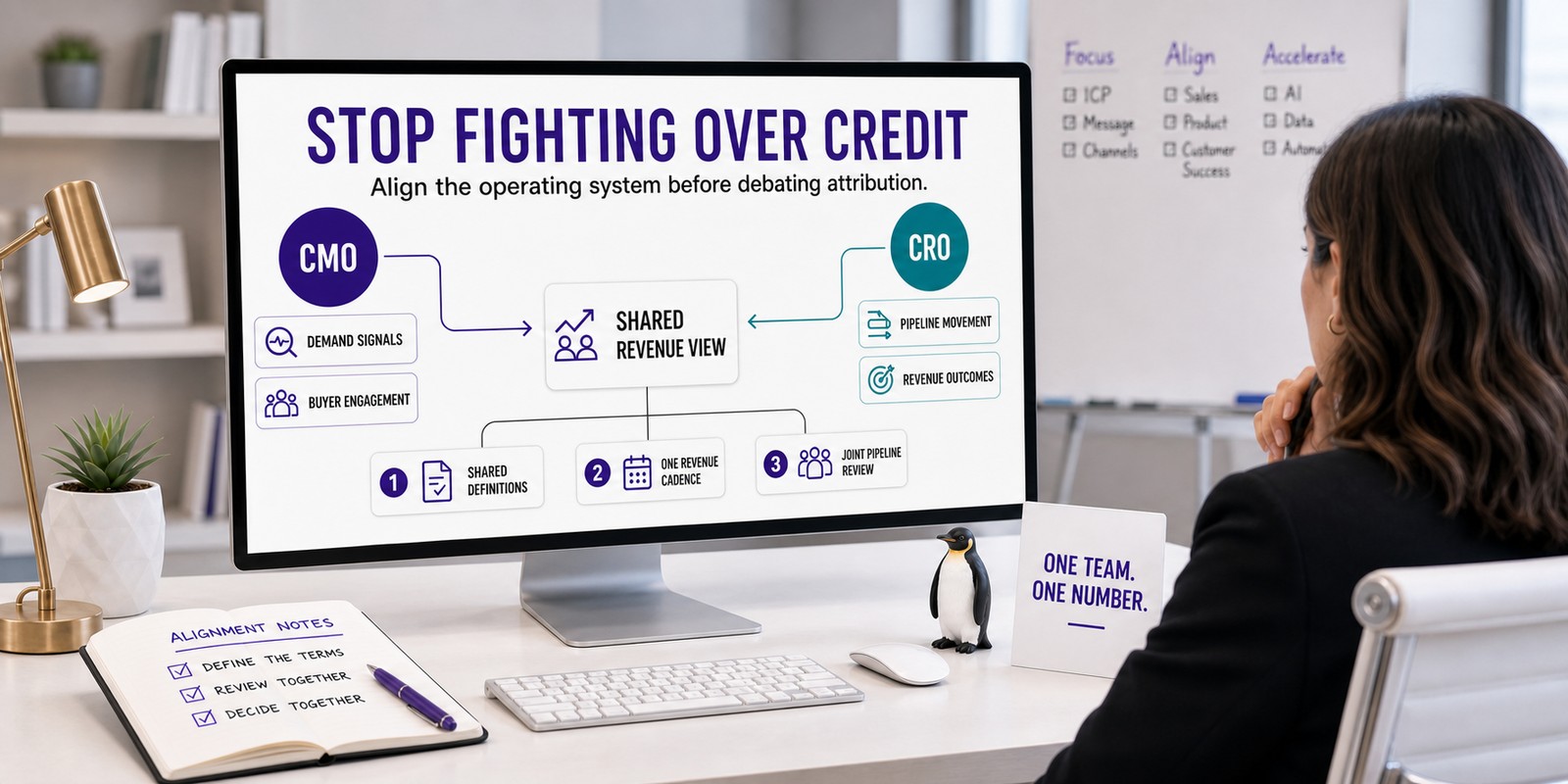
CMO-CRO alignment improves when marketing and sales share one financial target, agree on definitions, and review the same revenue story. Insights from Lisa Cole, Dave Bornmann, and Marshall Poindexter show how joint accountability, clean data, and a consistent operating cadence can replace attribution disputes with trust, better decisions, and stronger growth across the go-to-market engine.
When growth slows, attribution can become a contest over who created the pipeline and who deserves the credit.
That argument rarely improves the number.
In a CMO Huddles Studio conversation, three experienced marketing leaders explored a more productive model: One financial target, one set of definitions, and one operating rhythm shared across marketing and sales.
The discussion featured Lisa Cole, Chief Product, Marketing, and AI Officer at 2X; Dave Bornmann, retired B2B SaaS marketing executive and former CMO of Higher Logic; and Marshall Poindexter, Chief Marketing and Growth Officer with yorCMO.
Their insights point to three practical fixes for CMO-CRO alignment.
Separate pipeline quotas can make marketing and sales defend their respective slices of revenue. Lisa described how that structure can create conflict before the work even begins.
“The most important factor that enables an organization to align marketing and sales across that go-to-market engine to accelerate growth is they have to both be accountable to the same financial targets.”
A shared target changes the conversation. Instead of debating whether marketing sourced or influenced a deal, the team can examine whether the combined go-to-market engine is producing the intended business result.
Lisa also noted that the CEO plays a role in creating the conditions for alignment. When leadership assigns competing targets or treats sales and marketing as rivals for resources, even well-intentioned functional leaders can be pulled apart.
Alignment becomes difficult when marketing and sales use different definitions for pipeline stages, qualified opportunities, attribution, or account engagement.
A shared dashboard can help, but the definitions beneath it matter more than the visualization. Both functions need to understand where the data comes from, how stages advance, and which signals warrant action.
Dave connected that shared understanding to a deeper knowledge of how sales operates.
“I always sought to really understand the sales organization, the sales process, at as granular a level as possible, because I would be able to do my job better with that deeper understanding.”
That perspective moves marketing closer to the real sales process. It can also reveal where leads stall, where sellers lack context, and where marketing activity is not translating into buyer momentum.
CMO-CRO alignment is not created by one kickoff meeting. It develops through recurring conversations, shared decisions, and visible follow-through.
Marshall described the work as a broader go-to-market commitment.
“When you step into a role as a CMO, whether it’s a full-time role or whether you’re a fractional CMO, you have to take the time to build those relationships with the head of sales, the head of product, the head of customer success, and agree on a joint go-to-market strategy with joint metrics.”
A useful cadence might include:
The meeting itself is not the goal. The value comes from resolving disagreements early and giving both organizations the same account of what is happening.
Clean data supports trust, but it does not create trust by itself.
Dave emphasized the role of relationship building:
“You have to invest, just like you do in your personal relationships. You have to invest in them, spend time with them, understand them at a personal level.”
That relationship becomes especially important when the numbers are under pressure. A CMO and CRO who already understand each other can investigate the problem together. Without that foundation, the same shortfall can trigger defensive reporting and finger-pointing.
A shared financial target is a strong starting point. Supporting measures can include pipeline progression, win rate, deal size, retention, and customer lifetime value.
Shared definitions, one dashboard, and joint revenue reviews can redirect attention from credit toward business outcomes.
The right cadence depends on the sales cycle, but consistent working sessions are more useful than occasional alignment meetings held only when performance declines.
Yes. Goals, incentives, reporting structures, and resource decisions from the CEO can either support collaboration or create competition.
Listen to the full CMO Huddles Studio conversation about sales and marketing alignment.
CMO Huddles helps B2B marketing leaders win by bringing together peers, fresh perspectives, and opportunities to build stronger personal brands. Want to join the huddle? Learn more about CMO Huddles and apply to join the community.