
Back to Blogs
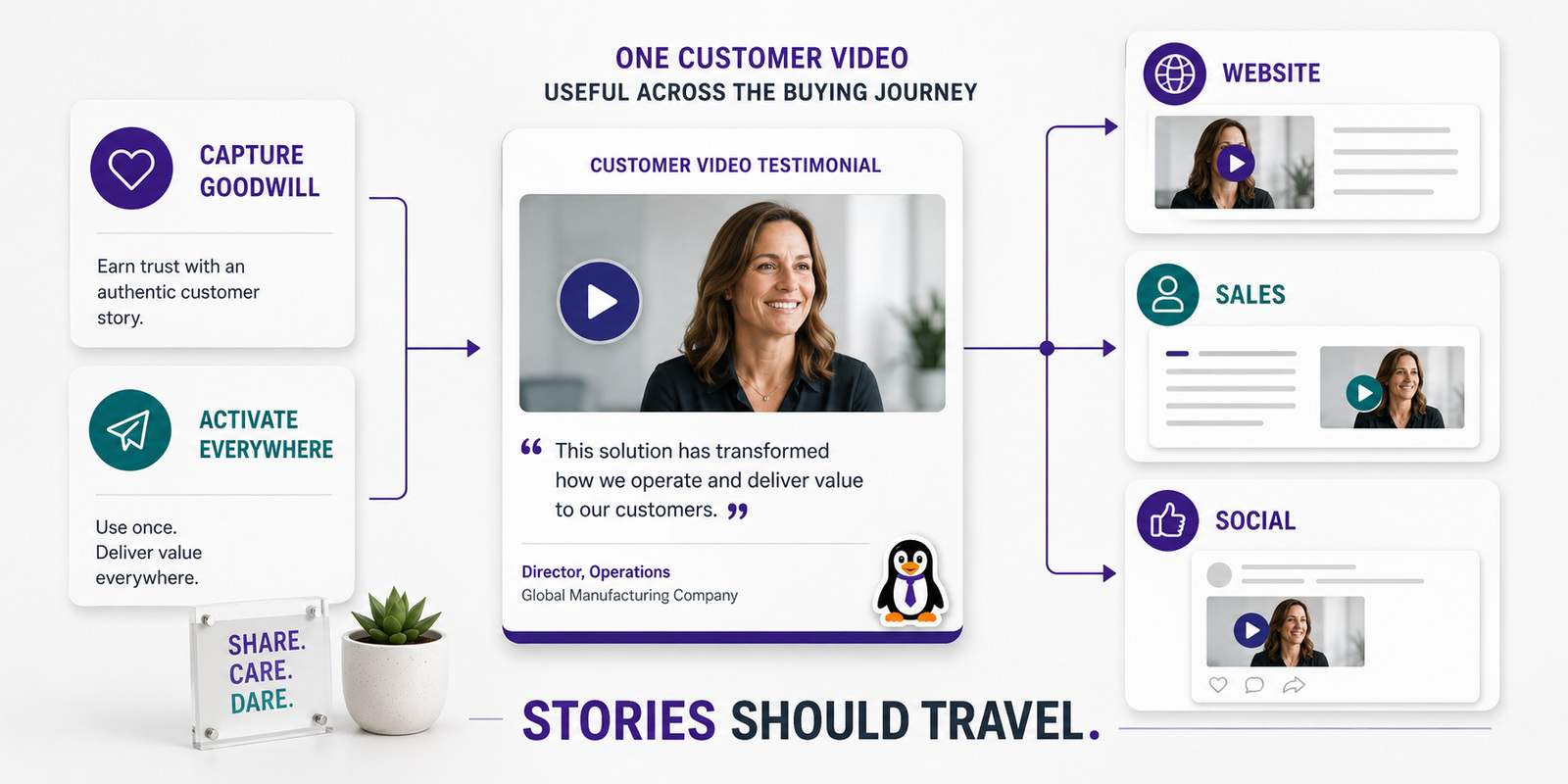
Video testimonials become valuable when customer stories appear throughout the buying journey instead of sitting on a single webpage. TeraLeap founder Alexander Ferguson explains how thoughtful timing, credible storytelling, broad distribution, and meaningful measurement can turn customer proof into a reusable marketing and sales asset that builds confidence and confidently supports more informed B2B decisions.
Buyers often place more trust in another customer’s experience than in a company’s claims. Yet many customer videos are published once, placed in a resource center, and left for visitors to discover on their own.
In a Renegade Marketers Unite conversation about video testimonials, Alexander Ferguson, founder and CMO of TeraLeap, explored how one customer conversation can become a reusable source of proof across marketing and sales. He opened the discussion with a statistic about sales content use.
“70% of content produced for sales teams goes unused. We create these great stories, but often they’re collecting digital dust on our website and not being leveraged across campaigns.”
The problem extends beyond production. Customer stories gain value when teams divide them into useful components and place each piece where a buyer is likely to encounter uncertainty.
A customer testimonial is most useful when it answers a question the buyer is already asking. That question may concern whether the solution works in a comparable environment, how difficult implementation will be, or whether the promised outcome is realistic.
Generic praise provides little decision support. A detailed account gives the buyer context they can apply to their own situation, including:
The story does not need to cover every point in one continuous video. A longer interview can generate shorter clips organized around specific buyer questions. One excerpt may establish relevance, while another reduces implementation anxiety or gives an internal champion evidence to share with finance.
This modular approach turns a single interview into a library of customer evidence. It also makes the material easier for sales teams to use because each clip has a clear purpose.
Many testimonial programs begin with a periodic request from marketing. That schedule may have little connection to the customer’s actual experience or willingness to participate.
During the conversation, Alexander discussed the timing of customer outreach. “If you’re able to capitalize on the maximum goodwill, the moment when they are excited and be able to make the request at that moment, then they have a much higher impetus,” Alexander said.
Those moments may include a successful implementation, a measurable result, a renewal, recognition at an event, or a conversation in which the customer spontaneously describes the value they received.
Customer success and sales teams are often closest to these signals. A shared process can help marketing recognize the opening without turning every positive interaction into an immediate production request.
The invitation matters, too. Customers may feel more comfortable when they understand the intended audience, production process, time commitment, review rights, and ways the final material will be used. Removing uncertainty makes the decision to participate easier.
The most credible testimonial sounds like a customer explaining an experience in their own language. A rigid script may produce polished footage, but it can also remove the details and natural phrasing that make the account believable.
An interview structure creates consistency without dictating every response. Open-ended questions allow the customer to describe the problem and result, while follow-up questions can uncover the tension, hesitation, and operational detail behind the outcome.
A polished production can still feel human. Minor imperfections, moments of reflection, and natural sentence patterns may increase credibility because they show the customer thinking through a real experience.
The company’s role is to create the conditions for a useful account and protect the accuracy of the story. Marketing copy should not replace the customer’s voice.
A testimonial page can serve as a useful archive, but it is rarely the only place a buyer needs reassurance. Relevant clips can appear on product pages, in nurture programs, during sales follow-ups, within event programming, on social channels, and in paid campaigns.
Placement works best when it matches the buyer’s question. A story about implementation belongs near implementation information, while a story about financial impact may be useful in an executive presentation or late-stage buying conversation.
Sales participation improves that match because sellers hear uncertainty directly. Marketing can tag assets by industry, problem, role, use case, objection, and buying stage so the team can locate a relevant story without reviewing an entire video library.
The distribution system can be simple. A searchable collection with brief descriptions, approved clips, suggested uses, and associated buyer questions may be more useful than a sophisticated platform that no one remembers to visit.
Reuse also changes how teams plan the interview. Questions, framing, composition, approvals, and recording quality can reflect the channels where the content is expected to appear.
Views offer only a partial picture of performance. During the conversation, Alexander outlined the video signals he monitors.
“The top stats that I’m constantly paying attention to when it comes to video specifically is impression-to-click ratio,” Alexander said. “Then I’m looking at watch time and completion ratio. And then the biggest one is conversions.”
Impression-to-click rate indicates whether the presentation earns initial interest. Watch time and completion show whether the story holds attention, while conversion activity reveals whether viewers continue toward the next step.
Measurement can also include sales usage, influenced opportunities, repeat viewing, and performance before and after a relevant video is introduced. Those findings require careful interpretation because correlation alone cannot prove that the testimonial caused the outcome. Alexander shared one customer example from his work.
“One of the customers I work with were able to see that 97% of the customers who actually closed and became customers went to these pages and watched these videos. They saw a perfect correlation with this as part of the sales journey that helped accelerate it.”
The finding does not establish that every organization will experience the same result. It demonstrates the visibility teams can gain when viewing behavior is connected to the wider customer journey.
A complete testimonial program considers reuse before the interview begins. That planning helps one conversation produce several useful assets without repeatedly asking the customer for more time.
One interview may support:
The approach also improves return on effort. The value comes from repeated use of authentic customer evidence wherever buyers need help evaluating a decision.
Approvals deserve the same advance planning. Customers should know which formats may be created, how their words may be edited, and what review opportunities they will have before publication. Clear expectations protect the relationship while allowing marketing to use the material effectively.
Specificity. The customer describes the original problem, decision process, experience, and outcome in language another buyer can understand and trust.
Positive moments such as a successful implementation, measurable result, renewal, or enthusiastic customer comment can create a natural opening.
Relevant excerpts can support webpages, sales follow-ups, nurture campaigns, presentations, events, social content, and paid media.
Useful signals include clicks, watch time, completion, conversions, sales usage, and whether the content appears in successful buying journeys.
Listen to the full conversation with Alexander Ferguson. CMO Huddles helps B2B marketing leaders win by bringing together peers, fresh perspectives, and opportunities to build stronger personal brands. Want to join the huddle? Learn more about CMO Huddles and join CMO Huddles Starter.