
Back to Blogs
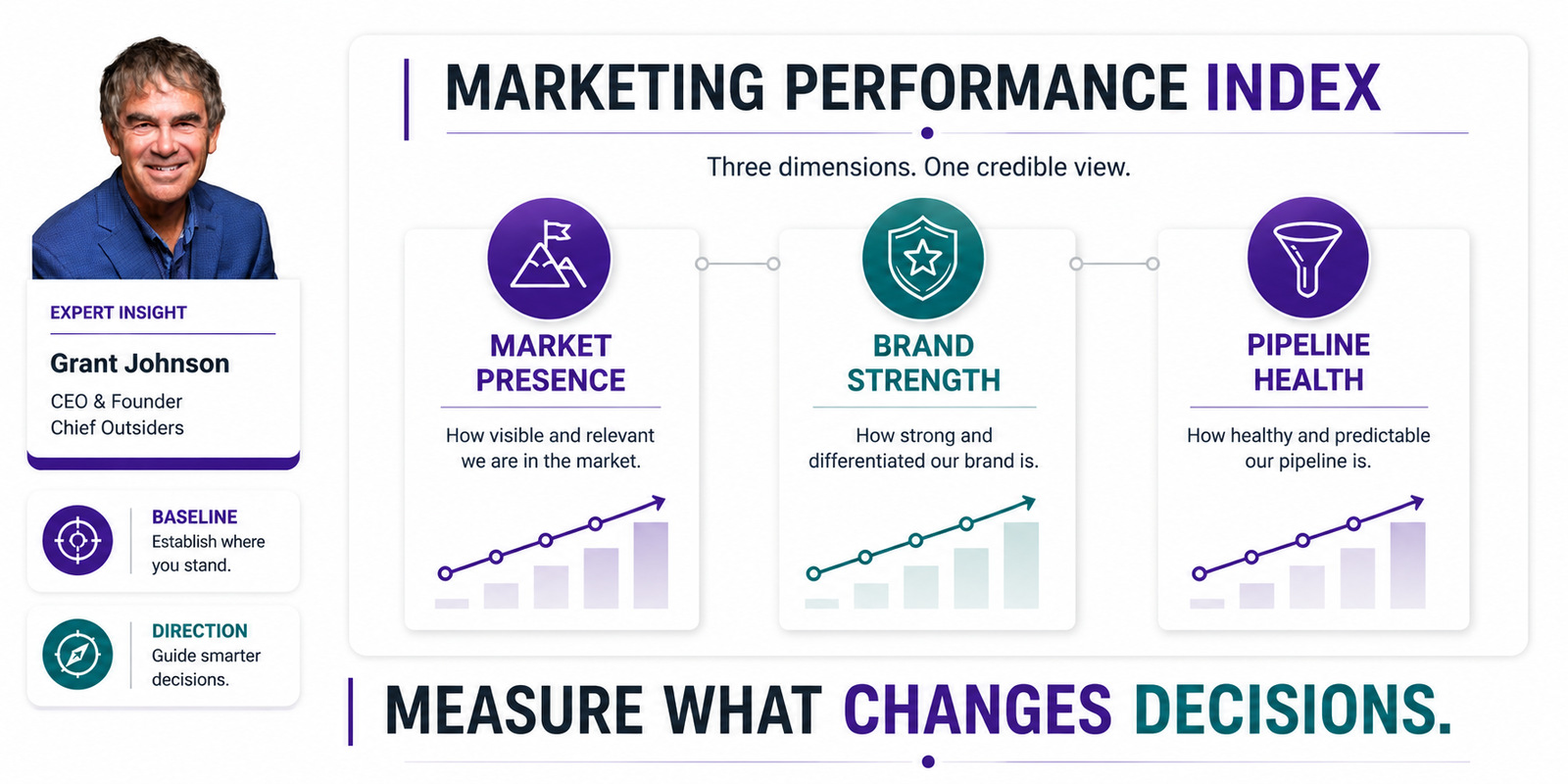
A credible marketing dashboard connects market presence, brand strength, and pipeline health instead of rewarding activity for activity’s sake. Marketing leader Grant Johnson explains how baselines, trend lines, executive agreement, and a focused performance index can reveal business momentum. The result is a clearer, defensible view of marketing’s contribution to sustainable customer growth and revenue.
Revenue and pipeline matter, but neither explains every condition that made a deal more or less likely to close. Market visibility, brand strength, customer loyalty, and pipeline progression shape commercial performance long before revenue appears.
In a Renegade Marketers Unite conversation about the B2B Marketing Performance Index, Grant Johnson, a seven-time CMO and founder of CMO Mentor, presented a framework connecting market presence, brand strength, and pipeline health.
The framework begins with a familiar measurement problem. “The first thing is they track far too many, and we’ve heard the term vanity metrics, metrics that only matter to marketing,” Grant explained.
An activity metric may still help a team diagnose performance. The problem arises when an executive dashboard fills with numbers that describe marketing activity without clarifying business momentum.
Page views, impressions, downloads, click-through rates, and social engagement can provide useful signals within a program. Presented without context, they leave the C-suite wondering what changed and why it matters.
A useful performance index begins before anyone chooses the visual format. Marketing, sales, finance, and the CEO need a shared understanding of which measures matter and what each one represents.
Without that agreement, marketing may report indicators it believes demonstrate progress while the rest of the executive team continues asking different questions. Marketing feels that its wider contribution is being ignored. Other leaders feel that the dashboard avoids the outcomes they care about.
“You’ve got to have measures that will stand up to scrutiny.”
That standard includes clear definitions, consistent sources, credible comparisons, and transparent limitations. If two teams calculate pipeline differently or interpret an engaged account differently, a polished dashboard will not resolve the disagreement.
Grant said marketing needs “positive affirmation that these metrics matter, or these metrics matter most,” because those are the measures that belong in executive communication. Marketing can still track additional diagnostic metrics internally while using a smaller, agreed set for the C-suite.
Before buyers evaluate a company, they need to encounter it. Grant described market presence as “being there, being found when prospects are searching, looking for alternative solutions, loosening the status quo.”
Possible indicators include search visibility, relevant website traffic, earned media, share of voice, event reach, community presence, and engagement among the intended audience. These signals become more useful when measured consistently against a baseline.
Total traffic alone reveals little. A sustained increase among priority audiences, supported by stronger search visibility and competitive share, may indicate that the company is becoming easier to discover.
Market presence also provides context when pipeline weakens. If the company is invisible during early research, sales may never receive the opportunity to explain the value proposition. That is a different problem from poor conversion later in the process, and it calls for a different response.
Reach reveals exposure. It does not show whether the audience understands, trusts, or prefers the company.
Brand strength can draw on engagement, customer loyalty, reputation, direct traffic, branded search, community participation, advocacy, and retention. No single measure captures the full condition, which makes direction and consistency especially important.
Customers who value the brand may be more willing to participate in research, recommend the company, expand their relationship, or defend the choice during a competitive review. Those behaviors create commercial value even when they don't show up as immediate campaign attribution.
“You can’t just get efficient and grow. You can’t cut your way to growth. You’ve got to ultimately grow the total pie.”
Efficiency can improve a functioning system. It cannot replace the market awareness, trust, and preference that create future demand. A company can lower acquisition costs temporarily while weakening the conditions needed for sustainable growth.
Pipeline health considers the value of opportunities and what happens after they enter the system. Volume alone can conceal targeting, positioning, qualification, or sales-process problems.
A focused review might examine:
This view creates a more productive bridge between marketing and sales. A large pipeline that rarely progresses may indicate weak fit or inflated qualification. A smaller pipeline with stronger conversion may reflect improved focus.
The index does not need to settle every attribution debate. It can give teams a shared set of patterns to examine, allowing a conversation about causes and decisions instead of competing claims for credit.
An isolated number provides a snapshot. A baseline makes movement visible.
The baseline might reflect a prior year, the company’s starting point, an agreed target, or a relevant competitive comparison. Different measures may require different reference points.
Trend lines are particularly valuable for market and brand indicators because their commercial effects develop over time. A quarter of stronger search visibility or customer engagement may not immediately produce a corresponding revenue jump. Consistent reporting allows executives to see whether the underlying conditions are improving.
Baselines also discourage selective storytelling. When definitions and starting points remain stable, teams have less room to highlight whichever number looks most favorable that month.
An executive index can simplify the conversation by grouping indicators into market presence, brand strength, and pipeline health. The simplicity becomes useful only when leaders can understand what sits behind each score.
A composite number should not disguise weak performance in one area or imply a level of mathematical certainty the model cannot support. Its purpose is to make patterns easier to recognize and discuss.
For example, stronger market presence paired with weak pipeline progression may direct attention toward positioning, qualification, or the sales experience. Strong customer loyalty paired with limited awareness may suggest that the company delivers meaningful value but has difficulty reaching enough prospective buyers.
The index functions as an operating instrument. It helps leaders locate a question worth investigating.
“Don’t drive your team crazy. Don’t just measure stuff because you can. Measure what you think is going to make a difference, because we’ve all got a lot to do.”
Modern marketing systems can produce more data than any leadership team can absorb. A disciplined dashboard therefore leaves out many numbers. The remaining measures clarify direction, withstand scrutiny, and support a decision. Detailed diagnostics can remain available when the team needs to understand why one of those indicators changed.
The result is a more credible marketing conversation. Executives gain visibility into the conditions surrounding growth, and marketers gain a clearer basis for deciding where attention and investment may be most useful.
It is a consolidated view of performance across market presence, brand strength, and pipeline health.
Baselines make direction visible by showing whether performance is improving, weakening, or holding steady.
No. It adds context around the conditions that influence pipeline quality, progression, conversion, and revenue.
A useful metric has a clear definition, withstands scrutiny, connects with a business priority, and informs a decision.
Listen to the full conversation with Grant Johnson.
CMO Huddles helps B2B marketing leaders win by bringing together peers, fresh perspectives, and opportunities to build stronger personal brands. Want to join the huddle? Learn more about CMO Huddles and join CMO Huddles Starter.