
Back to Blogs
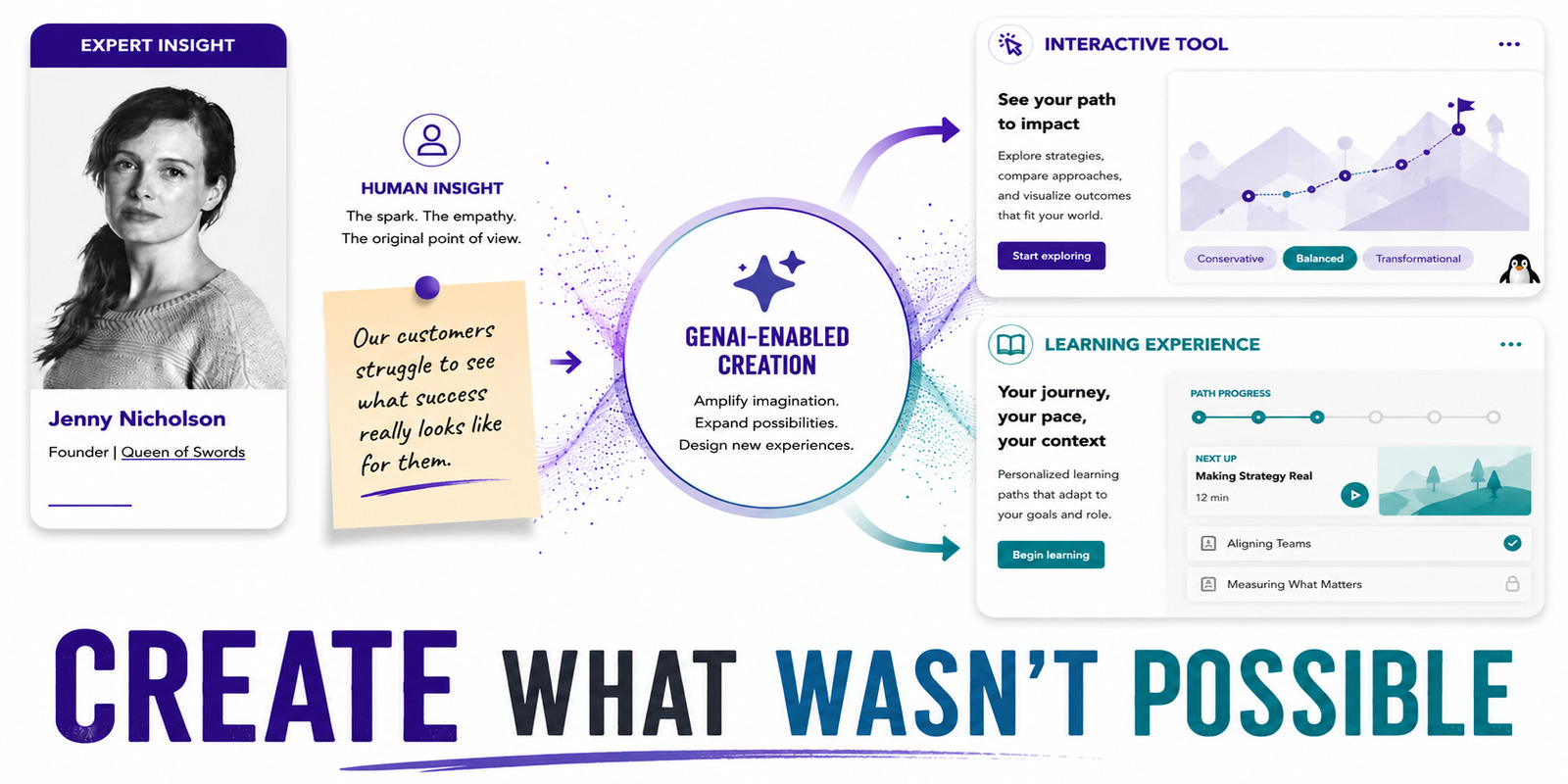
GenAI can expand what marketing creates, not just accelerate familiar work. Queen of Swords founder Jenny Nicholson shows how it can shape customer experiences, make routine tasks engaging, prototype new ideas, and turn static information into interaction. The strategic opportunity lies in creating experiences that were previously too difficult, slow, or expensive to build.
Efficiency is an obvious GenAI benefit. A system that accelerates research, drafting, analysis, or production can release meaningful capacity. The more imaginative opportunity begins when marketing examines what the technology can make possible.
In a Renegade Marketers Unite conversation about creative GenAI applications, Jenny Nicholson, founder of Queen of Swords, shared examples designed to create experiences that were previously difficult, slow, or expensive to build.
“Instead of looking at LLMs or GenAI to do what you’ve always done, but faster and cheaper and with fewer people, what would happen if you used it to actually do things that you couldn’t have done before?”
That question moves GenAI beyond production efficiency. It brings the technology into conversations about customer experience, product thinking, learning, and creative strategy.
Many AI projects begin with a tool and search for a use. Creative applications begin with an experience that contains friction, untapped potential, or an unmet need.
The opportunity may be a confusing onboarding process, an intimidating body of information, an underused resource, or a repetitive task people avoid. GenAI can make that experience more responsive by adapting information to a person’s context, questions, or progress. Jenny demonstrated concepts that transformed ordinary activities into games, helped people explore ideas through conversation, and converted static knowledge into personalized guidance.
The technology enables the interaction, but the value comes from understanding the person experiencing it. A responsive interface wrapped around weak information or an irrelevant task remains a weak experience. Customer interviews, support questions, behavioral data, and direct observation can help identify moments where greater adaptability would be useful.
Some of the most promising opportunities sit inside necessary interactions that people routinely avoid.
“If we could find a way to turn even the most boring moments of onboarding or task completion into a fun and engaging experience, that’s a huge world of opportunity that I wish more companies were paying attention to.”
B2B marketing includes many necessary but uninspiring interactions. Prospects complete assessments, employees review enablement material, customers navigate implementation steps, and partners search for information. A conversational or game-like layer can make those interactions easier to begin and continue.
The point is not to add novelty to every task. Playfulness becomes useful when it improves understanding, participation, completion, or adoption.
An onboarding experience, for example, might respond to a customer’s industry and role instead of presenting the same sequence to everyone. An assessment could turn static questions into an interactive conversation that produces a relevant output. The business outcome gives the creative idea discipline.
Marketing organizations hold large amounts of information in reports, webinars, guides, enablement documents, and product materials. Audiences still need to locate, interpret, and apply that information.
A conversational experience can help a person explore the material through their own questions. Instead of reading an entire guide, a customer might ask how the guidance applies to a specific situation and receive an answer grounded in approved sources.
That experience requires careful boundaries. The system needs reliable content, transparent limitations, and a clear path to human help when the question exceeds its scope.
Interactive access does not make the underlying source material less important. It increases the importance of accuracy, structure, and governance because the system can recombine that information in many ways.
Some AI concepts are difficult to evaluate through a slide deck. A lightweight prototype gives people something concrete to test.
A custom GPT or small interactive experience can help a team determine whether an idea is useful before investing in full production. The prototype may reveal that the concept needs better source data, clearer guardrails, a narrower audience, or a different interface.
It can also improve executive discussions. Leaders can respond to the experience instead of debating an abstract description of what AI might do.
The prototype functions as a learning instrument. Early users can reveal what they understand, where they hesitate, which outputs they value, and what makes them uncomfortable.
A promising demonstration still needs a path toward governance, maintenance, measurement, and ownership before it becomes part of the customer experience.
“When it comes down to it, prompt engineering is about knowing what to say so that you say what you actually mean, not what you think you’re saying.”
An AI system responds to the information it receives. When the output misses the intended result, the problem may be the model, but it may also be ambiguity in the request.
Useful prompting forces a team to clarify the objective, audience, context, constraints, and definition of quality. Those questions are valuable even when no AI system is involved.
A vague creative brief produces inconsistent work from people and machines. Prompting can therefore become a practical exercise in strategic communication.
GenAI can produce variations, combine ideas, and create interactive outputs. It does not own responsibility for whether the experience is accurate, distinctive, appropriate, or useful.
People define the purpose, select the idea, evaluate quality, and accept accountability for the result. Human judgment becomes especially important when the experience uses customer information, provides recommendations, or represents the brand through unscripted interaction. Jenny grounded that responsibility in a simple observation: “No matter who your audience is, whatever title they have, whatever company they work at, at the end of the day, they’re still people.” Customer insight, cultural Awareness, humor, taste, and strategic context give GenAI more meaningful material to work with.
A generic prompt built from familiar category language is likely to produce familiar work. Customer insight, cultural awareness, humor, taste, and strategic context give the system more meaningful material.
The technology supplies leverage. People determine whether that leverage creates something worth experiencing.
A creative GenAI experiment may not initially produce a clean cost-saving calculation. Its early value may appear in participation, completion, learning, adoption, or the quality of feedback.
The measurement approach can reflect the experience being tested. An onboarding prototype might track completion and comprehension. An interactive research tool might measure engagement depth and whether users reach a useful answer. A sales-enablement experience could be evaluated through adoption and confidence.
Efficiency may still matter. The broader evaluation considers whether the organization created a capability or experience that was previously out of reach.
Efficiency applications accelerate familiar work. Creative applications enable experiences or capabilities that were previously impractical.
It begins with a meaningful experience, defines the intended outcome, and uses a prototype to gather evidence.
It can make onboarding more interactive and contextual when the experience uses reliable information and appropriate review.
Prompts expose whether the objective, audience, context, constraints, and definition of quality are clear.
Listen to the full conversation with Jenny Nicholson.
CMO Huddles helps B2B marketing leaders win by bringing together peers, fresh perspectives, and opportunities to build stronger personal brands. Want to join the huddle? Learn more about CMO Huddles and join CMO Huddles Starter.