
Back to Blogs
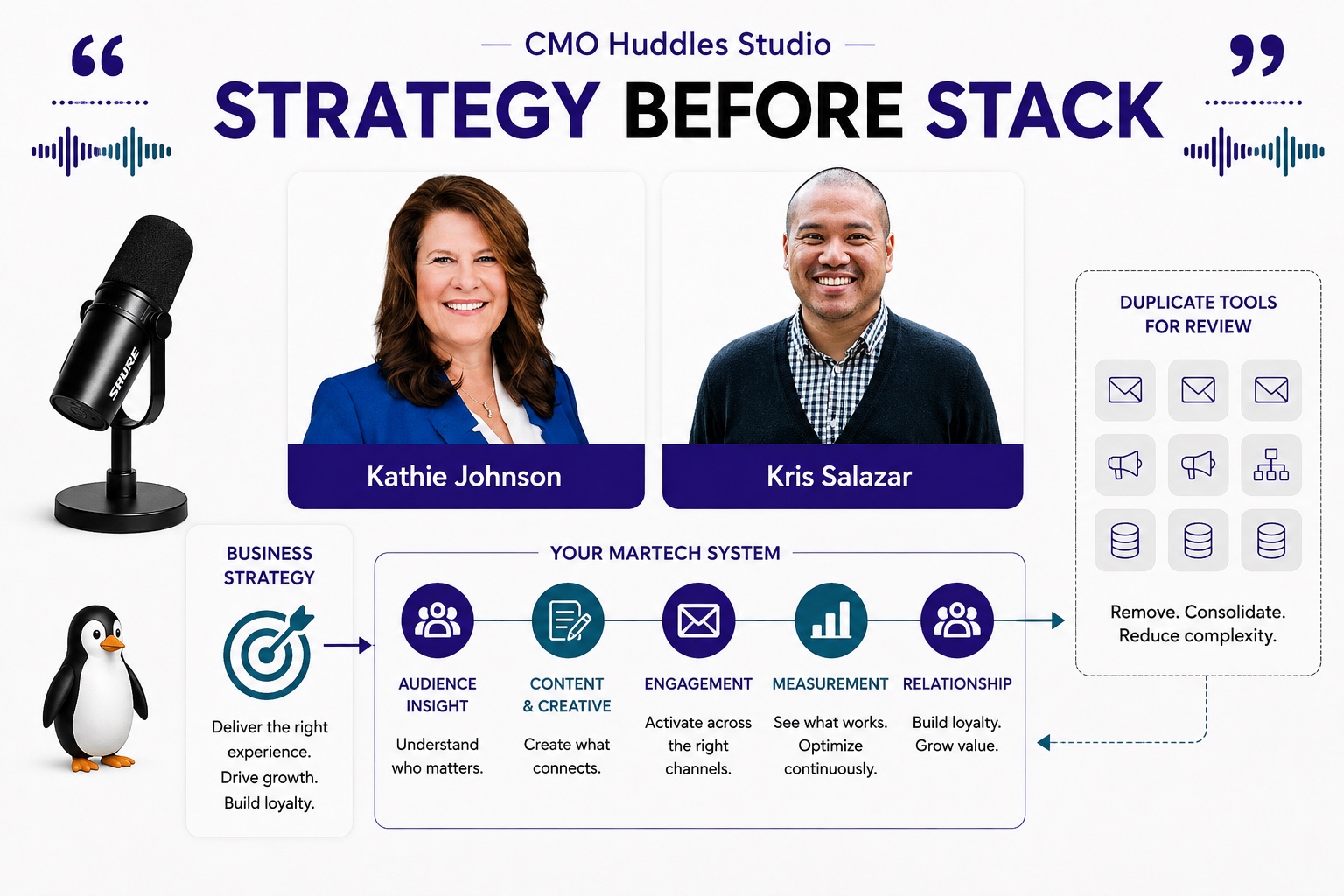
A MarTech stack creates more value when every platform connects to strategy, has an accountable owner, and earns its place through measurable outcomes. Kathie Johnson and Kris Salazar share how visual mapping, audits, vendor management, and capacity planning can reduce stack bloat while helping marketing teams get more from the technology they already own.
A growing technology stack can create the appearance of capability while increasing cost, complexity, and operational friction. New platforms arrive with compelling features, but their value depends on how well they support the company’s strategy, workflows, data, and people.
In a CMO Huddles Studio conversation about strategy-first MarTech, Kathie Johnson, formerly of Sitecore, and Kris Salazar of Appcast explored how marketing leaders can evaluate the entire system before adding another tool.
The discussion begins with a distinction that can easily become blurred: The stack supports the strategy. It does not define it.
Kathie described the first task she undertakes when entering an organization.
“The first thing I always do is build that visual map of all the MarTech we have. I like to have that big picture understanding and how it ties to my strategy.”
The map gives teams a shared view of the platforms, integrations, data flows, owners, contracts, and workflows that make marketing possible. It can reveal several tools performing similar jobs, critical systems operating without clear ownership, or manual handoffs created by disconnected platforms.
Kathie evaluates the stack through four questions:
For Kathie, the website and CRM sit near the center of the system because they connect the company’s customer information, differentiated story, and digital experience. The exact center may vary by business, but the map still needs to show how technology supports the customer journey and company strategy.
Feature comparisons can dominate MarTech discussions. A strategy-first evaluation begins further upstream with the business outcome and the workflow required to support it.
A company focused on enterprise account progression may need reliable account insight, coordinated engagement, sales visibility, and measurement across a long buying cycle. A company prioritizing retention may place more emphasis on customer data, lifecycle communication, product usage, and expansion signals.
The difference matters because a missing capability becomes meaningful only when it interferes with an important workflow or outcome. Conversely, an impressive capability may add little value when the organization lacks a clear use for it.
Kathie returned to this connection throughout the conversation.
“What is it you fundamentally need to do? Are you trying to build engagement, build brand, build pipeline?”
Those questions create a practical filter for evaluating technology. They also make it easier to explain investment decisions to finance, IT, operations, and executive leadership because the discussion remains connected to business priorities.
A stack diagram becomes more useful when it shows what moves between the systems. Customer data, content, campaign activity, account information, and performance signals can lose value when they remain trapped in separate platforms.
Kathie described the relationship among the content management system, customer data platform, digital asset management system, and other connected tools.
“That’s when magic happens, and that’s when you can really help make personalization come to life.”
The value comes from the systems working together. Customer information can inform the experience, the right content can reach the right visitor, and teams can learn from the interaction. Without accessible and reliable data, personalization remains an aspiration regardless of how advanced the individual platforms appear.
This makes data quality and integration part of the MarTech strategy. A platform may function exactly as designed while producing limited value because the information feeding it is incomplete, inconsistent, or inaccessible.
Kris approached the stack from another part of the operating model.
“These tools are not automated machines you just leave. You need people that know how to manage them. Part of that is understanding if they have the bandwidth.”
Platform ownership extends beyond permissions and contract renewals. An owner may monitor adoption, coordinate training, manage the vendor relationship, resolve workflow problems, evaluate performance, and help users understand how the technology fits the broader system.
Capacity deserves as much attention as accountability. Assigning a tool to someone who lacks the time, knowledge, or interest to manage it creates ownership on paper without changing the outcome.
Kris compared an overloaded stack to Batman’s utility belt. A team may own ten capabilities while relying on only two or three. The unused features still create costs through licensing, training, administration, integration, and cognitive load.
Kris described an audit that looks beyond the marketing department. It considers who uses each tool, how much it costs, what other teams think of it, where it overlaps with technology elsewhere in the company, and whether it still supports the current operating model.
“Do we like the tools? Do we still feel like it’s the right tool for us for what we need to do on a day-to-day basis?”
That assessment can separate several different problems. One tool may no longer support a strategic priority. Another may be valuable but poorly configured. A third may have low adoption because training stopped when its internal champion left.
A useful audit can examine:
Cancellation is one possible result. The audit may instead reveal an integration problem, a training need, an opportunity to reduce the contract tier, or a platform that could replace several narrower tools.
Annual planning, organizational changes, and AI development can alter technology requirements quickly. Long contracts may make financial sense at signing while limiting the organization’s ability to respond later.
Kris prefers shorter commitments where possible.
“Always figure out: Is that still the right tool? Is that the right tool, especially with the evolution of AI tools?”
Contract flexibility creates regular decision points. The team can compare current use with current strategy before automatically renewing a platform selected under different conditions.
Those conversations work better when they begin well before the renewal deadline. Early reviews create time to gather user feedback, evaluate alternatives, renegotiate terms, or improve adoption before making the final decision.
Vendor management also belongs in the operating model. Product teams may be able to improve the platform, provide training, explain underused capabilities, or adjust contract terms when customers bring them a well-supported business case.
Kris participates in recurring vendor conversations and connects feedback to specific customer and business problems. He explained that broad relevance makes a request more persuasive than an isolated feature preference.
A team that understands its platform deeply can have a stronger vendor conversation. It can identify where the product creates friction, quantify the effect, and explain how an improvement could benefit other customers with similar needs.
AI has made it easier for individual employees to adopt specialized tools. That accessibility can accelerate learning, but it can also produce scattered subscriptions, unclear data practices, and overlapping capabilities.
Kathie’s Project 30 gave the team a defined environment for exploring new approaches.
“The key is to test them, see if they work, and if they don’t, don’t continue to engage.”
The experiment was not an open-ended commitment to every new tool. A defined pilot can include an owner, business problem, testing period, data rules, success measures, and decision date. The evaluation can consider whether the tool improves a meaningful outcome and whether the surrounding workflow can absorb the change.
Faster content creation, for example, may increase review requirements. Better analysis may depend on integrations that do not yet exist. A useful AI capability still needs operational support.
The conversation suggests a practical order for managing the stack:
This sequence gives marketing leaders a fuller view of the system. It also makes technology decisions easier to explain because each investment connects to a visible strategic and operational need.
It is a technology ecosystem in which each platform supports a defined business priority, customer need, or operating workflow.
Annual audits can support contract decisions, while lighter quarterly reviews can surface adoption, ownership, and integration problems earlier.
Common signals include low adoption, unclear ownership, duplicated capabilities, unreliable data, weak integration, and limited connection to business outcomes.
No. It means retaining technology the organization can use, govern, integrate, and connect to meaningful outcomes.
Listen to the full Strategy-First MarTech Stack conversation.
CMO Huddles helps B2B marketing leaders win by bringing together peers, fresh perspectives, and opportunities to build stronger personal brands. Want to join the huddle? Learn more about CMO Huddles and join CMO Huddles Starter.