
Back to Blogs
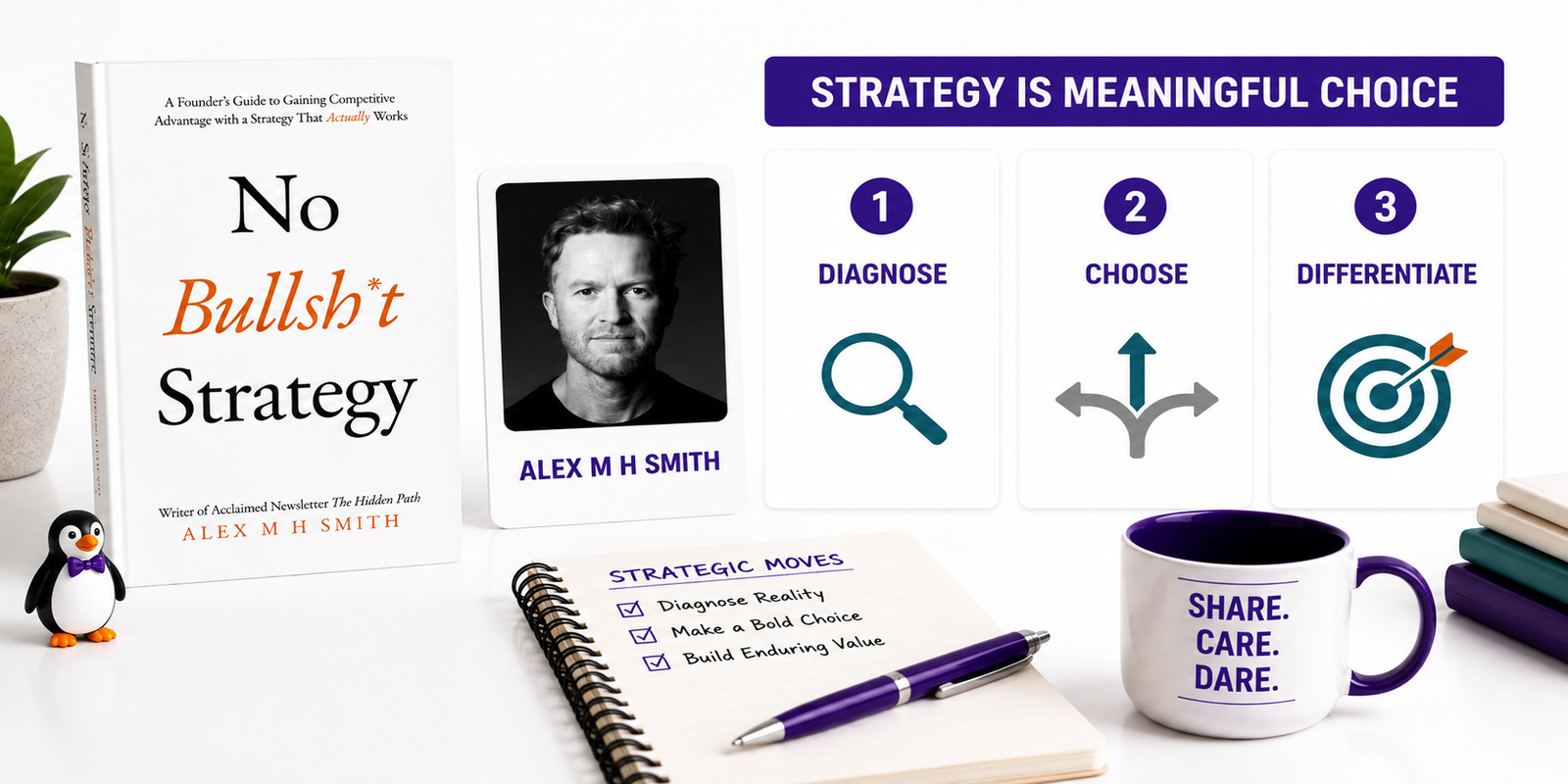
Strategy is more than goals, tactics, or a positioning statement. No Bullsh*t Strategy author Alex M. H. Smith frames it as a choice about creating value customers want and cannot obtain elsewhere. For CMOs, that perspective links customer insight and communication with product, operations, and the deliberate tradeoffs that make differentiation credible and commercially valuable.
Growth, market leadership, customer obsession, and category dominance describe desired outcomes. They do not explain the distinctive choices that might produce them.
In a Book Huddle conversation about No Bullsh*t Strategy, Alex M. H. Smith, founder of Basic Arts, challenged the jargon and communications-first thinking that often surround strategy.
“There’s a whole lexicon of terms which are sort of strategy-adjacent in the world of marketing, like positioning, vision, mission, purpose, proposition.”
Each concept can be useful when the organization defines it precisely. Together, however, they can create the appearance of strategic rigor without answering the central question: What valuable thing will this business do that customers cannot easily obtain elsewhere?
A goal describes where the company hopes to arrive. Strategy explains the meaningful choices that could give it an advantage on the journey.
“Business is the strategy, how it’s delivered, and how it’s communicated. Marketers are only given true control over the question of how it’s communicated. But the problem they often have is that the thing they’re asked to communicate is not very good in the first place.”
Marketing leaders are frequently asked to clarify, differentiate, and promote an offer they had limited influence over creating. Product, pricing, service, distribution, operations, and customer experience determine whether that promise is credible. Communications can make a difference easier to understand, but they cannot create a durable distinction that the rest of the company does not deliver.
This does not leave the CMO powerless. Marketing can bring customer understanding, competitive intelligence, search behavior, win-loss findings, and market response into the strategic discussion. Those inputs help the executive team identify where customers see meaningful value and where the company remains interchangeable.
Earlier marketing participation also improves the connection between the market promise and operating reality. Positioning becomes stronger when it expresses a choice the organization has already made.
“Can you create something number one, people want; but number two, they can’t get anywhere else? That’s the trick.”
Many companies satisfy one side of the strategic equation while missing the other. Some create something unusual that few customers value. Others enter a proven market with an offer buyers can obtain from many competitors.
Desirability without distinction leaves the company exposed to comparison, substitution, and price pressure. Distinction without demand may produce an interesting idea with little commercial potential.
The intersection is more demanding. The company creates value customers recognize and organizes itself to deliver that value in a way competitors cannot easily copy.
For CMOs, this test can sharpen customer research. Instead of asking only which messages resonate, the inquiry can explore which problems matter most, how buyers currently solve them, where dissatisfaction remains, and which company capabilities could support a meaningfully different answer.
Claims of being the best invite comparison against familiar competitors and criteria. The buyer remains inside the established category and decides which supplier performs a similar job more effectively.
An “only” strategy seeks a different basis for choice. It may involve a distinctive combination of audience, product, delivery model, expertise, experience, or operating decisions.
A company might focus on an underserved customer group and configure the product around that group’s working reality. It might combine capabilities the category traditionally sells separately. It could remove complexity buyers have come to accept as unavoidable.
The distinction does not need to be unprecedented in every detail. It needs to be difficult to reproduce as a complete system. A slogan can be copied in an afternoon. Connected operational choices are harder to imitate.
Positioning helps the market understand why a company matters. It becomes more credible when it reflects value the business is prepared to deliver consistently.
When strategy and positioning are confused, marketing inherits an impossible assignment. The team may simplify the proposition, sharpen the message, and build a distinctive campaign while the underlying product and experience remain similar to every alternative.
A stronger sequence begins with the business. Which customers will receive unusual value? What will the company deliver for them? Which capabilities make that possible? What will the organization decline to pursue so those capabilities receive sufficient attention?
Positioning then gives the choice a form buyers can understand, remember, and repeat. It translates the strategic system without pretending language created the system.
A strategy that includes every audience, benefit, channel, and opportunity resembles a wish list. It offers departments little guidance when priorities conflict.
Alex put the consequence plainly: A company may need to “choose to suck at something which your competitors do well at” to create the leverage to offer something new. The sacrifice concentrates resources behind a distinction instead of preserving acceptable performance everywhere.
Tradeoffs concentrate resources. They identify the customer the company is prepared to serve unusually well, the capabilities worth strengthening, and the opportunities that fall outside the chosen direction.
The effects extend across the organization. Product receives clearer priorities. Sales gains a sharper view of fit. Marketing can build recognition around a consistent promise. Customer teams understand the experience the company intends to deliver.
Tradeoffs can also make growth feel uncomfortable. Saying no to a plausible market or feature may appear limiting in the short term. The alternative is often fragmented investment that leaves every opportunity partially served.
Strategy becomes visible when the organization encounters an attractive option and can explain why it does or does not fit.
During the conversation, Alex asked directly, “You want to increase the amount of value you’re bringing in?” His answer followed immediately: “Increase the amount of value you’re putting out into the world.”
This view keeps growth connected to customers. Revenue emerges from delivering something people genuinely value, supported by a system that makes the value distinctive and sustainable.
Marketing contributes by clarifying where that value is understood, where it remains invisible, and how the market responds. Customer interviews, demand signals, reputation, sales feedback, and competitive patterns can help leadership determine whether its strategy is becoming more compelling.
Those insights may lead to a clearer message. They may also expose the need for a different product, experience, pricing model, or strategic choice. A useful strategy conversation leaves room for both possibilities.
A coherent strategy gives different functions a shared basis for decisions. It reduces the need for every team to invent its own interpretation of growth.
That coherence does not mean every decision becomes obvious. It means leaders can evaluate options against the value the company intends to create, the customer it has chosen to serve, and the capabilities it wants to strengthen.
For CMOs, this creates a more substantive role than promoting a finished plan. Marketing becomes a source of market evidence, a translator of customer value, and a steward of the promise connecting the company’s choices with its reputation.
Strategy is a coherent choice about how a company will create distinctive customer value and organize the business to deliver it.
Strategy determines the value and operating choices. Positioning helps the market understand and remember them.
“Only” points toward a distinctive value system instead of asking buyers to compare similar offers using familiar criteria.
Tradeoffs concentrate resources, improve coordination, and give the company’s strategic choice practical consequences.
Listen to the full conversation with Alex M. H. Smith.
CMO Huddles helps B2B marketing leaders win by bringing together peers, fresh perspectives, and opportunities to build stronger personal brands. Want to join the huddle? Learn more about CMO Huddles and join CMO Huddles Starter.